Key takeaways
- Match vacuum accessories to their exact machine and part numbers, then organize confirmed, shared and unidentified tools with a reusable registry.
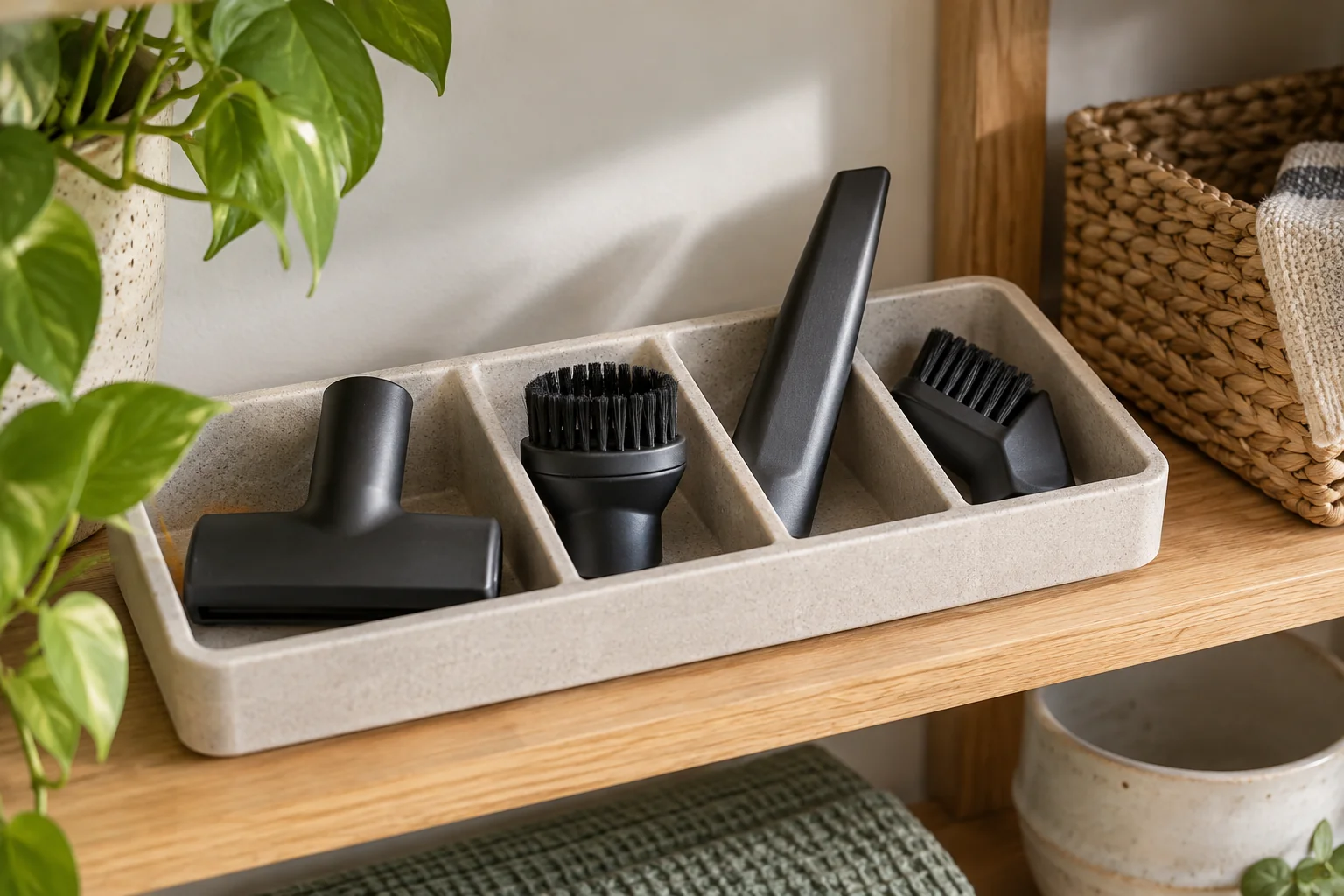
Organize vacuum attachments by confirmed machine and part number before organizing them by shape. A nozzle that resembles another one, or even appears to connect, does not establish that it is the correct accessory. Begin with a small registry, keep unidentified pieces separate and give each confirmed tool a storage position.
This approach is useful when two vacuums share a cupboard, a used machine arrives with mixed accessories, or replacement parts accumulate over time. The goal is to retrieve the right tool without repeatedly guessing which machine it belongs to.
Identify the machines first
Write the manufacturer and exact model for each vacuum using its accessible label, original paperwork or official support account. Keep any serial number in your private equipment record. Give the storage groups short household names such as “upstairs cordless” and “utility vacuum,” but retain the actual model beside those names in the registry.
Do not identify a machine solely from its color or floor head. Accessories can have been replaced, and different versions may look similar. If the label is unclear, contact the maker with the information you can safely read before buying more attachments.
Keep the machine switched off and follow its instructions when detaching accessories. Do not force a connector, add an improvised adapter or energize an unidentified powered tool as a compatibility test.
Match each tool to an official reference
Look for an accessory part number on the tool, packaging or purchase record. Search the manufacturer’s support or parts site for that number and read the compatible-machines section. Record the exact page, date checked and applicable model, including any variant restrictions.
For example, Dyson’s Combination tool page, part 967482-01, lists compatible machines including V7, V8, Cyclone V10, V11, V12, V15, Gen5detect and Gen5outsize families. That is evidence about that listed part, not proof that every attachment from those families is interchangeable. Check a powered head or another accessory separately.
If the official reference does not clearly match your machine, label the result “unconfirmed.” Similar connector measurements or a seller’s broad title should not silently upgrade that status to confirmed.
Build a compact attachment registry
| Tool identity | Compatible machine | Evidence | Storage decision |
|---|---|---|---|
| Part number and plain description | Exact model or listed family | Official page and date | Assigned compartment |
| Shared confirmed tool | Both models independently checked | Reference covering both | Shared section |
| Unmarked accessory | Unknown | Support enquiry pending | Separate unconfirmed container |
| Damaged connector or missing component | Record if known | Maker replacement guidance needed | Keep out of active tools |
Add a photograph for similar-looking pieces, preferably beside its storage label rather than covering ventilation openings or moving parts. A simple drawing in the registry can also distinguish a sliding-brush tool from a fixed nozzle without implying performance differences.
Choose storage after the compatibility sort
Use compartments, small bins or existing shelf space according to the actual sizes of the confirmed tools. Give long nozzles enough room to lie without bending and avoid piling heavy pieces onto delicate bristles. Keep the registry nearby so a household name can be traced back to the model.
A shared-tools section only works when compatibility is documented for both machines. Otherwise, separate the sets even if keeping everything in one basket would look tidier. Make the unconfirmed container visibly different so a visitor does not treat it as a spare-parts selection.
If you choose a fitted wall holder, confirm that it supports the intended tools and that its installation suits the wall. Do not assume a storage bracket is also a charging dock. Keep charging instructions and electrical accessories with the exact machine they belong to.
Worked example: two vacuums and six loose tools
In a fictional household, six loose accessories sit beside two machines. Official records confirm three tools for the upstairs cordless and two for the utility vacuum. The sixth has no readable number and appears similar to a cordless nozzle.
The owner creates five active entries and one unconfirmed entry. The three cordless tools occupy one tray; the two utility tools occupy another. The sixth goes into a separate container while the owner asks the maker for identification. There is no need to buy a replacement simply because that last piece has not yet been matched.
Later, the maker confirms that one registered tool supports both household models. The owner can move that specific tool to a shared compartment and update both model lists. The change does not make the rest of the two sets interchangeable.
Keep identification separate from surface suitability
A confirmed connection answers which machine can use the tool; it does not answer whether the tool is suitable for every surface. Follow the vacuum, attachment and surface-care instructions before using it on upholstery, delicate finishes or unusual debris. Do not infer liquid pickup capability from a wide nozzle.
Cleaning instructions also belong to the particular accessory. Do not wash every piece in a mixed tray as one batch: powered components, brush assemblies and simple plastic nozzles may have different requirements. Return tools to storage only after completing their specified care.
Update the registry whenever you replace a machine or buy an accessory. Archive obsolete entries instead of leaving them in the active set. A small, accurate collection is easier to use than a full cupboard of parts whose ownership has been forgotten.