Key takeaways
- Create multilingual entryway basket labels with household-approved words, supporting cues and a practical sorting trial that respects personal preferences.
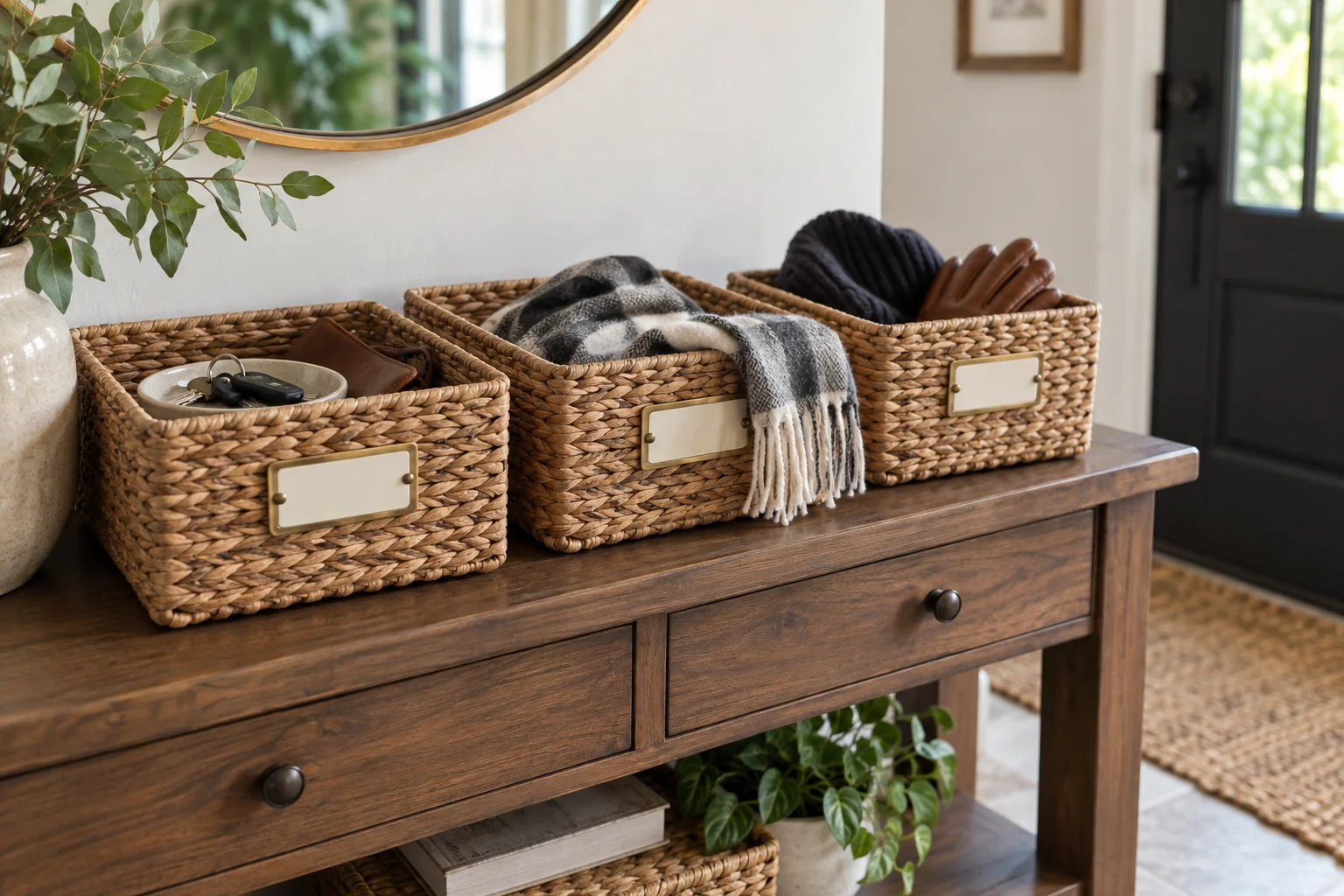
Label entryway baskets for a multilingual household by agreeing on what belongs in each basket, then pairing household-approved words with a simple visual cue. The label should help someone put an item away without asking which language, color or abbreviation has priority.
Start with the people using the entrance, including regular guests who need access to shared items. This is a practical household design exercise. A translated label is not automatically understandable, and a basket system does not establish accessibility for every person.
Choose the category before translating it
Put the actual everyday items on a table and discuss their destination. Decide whether a basket belongs to a person, a category or a next action. “Alex,” “gloves” and “take upstairs” are three different sorting systems; mixing them without explanation makes a small entrance harder to use.
Prefer concrete categories that everyone recognizes. A broad word such as “essentials” may mean keys to one person and charging cables to another. List two or three examples beside the draft label during the trial. If those examples cannot fit the intended basket, change the category or container.
Keep wet footwear, leaking containers and items needing special storage outside a general dry-item basket. The label describes the destination; it should not hide a mismatch between the contents and the storage conditions.
Ask household members to supply the words
Write each label in the languages actually useful to the household. Ask a fluent reader to confirm the meaning and natural wording. A literal machine translation may be technically recognizable yet unfamiliar for an everyday object or action.
Use a consistent language order and comparable visual prominence. Decide that order together rather than changing it between baskets. Preserve accents and the correct script. If a label becomes too crowded, simplify the category instead of shrinking one language until it is difficult to read.
For a personal basket, use the person’s preferred name or an agreed identifier. Do not display a full legal name, apartment access information or private schedule merely to make the system look complete. Shared labels need only enough information for the people who use them.
Add a cue that does not depend on color alone
A small photograph of the actual shared item, a recognizable symbol or a distinctive shape can support the words. Check that people interpret the cue as intended. A picture of a key might mean all keys, one person’s keys or spare keys unless the category is explicit.
W3C’s web-accessibility design guidance advises against using color as the only information channel. Applying that general idea to these physical labels is an editorial design choice, not a claim that a basket meets a web standard. Keep words or another agreed cue even when you also choose different colors.
Try the labels in the actual entrance lighting and from the normal approach. Glossy covers can create reflections; small decorative type can become difficult to distinguish. Ask each user what they can read comfortably instead of choosing a universal font size from a photograph.
Use a small translation and placement worksheet
| Basket purpose | Words | Supporting cue | Check |
|---|---|---|---|
| Shared dry gloves | Household-confirmed translations | Photograph of one representative pair | Not confused with personal clothing |
| Items to take upstairs | Short agreed action | Agreed direction cue | Destination understood from entrance |
| Personal everyday items | Preferred name or identifier | Optional chosen shape | Owner recognizes it without color |
The rows are examples, not a required three-basket layout. A household may need only one shared basket and personal hooks elsewhere. Keep the worksheet while testing so a changed word does not silently change the category.
Worked example: a word that hides two jobs
Imagine two housemates initially label one basket “outgoing” in their two languages. One places things to take to work inside it; the other adds borrowed items that must be returned. Both interpretations are reasonable, but the basket now mixes daily departures with occasional errands.
They change the arrangement to “take today” and “return to owner,” using household-checked translations and different supporting pictures. During the trial, each person sorts a few ordinary items and explains the choice. A confusing item leads to a revised rule, not a correction imposed on the person.
This fictional example illustrates a category problem that translation alone would not solve. The goal is agreement about the action behind the words.
Keep labels movable and review the result
Use a holder or attachment suitable for the basket material, following its product guidance. Avoid promising that tape or adhesive will remove without a mark. Leave handles, openings and the route through the entrance usable; a readable tag should not become a snagging obstacle.
After normal use, check misplaced items together. Is the category unclear, the translation awkward, the basket inconvenient, or the item simply outside the system? Change one issue at a time and retain useful wording. When a housemate or language need changes, update the labels as part of the handover rather than expecting the newcomer to memorize an unexplained color code.