Key takeaways
- Plan a laundry tote around original closed product containers, a fit check and a departure-and-return checklist for shared laundry rooms.
What's inside
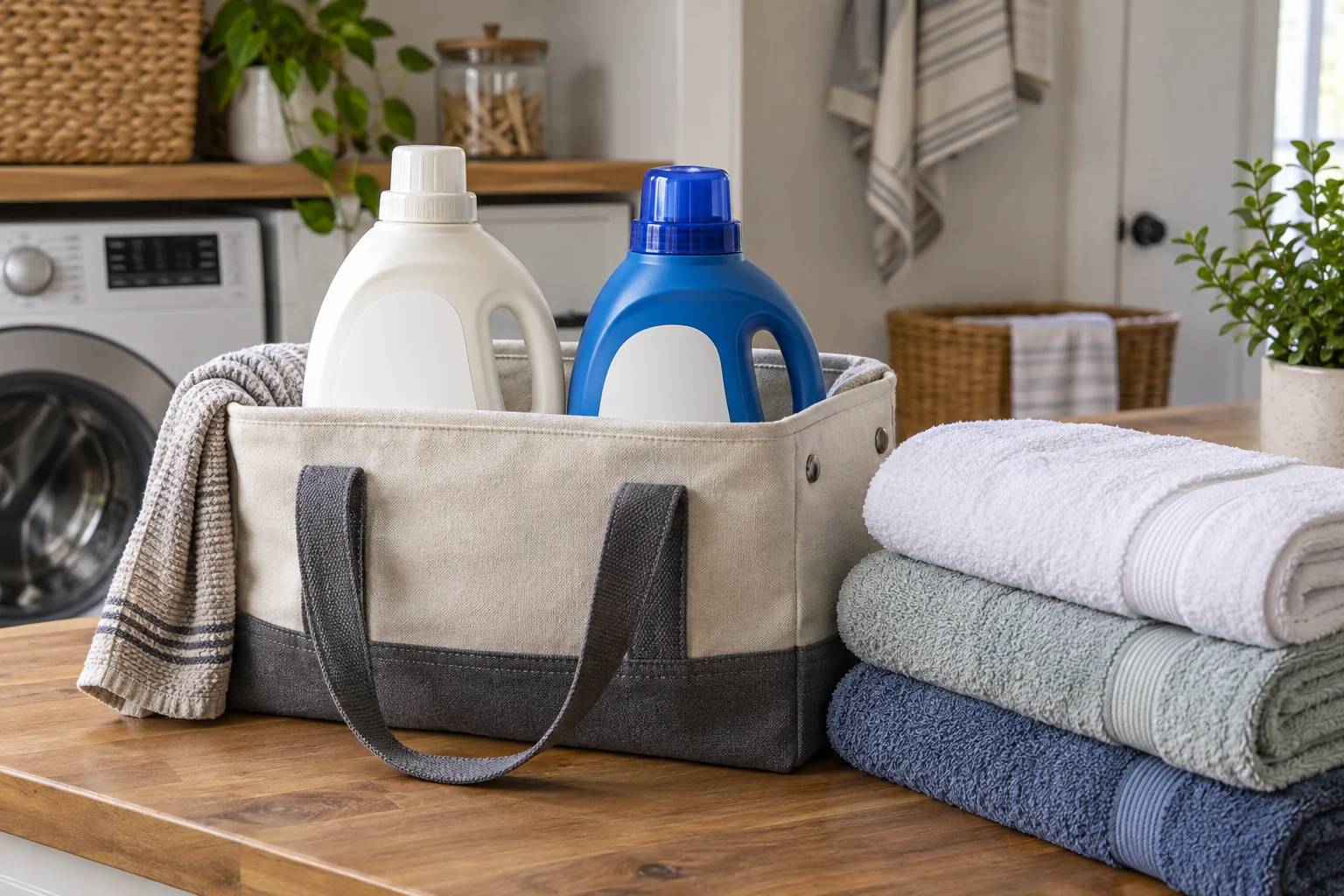
Build a portable laundry tote around the supplies needed for one planned session, keeping every laundry product in its original labeled container. Check that the closed containers fit upright and that you can carry the loaded tote comfortably. Store the supplies securely after the trip; an open tote is not a child-resistant storage system.
For a shared laundry room, the organizer has three jobs: get the right supplies there, keep individual products identifiable while you work, and bring everything home without leaving bottles beside the machines. A short departure-and-return checklist helps more than filling every compartment.
Start with the products you actually use
Write down the planned load, its garment instructions and the detergent compatible with the machine. Add only any other product that the relevant instructions call for. Do not carry several half-used detergents just because the tote has spare room, and do not combine leftovers to save space.
The American Cleaning Institute’s laundry safety guidance says to keep products in their original containers with labels intact, close them immediately after use and put them away securely. It also warns against combining laundry detergents with ammonia or other household cleaning agents. A decorative bottle or loose collection of detergent packets defeats the original-container part of that guidance.
Keep laundry products away from children and pets throughout the trip and session. If a large original package is impractical to carry, consider an appropriate smaller retail package of the product rather than pouring it into a travel bottle. Follow the label’s storage and handling instructions for the package you choose.
Measure the containers, not the tote’s advertised capacity
Stand the closed containers together on a stable surface. Measure each base and total height, including the cap or pump. Compare those measurements with the tote’s usable interior and opening. A tapered side, handle support or internal divider can reduce the space available at the bottom.
Check that labels remain accessible without unpacking everything. A container may fit sideways but should not be turned on its side just to make a layout work. Choose a different tote or take fewer supplies if the intended carrying position cannot be maintained.
| Item | Before leaving | During the session | On return |
|---|---|---|---|
| Detergent | Original label readable; closure secure | Follow dose and machine directions | Close and return to secure storage |
| Any additional product | Needed and compatible with planned use | Keep separate; do not mix products | Check package condition |
| Payment or access card | Separate dry pocket | Return after use | Ready for next visit |
| Care notes and timer | Keep dry and readable | Track the correct machine | Update unfinished tasks |
| Empty laundry bag | Clean destination for finished items | Separate from product containers | Put away as appropriate |
Separate carrying from storage
A tote helps carry supplies between two locations. It should not automatically become their permanent home on the floor or a low shelf. Choose the secure storage location first, and check that you can return the containers there promptly when the laundry is finished.
Keep food, drink and personal items outside the chemical compartment. Use a separate dry pocket or pouch for keys, payment cards and the laundry-room access token. If you use removable compartments, make sure they do not obscure product labels or press against closures.
Inspect the tote’s handle and base and follow any stated load limit. Do not infer a safe carrying weight from its volume in liters. Pack the actual supplies and assess whether you can manage the stairs, doors and basket involved without overloading yourself. Two lighter trips may be more workable than one awkward load.
Worked example: a narrow tote has enough volume but not enough floor space
Suppose a tote has an illustrative usable base of 28 by 18 centimeters. A detergent bottle has a 16 by 12 centimeter base, and a second closed product container measures 14 by 10 centimeters. Side by side along their wider dimensions, they require 30 centimeters, so that arrangement does not fit the 28-centimeter base.
Turning one package or moving it may produce another possible layout, but do not count on squeezing the tote or tilting the bottle. Check the real shapes and closures. If both are genuinely needed, a wider carrier is an option; if the second product is not needed for this session, leaving it securely stored is simpler.
The example is a fit exercise, not a chemical-storage recommendation or a tote load rating. Product handling requirements still govern, and a neat arrangement does not make incompatible products suitable for joint use.
Use a departure-and-return routine
Before leaving, confirm the machine plan, readable labels, secure caps, payment method and a clean route for finished laundry. At the shared room, keep your supplies under your control and follow the building’s rules. Do not leave the tote unattended as a way to reserve a machine.
After dosing, close each package before doing another task. Deal with spills according to the product label and the facility’s procedure. Do not put a leaking or contaminated package back beside clean laundry and hope the tote will contain it.
On return, put the products in their secure storage location and check the tote for residue or damage before its next use. Record anything that ran out on a shopping note. This keeps the tote small, readable and ready without turning it into a collection of unlabeled leftovers.