Key takeaways
- Sort reusable food containers by confirmed lid family, count complete sets and plan drawer access before buying more storage dividers.
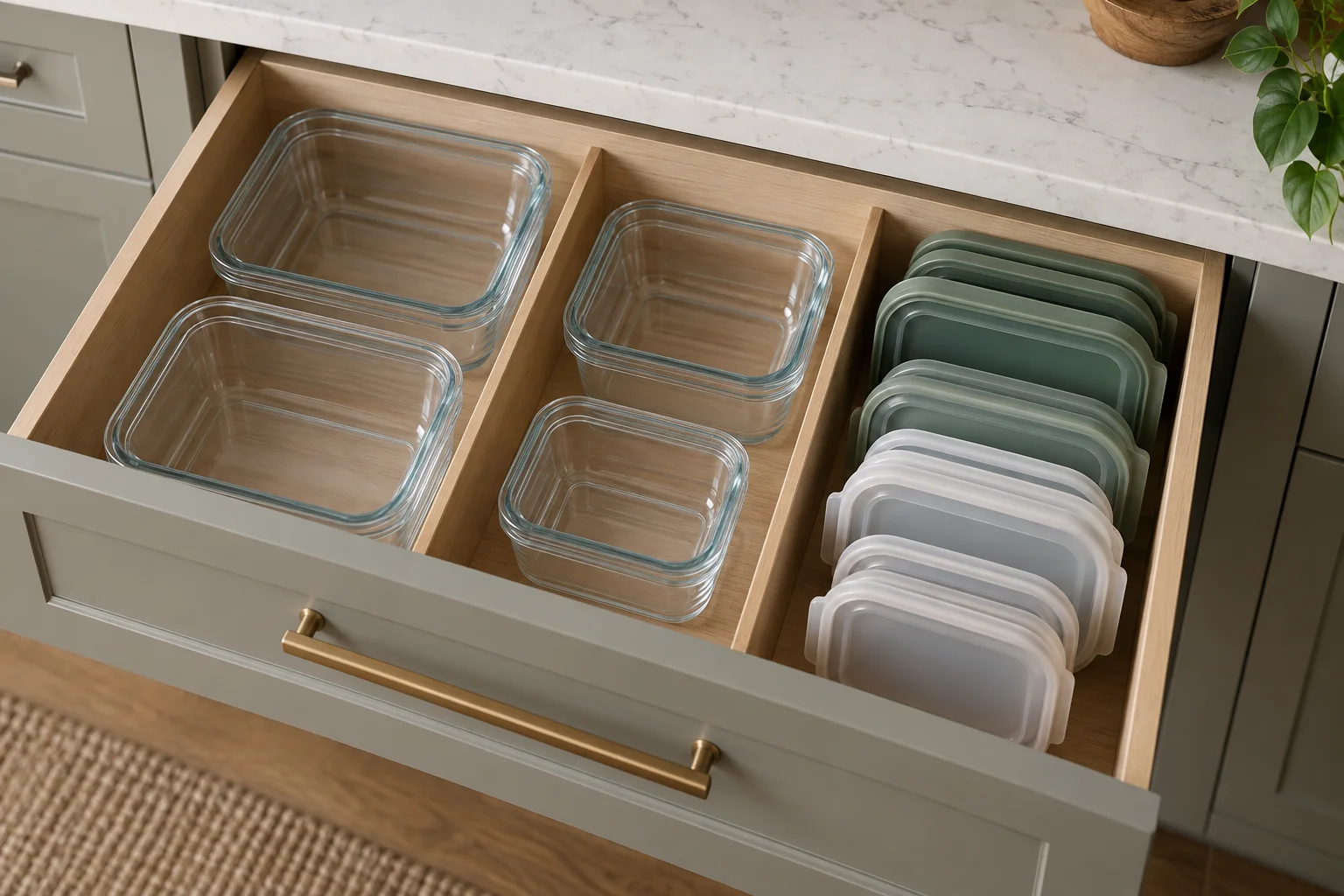
Organize reusable food containers by confirmed lid family, then by the space needed to retrieve and return each set. Start with clean, dry, empty pieces and match them before buying drawer dividers. A pile sorted only by color can still leave you searching for a lid that fits.
This is a cupboard and drawer organization guide. A storage match does not establish that a container is suitable for heating, freezing or carrying liquids. Those uses depend on the exact base, lid and manufacturer’s instructions.
Sort the collection without forcing a match
Gather the empty pieces from the areas where they normally live. Separate bases, lids and any removable components that belong to them. Keep parts from different product families apart until their identity is established. Do not force clips or stretch a lid onto a rim merely because the outline looks close.
Look for the maker, series, article number or other identification on the pieces and packaging. A lid may serve several depths within one confirmed family, while a similar-looking lid from another range may not. Capacity alone is not a reliable matching rule.
For a specific example, IKEA identifies rectangular plastic lid 405.779.43 as fitting rectangular food containers in its IKEA 365+ series. Its page gives a lid size of 8¼ by 6 inches. That is evidence for the stated product family, not a claim that all rectangular containers or older unidentified pieces share the same fit.
Make a lid-family map
| Family | Confirmed bases | Matching lids | Missing or uncertain pieces | Storage decision |
|---|---|---|---|---|
| Rectangular family A | Record exact series and sizes | Record lid identity | Count unmatched bases | One base stack and adjacent lid section |
| Round family B | Record independently | Keep with its own group | Do not borrow a similar lid | Separate section |
| Unidentified pieces | Unknown | Unknown | Identification needed | Outside active matched stock |
| Damaged piece | Record if identifiable | Do not treat as usable stock | Maker guidance needed | Remove from normal retrieval |
Count complete usable combinations, not just the total number of plastic or glass pieces. Six bases and two compatible lids provide a different working collection from four complete sets. This count helps decide whether a replacement lid would be useful without automatically buying more bases.
Choose between assembled and separate storage
Storing each empty set together can make retrieval straightforward, but it may use more space. Nesting compatible empty bases and storing lids upright nearby can reduce the footprint, provided the pieces can be removed without force or an unstable pile. Follow any product-specific stacking guidance.
Try both arrangements with the actual drawer or shelf. Measure usable interior space around hinges, drawer sides and the opening above. A stack that fits inside the cupboard may still be too tall to lift out through the door opening.
Use a simple divider to keep lid families visible if it suits the furniture and products. Do not drill a rental cabinet or attach an adhesive organizer without resolving permission, surface compatibility and the organizer’s installation requirements. Existing loose dividers may be enough.
Give unmatched pieces a decision date
Put unidentified or unmatched pieces in a separate, clearly temporary group. Record what is missing and what would confirm the match. A photograph of the rim and any identification can help a manufacturer answer a question more accurately than “the medium clear box.”
Avoid keeping a growing stack indefinitely because a matching lid might appear. At an agreed review date, either identify a useful replacement, reassign the piece to another appropriate use or follow local disposal guidance. Do not assume every plastic container belongs in local recycling.
Keep food-use suitability separate from organizational convenience. A container reassigned to storing craft supplies should not drift back into food storage without a clear, appropriate decision. Household labels should make the purpose understandable to everyone who uses the drawer.
Worked example: eight bases become three clear groups
In an illustrative kitchen, eight empty bases and seven lids occupy one drawer. Matching by verified product family produces four rectangular sets, two round sets, one extra rectangular lid and two unidentified bases. The original piece count hid the fact that only six combinations were ready to retrieve.
The household tries a single nested pile but finds that removing a small base requires lifting every larger one. Instead, the rectangular and round groups receive separate positions, with matching lids beside them. The spare confirmed lid stays with its family; the unidentified bases move to a temporary review area.
Before buying a divider, the household opens the drawer fully and checks that lids can be lifted out without hitting the cabinet above. The example describes organization only. It does not establish leak resistance, food-storage duration or heating compatibility for any piece.
Make returning pieces as easy as taking them out
After cleaning according to the product’s instructions, return dry pieces to the matching group. If a newly acquired container has no assigned family, identify it before adding it to the drawer. Otherwise, the old mixed-pile problem returns one item at a time.
Keep a short photograph or sketch of the arrangement inside your household notes. Revisit the complete-set count when pieces are lost or damaged. The best layout is the one that lets someone find a confirmed pair and put it back without guessing, forcing a fit or emptying the whole cupboard.