
Key takeaways
- Count real sessions: Take last month honestly and multiply by twelve. Under about 60 a year, buy for comfort and price. Over 200, buy for material durability and stop looking at the sticker.
- Price the replacement, not the purchase: A cheap mat replaced twice costs more than a mid-priced one kept for three years, and you also absorb two rounds of breaking in a new surface.
- Weight the grip you will actually use: Sweat-activated surfaces only repay their premium if you sweat. In a cool room they are an expensive way to get ordinary traction.
- Add the accessories into the sum: Thin mats often need a folded blanket or knee pad, and slick mats often need a grip towel. Those extras belong in the cost comparison.
- Factor in the care effort: A mat that needs hanging to dry after every session has a real cost in habit. If you will not do it, its rated lifespan does not apply to you.
Divide the price of a mat by the number of sessions you will get out of it and the shopping decision changes shape. A budget foam mat that costs little but goes slick and dented inside eight months of four-times-a-week practice works out more expensive per session than a dense POE or rubber-based mat that holds its grip for three years. The reverse is also true: if you practise twice a month, paying premium money for a mat engineered to survive daily heated flows is money spent on durability you will never consume.
The variable that decides everything is honest practice frequency, not aspirational frequency. Someone rolling out a mat five mornings a week puts roughly 250 sessions a year through the hand and knee contact zones. Someone doing a Sunday class puts through 50. Those two people should not buy the same mat even if they have identical slipping problems. The picks below are grouped by the practice volume they make financial sense at, with grip behaviour for dry and sweaty hands noted for each.
Our top picks




As an Amazon Associate we earn from qualifying purchases at no extra cost to you. Ratings are shown as listed on Amazon.
Quick Comparison
| Product | Best For | Standout Feature | Watch Out For |
|---|---|---|---|
| Gruper Eco Mat | Two or three sessions a week | Reversible textured faces extend usable life | Thin cushioning wears through at knees first |
| Gaiam Thick NBR Mat | Occasional practice on hard floors | Deep foam comfort at a low entry price | Foam compresses fastest of anything here |
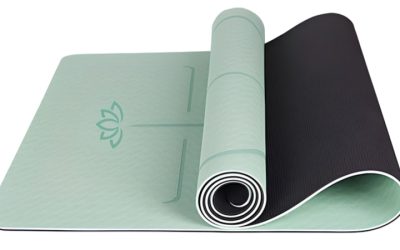
| LVME Foldable Mat | Frequent practice plus travel | Dense 8mm POE that resists surface polishing | Fold lines are permanent stress points |
| Premium PU Sweat-Activated Mat | Daily sweaty sessions over years | Rubber base that does not dent at contact points | Highest upfront outlay of the group |
| Gaiam Dry-Grip Mat | Regular hot classes | Grip that holds instead of fading mid-session | Needs drying after every use to earn its lifespan |
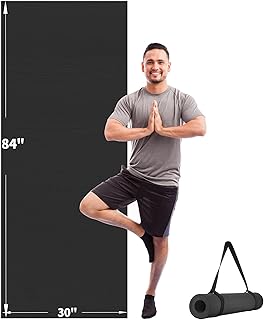
| CAMBIVO Extra Long Wide Mat | Shared household use | Extra length and width spreads wear over more area | Bulk makes it a one-room mat |
How to Choose
- Count real sessions: Take last month honestly and multiply by twelve. Under about 60 a year, buy for comfort and price. Over 200, buy for material durability and stop looking at the sticker.
- Price the replacement, not the purchase: A cheap mat replaced twice costs more than a mid-priced one kept for three years, and you also absorb two rounds of breaking in a new surface.
- Weight the grip you will actually use: Sweat-activated surfaces only repay their premium if you sweat. In a cool room they are an expensive way to get ordinary traction.
- Add the accessories into the sum: Thin mats often need a folded blanket or knee pad, and slick mats often need a grip towel. Those extras belong in the cost comparison.
- Factor in the care effort: A mat that needs hanging to dry after every session has a real cost in habit. If you will not do it, its rated lifespan does not apply to you.
Top Picks Reviewed
Best Value Per Session: Gruper Eco Mat
For someone practising a few times a week, this hits the sweet spot. Both faces are textured and usable, so when the hand zone polishes smooth you flip it and reset the clock, which is a genuine doubling of grip life rather than a marketing line. Dry grip is reliable and the carry strap prevents edge damage.
The limitation shows in cushioning. Knees find the floor sooner than on thicker mats, so anyone doing a lot of kneeling work should add a folded towel and count that in.
Low-Frequency Pick: Gaiam Thick NBR Mat
If your practice is genuinely occasional, deep NBR foam gives you the most immediate comfort on tile or laminate for the least money, and the cinch strap keeps it tidy between uses. Over 50 sessions a year, its compression weakness never becomes your problem.
Push it to daily use and the maths flips fast. NBR takes permanent dents at contact points and turns slick under sweat, so heavy users burn through it and pay twice.
High-Mileage Pick: LVME Foldable Mat
Dense POE at 8mm across 71 by 24 inches resists the surface polishing that makes older mats slippery, and the SGS-certified material does not shed particles as it ages. For frequent practitioners who also travel, the flat-folding format removes the need for a second travel mat, which is a real saving.
Folding repeatedly along the same lines concentrates wear there. Storing it flat or rolled between trips meaningfully extends the run.
Long-Haul Pick: Premium PU Mat
The polyurethane top over a natural rubber base is the choice when sessions are daily and sweaty. Rubber does not compress into permanent knee craters the way foam does, and the top layer gets tackier with moisture rather than degrading, so grip does not decay across a year.
You pay for it upfront, and the payoff only exists at volume. At two sessions a month it is simply an expensive mat that spends most of its life rolled up.
Heated-Class Pick: Gaiam Dry-Grip Mat
Built for hot rooms, this holds traction when your forearms are dripping, which spares you buying a grip towel and replacing a slicked-out mat every year. For regular heated practice it removes two recurring costs at once.
Its economics depend on care. Rolled away damp session after session, the finish dulls early and you lose the durability you paid for.
Shared-Use Pick: CAMBIVO Extra Long Wide Mat
When two people in a household use one mat, wear accumulates twice as fast, and the extra length and width here spread that load across far more surface. Cushioned PVC also tolerates constant unrolling without complaint.
It is heavy and bulky, so it becomes the mat that stays in one room permanently. Anyone wanting to carry it to a class will want something else.
Frequently Asked Questions
How many sessions does a typical mat last?
Soft foam mats commonly hold their shape for 200 to 300 sessions before contact points dent. Dense POE, TPE, and rubber-based mats regularly pass 700 with grip intact if kept clean and dry.
Is an expensive mat worth it for a beginner?
Not usually. Early practice is inconsistent by nature, and a mid-priced textured mat tells you plenty about what you actually want before you commit real money.
Does cleaning frequency change the lifespan?
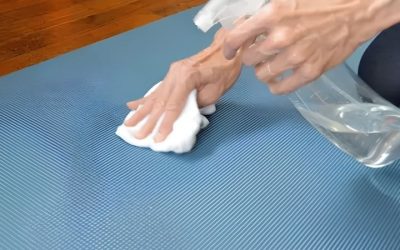
Substantially. Body oils build an invisible film that kills grip long before the material wears out, so a mild soap and water wipe after sweaty sessions is the cheapest life extension available.
When is it time to replace rather than clean?
When the surface texture has polished flat under your hands, when foam stays dimpled after pressure, or when a top layer starts lifting at an edge. None of those are recoverable.
Final Thoughts
Run the numbers before you run the reviews. Occasional practice is well served by the Gaiam NBR at its price, a few sessions a week suits the flippable Gruper, and daily or heated practice justifies the dense LVME, the Gaiam Dry-Grip, or the rubber-based PU option because they survive the volume. The most expensive mat is always the one you replace early.
Write Your Review
No reviews yet. Be the first to share your experience!