
The same mat behaves like two different products depending on what is underneath it. On tile or laminate, a mat’s whole job is cushioning and staying put — the floor gives you nothing, and a thin mat means your kneecaps take the full load. On carpet, the floor already provides cushioning, and the mat’s job flips entirely: it has to give you a stable, flat surface that does not sink and wander when you press a hand into it.
Almost nobody accounts for this before buying, which is why so many mats end up disappointing. A 10mm foam mat on plush carpet is a genuinely unstable surface for standing poses. A 3mm mat on ceramic tile is an insult to your knees. And on hard floors the mat’s underside matters as much as its top, because a smooth backing on polished wood slides on the first downward dog. The options below are sorted by which floor they suit.
Our top picks


As an Amazon Associate we earn from qualifying purchases at no extra cost to you.
Quick Comparison
| Product | Best For | Standout Feature | Watch Out For |
|---|---|---|---|
| KEEP Extra Thick NBR Mat, 10mm | Bare tile and concrete | 10mm of NBR foam over an unforgiving floor | Far too soft to use on top of carpet |
| CAP Barbell 1/2-Inch High Density Mat | Hard floors with standing work | Dense half-inch foam that resists sinking | Bulky roll for a small storage spot |
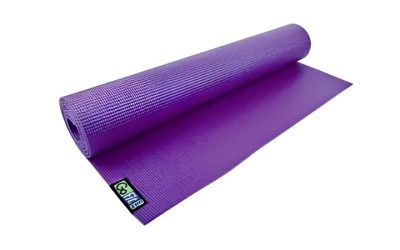
| CAP Non-Slip Yoga Mat | Carpeted rooms | Thin profile that keeps you close to a stable base | Minimal padding on tile or wood |
| Gaiam Thick NBR Yoga Mat | Wood floors and mixed use | Cushioning with an easy-cinch carry strap | Compresses underfoot in balance poses |
| Amazon Basics Extra Thick Exercise Mat | Hard floors on a budget | Extra thickness plus a carrying strap | Soft foam creeps on polished surfaces |
| Fitvids 1/2-Inch Extra Thick Mat | Garage and basement floors | Anti-tear construction over rough concrete | Thickness works against standing stability |
How to Choose
- Identify the floor first: Tile and concrete demand thickness. Carpet demands the opposite — a thin, firm mat that does not add another layer of sink.
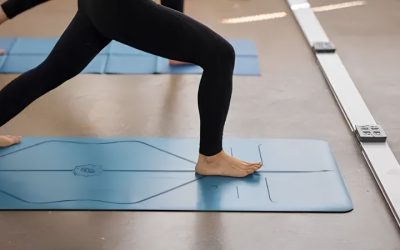
- Check the underside: On polished wood or laminate, a smooth backing slides. A textured or tacky underside is what keeps the mat where you put it.
- Density beats depth on hard floors: Dense foam distributes pressure; soft foam simply bottoms out and you feel the tile through it anyway.
- Test for creep: Push a hand forward hard, as in downward dog. If the mat travels an inch, it will travel a foot over a full session.
- Consider room temperature: Cold concrete pulls heat through a thin mat. Thicker foam insulates as well as cushions, which matters in a garage or basement.
Top Picks Reviewed
Best for Tile and Concrete: KEEP Extra Thick NBR Mat
At 10mm thick and 72 by 24 inches, this is built for the least forgiving floors there are. On ceramic tile or a concrete slab, that depth of NBR foam is the difference between finishing a session of core work and stopping because your tailbone hurts, and it insulates against cold floors as a bonus.
Put it on carpet and it becomes a liability. Two layers of soft compression underfoot make standing poses genuinely unstable, and you will feel your ankles working overtime to correct. This mat belongs on hard surfaces only.
Best Hard-Floor Compromise: CAP Barbell 1/2-Inch High Density Mat
High density is what lets a thick mat still feel stable. Half an inch of dense foam distributes pressure across your knees and spine without collapsing under a single standing foot, which is the balance most hard-floor practitioners are actually looking for.
The roll is substantial. Half-inch foam does not compress down to a slim cylinder, so if your storage is a narrow gap beside a wardrobe, measure before buying. The included strap helps, but it cannot make the roll smaller.
Best for Carpet: CAP Non-Slip Yoga Mat
On carpet you want as little foam as you can get away with, because the carpet is already the cushion. A thin, textured mat gives you a clean grippy surface and keeps you close to a stable base, which preserves balance in standing sequences.
Move it to a tiled bathroom or a wooden floor and the shortcoming is immediate — there is very little padding, and knees, elbows and hips will notice within a few minutes. It is a carpet specialist rather than an all-rounder.
Best for Wood Floors: Gaiam Thick NBR Yoga Mat
Wood is somewhere between tile and carpet: hard, but warmer and slightly more forgiving. A cushioned NBR mat suits it well, providing enough padding for floor work without the extreme depth that undermines standing poses, and the cinch strap makes it easy to store away in a shared room.
Under a single foot the foam still compresses noticeably, so extended balance work feels less secure than on a firmer mat. Practitioners doing long standing sequences may prefer something denser.
Best for Garage and Basement: Fitvids 1/2-Inch Extra Thick Mat
Rough concrete destroys thin mats — the abrasive surface works at the underside and grit gets ground into the foam. Anti-tear construction at half an inch thick is the right specification for that environment, and the thickness handles the cold as well.
Standing stability is the compromise, as with any thick mat. If your garage sessions involve balance work rather than floor exercises, you will feel the surface giving under you.
Frequently Asked Questions
Do I need a mat at all on thick carpet?
Yes, for grip and hygiene rather than cushioning. Hands slide on carpet fibre and carpet is not a surface you want your face near. A thin mat solves both without adding instability.
How thick should a mat be for tile floors?
Around 6mm to 10mm for comfort during floor work, favouring denser foam over softer at the same thickness. Below about 6mm, kneeling on tile becomes uncomfortable quickly.
Why does my mat slide on wooden floors?
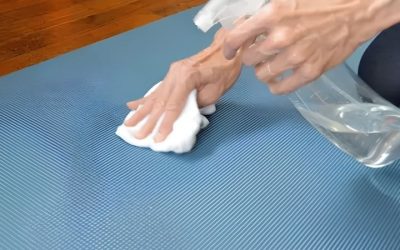
Smooth backing plus floor polish is a poor combination. Check the underside texture, clean both the mat and the floor of residue, and if it persists a thin rug or towel underneath will hold it.
Can one mat cover carpet and hard floor?
A mid-thickness dense mat around 6mm is the best compromise, though it is slightly too soft for tile and slightly too thick for plush carpet. If you regularly use both, two mats is genuinely the better answer.
Final Thoughts
Buy for the floor you will actually practise on. Tile and concrete call for the KEEP 10mm or the dense CAP Barbell half-inch mat, carpet calls for the thin CAP non-slip mat, and wood sits comfortably with a cushioned Gaiam NBR option. Check the underside texture before committing, and if you practise on two very different surfaces, accept that no single mat handles both well.
Write Your Review
No reviews yet. Be the first to share your experience!