
The hardest part of putting a power cage in a spare bedroom isn’t the money — it’s the tape measure. A standard 8-foot ceiling gives you about 96 inches of air, and once you subtract a drywall lip, a ceiling fan, or the track of a sectional garage door swinging overhead, a 90-inch rack suddenly becomes a negotiation. Depth matters just as much: a 30-inch-deep cage plus a bench plus the six inches you need behind you to unrack a bar comfortably eats a wall in a hurry.
The good news is that the compact end of the rack market has gotten genuinely serious. Short-height cages now come with the same 11-gauge tubing and 1,000-pound-plus ratings that used to require a 7-foot frame, flat-foot designs let you skip drilling into a slab you don’t own, and wall-mounted folding racks collapse to roughly the thickness of a bookshelf. Below are five configurations that survive a small-room reality check, plus the measurements to check before you click buy.
Our top picks
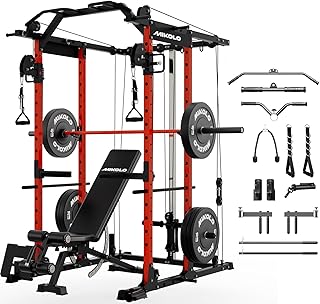
 SPORTSROYALS Power Rack
- 【Build with gym Quality】- Sportsroyals power cages are…
- 【Precision & Durable Pulley System】- Sportsroyals home gym…
- 【Train all your muscles with one machine】- Sportsroyals…
 ULTRA FUEGO Power Cage
- Warranty Description: 2 Year Manufacturer
- Tension Supported: 1000 pounds
- Handle Type: Fixed Handle
 DP01 Power Cage
- Warranty Description: 2 year
- Tension Supported: 2000 pounds
- Grip Size: Standard


As an Amazon Associate we earn from qualifying purchases at no extra cost to you.
Quick Comparison
| Rack | Approx. Height | Footprint Style | Steel & Rated Load | Best For | Price Tier |
|---|---|---|---|---|---|
| REP Fitness PR-1100 | ~71.5 in | Freestanding, ~48 x 48 in | 2×2 in, 11-gauge, ~1,000 lb | First rack on a tight budget | $ |
| Titan T-3 Short (72 in) | ~72 in | Bolt-down, 24 or 36 in depth | 2×3 in, 11-gauge, 1,100+ lb | Low basement ceilings | $$ |
| PRx Profile Folding Rack | Wall height dependent | Folds to ~5 in from wall | 3×3 in, 11-gauge, heavy rated | Rooms that must double as something else | $$$ |
| Rogue RML-390F Flat Foot | 90 in (100 in option) | Freestanding, no anchoring | 3×3 in, 11-gauge, very high | Renters with tall ceilings | $$$ |
| Force USA MyRack Modular | ~85–87 in | Freestanding, expandable | 2×2 in, high-gauge, ~800–1,000 lb | One-station full gym | $$$ |
How to Choose
- Measure standing pull-up clearance, not ceiling height. Add your seated-to-crown height above the bar — usually 10 to 14 inches — to the rack’s pull-up bar height. If that number exceeds your ceiling, you’ll be doing chin tucks forever.
- Decide depth before width. A 24-inch-deep cage is fine for squats and presses but leaves almost no room to walk a bar back; 30 inches is the comfortable minimum if you want to bench inside the uprights with a spotter arm behind you.
- Check hole spacing in the bench zone. Two-inch uniform spacing is workable. One-inch (Westside) spacing through the press range is the difference between a safety bar that catches a failed rep at the right height and one that’s two inches too low.
- Know whether you can anchor. Bolt-down racks are lighter, cheaper, and rock-solid — but only if you own the concrete. Flat-foot and folding designs solve that at the cost of either floor space or a stud-wall commitment.
- Confirm attachment compatibility now, not later. Uprights come in 2×2, 2×3, and 3×3 with 5/8-inch or 1-inch hardware. Buying a cage in an ecosystem with dip bars, landmines, and lat towers already available saves you from replacing the whole frame in two years.
Top Picks Reviewed
REP Fitness PR-1100 — Best Value Compact Cage
At roughly six feet tall and a four-by-four-foot footprint, the PR-1100 is the rack that fits under a finished basement ceiling without argument. It ships with a multi-grip pull-up bar, dip attachments, and a pair of J-cups, which covers the entire beginner and intermediate lift list out of the box. The tradeoff is the 2×2 tubing and the shorter pull-up bar height, meaning taller lifters will need to bend their knees. For someone squatting under 315 pounds who wants a real cage instead of a squat stand, it is difficult to beat on price per pound of steel.
Titan T-3 Short (72 in) — Best for Very Low Ceilings
The 72-inch T-3 uses the same 2×3, 11-gauge uprights and 5/8-inch hardware as its full-height siblings, so the accessory catalog is enormous and cheap. Choose the 24-inch depth if you’re squeezing into a closet-sized nook and the 36-inch if you plan to bench inside the frame. It’s designed to be bolted to the floor — do it, because a short, narrow rack with a bar swinging inside it wants to walk. Fit and finish is functional rather than beautiful, and hardware alignment can take patience during assembly.
PRx Performance Profile Folding Rack — Best Disappearing Act
This is the answer for a garage that still has to hold a car or a guest room that has to look like a guest room. The uprights hinge into a wall-mounted bracket and fold flat to roughly five inches of protrusion, leaving 3×3 heavy-gauge steel available when you unfold it. The requirements are non-negotiable: you need solid studs or concrete, accurate mounting, and a landlord who won’t mind. Once installed, it lifts like a full-size rack because it essentially is one.
Rogue RML-390F Flat Foot Monster Lite — Best No-Drill Option
The flat-foot design uses forward-extending base plates to convert a bolt-down rack into a freestanding one, so nothing touches your slab. You get 3×3 uprights, 1-inch Westside spacing through the bench and press range, and access to the widest attachment ecosystem in home fitness. The 90-inch version clears most 8-foot ceilings; the 100-inch version does not, so measure twice. It costs more than the rest of this list, and the base plates add a few inches of length you have to account for in a narrow room.
Force USA MyRack Modular — Best One-Station Gym
If the room only has space for a single piece of equipment, a modular cage that accepts a lat pulldown, a chin-up station, a landmine, and multiple pulley setups replaces three separate machines. The MyRack’s appeal is that you buy the frame once and bolt capability onto it gradually. Rated capacity sits below the Monster Lite tier, and each add-on extends the footprint — a lat tower typically adds a foot or more of depth — so plan the finished configuration on graph paper before you commit.
Frequently Asked Questions
Do I need to bolt my power cage to the floor?
Only if the manufacturer specifies it, which is common for narrow, short, or 2×2-upright racks. Wide-footprint and flat-foot designs are engineered to stay put unbolted. If you’re unsure, load the base with plate storage and avoid kipping pull-ups until you’ve tested stability with a light bar.
What ceiling height do I actually need?
For a 90-inch rack, plan on 96 inches minimum, and confirm nothing hangs below that line. For strict pull-ups on a 72-inch short rack, most lifters under six feet manage with bent knees; anyone taller should either go with a taller frame or accept hanging knee-tuck variations.
Is a half rack or squat stand a better use of small space?
A squat stand saves depth and stores easily, but you lose the safety of adjustable spotter bars for solo benching and squatting. If you train alone, the enclosed cage earns its footprint. If you always have a partner or use a Smith-style setup, a stand is a reasonable compromise.
Can I fit a full-size barbell in a compact cage?
Yes — the constraint is room width, not rack width. A 7-foot Olympic bar needs about 8 feet of clear space including plate loading room, so measure wall to wall before assuming a 47-inch cage solves your problem.
Final Thoughts
Small-space rack shopping rewards whoever measures most carefully. Pull a tape across your ceiling, mark the footprint on the floor with painter’s tape, and walk through an imaginary set before you buy anything. If the budget is tight and the ceiling is low, the PR-1100 or the 72-inch T-3 will handle years of training. If the room has another job to do, the folding wall-mount design is worth its premium. And if you have the height and can’t drill, the flat-foot Monster Lite is the rack you’ll still be using long after your lifts have doubled.
Write Your Review
No reviews yet. Be the first to share your experience!