Key takeaways
- Compare weather-resistance claims, product limitations and balcony exposure with a practical worksheet for choosing outdoor storage.
What's inside
Compare balcony storage by the conditions the manufacturer actually describes, not by the strongest weather-related word in the title. Weather-resistant, UV-resistant and waterproof are not interchangeable evidence. Record what each claim covers, its limitations, and whether it applies to the exact model sold in your region.
A box intended for outdoor furniture cushions still needs a separate decision about paperwork, electronics or other moisture-sensitive belongings. This guide creates that decision record without inventing a weather rating that the manufacturer has not supplied.
Describe your balcony before comparing products
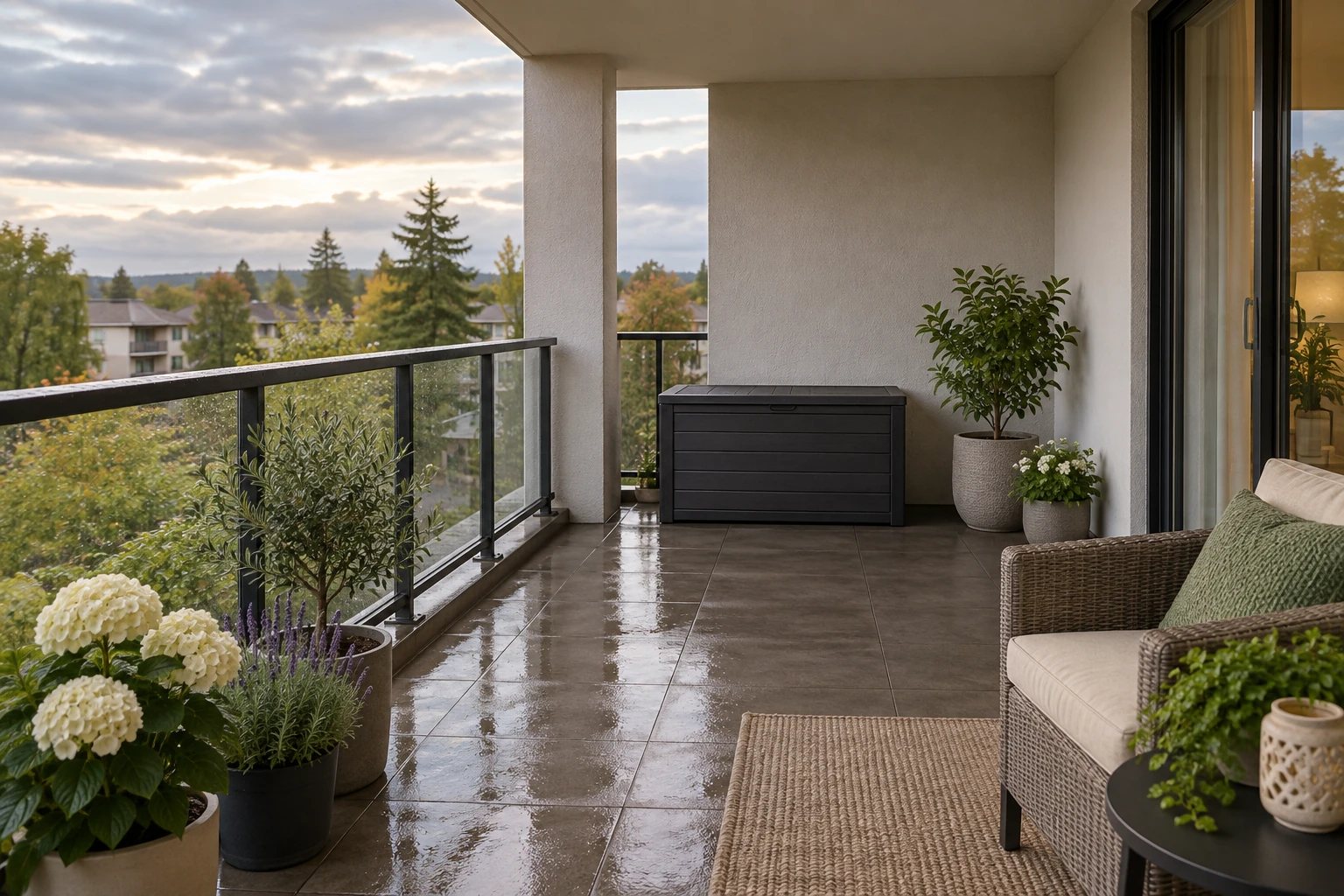
List what the proposed location experiences: direct rain, rain blown beneath a roof, strong sun, splashing, or water collecting on the floor. Note whether you have actually observed each condition or are still unsure. A covered balcony is not a complete description of exposure.
Draw the intended position with the balcony door, drainage points and walking route. Keep building-required access clear. If there are restrictions on balcony storage, fixing or loading, resolve them with the building manager before choosing a size. A storage-box capacity in gallons is not evidence of the balcony’s structural capacity.
Make a second list of intended contents. Separate ordinary outdoor accessories from items that would be damaged by small amounts of moisture. The same box may be an acceptable candidate for one group and an unsuitable location for another.
Read the qualification beside the claim
Keter’s US deck-box guidance describes its boxes as highly weather-resistant, designed to keep contents dry and ventilated in rain and snow, while explicitly excluding submersion. It also gives instructions for closing the lid during storms. This is a manufacturer’s stated use case, not our independent water-ingress test.
Keter South Africa’s FAQ similarly distinguishes normal weather exposure from submersion and recommends a level surface, a fully closed lid and sealed inner containers for moisture-sensitive belongings. That regional advice illustrates the limits worth checking; it does not replace the instructions for a specific US model.
When comparing any brand, save the relevant sentence with its surrounding qualification. A screenshot containing only “waterproof” can lose the condition that gives the claim meaning. If a formal test or certification is mentioned, record its identifier and scope; if none is supplied, write “no formal rating located.”
Use a claim-to-use worksheet
| Question | Evidence to record | Decision if missing |
|---|---|---|
| Outdoor exposure | Described rain, sun and seasonal use conditions | Request the applicable product guidance |
| Water limitation | Exclusions such as submersion or standing water | Do not infer protection from the product name |
| UV claim | What part is protected and any qualification | Avoid predicting a fade-free lifespan |
| Closure | Required lid, latch or lock position | Resolve before leaving items inside |
| Contents | Permitted uses and sensitive-item precautions | Keep vulnerable belongings indoors |
| Placement | Support surface, access and model instructions | Choose another location if requirements conflict |
Add the model number, country of sale and retrieval date above the table. Do not transfer a claim from the largest box in a collection to a smaller unit without checking that it is included in the same guidance.
A worked comparison without invented scores
Illustrative scenario: Box A has a short retailer title saying waterproof, but no manufacturer document is available. Box B has documented resistance to ordinary rain, a submersion exclusion and instructions for closing the lid. Both fit the balcony with their lids closed.
For storing dry outdoor games, B provides a clearer basis for a decision, provided the actual balcony conditions and product instructions match. A remains unconfirmed; the stronger word in its title does not give it a higher evidence score.
Now suppose the proposed corner sometimes holds standing water after rain. Neither the broad title nor B’s ordinary-rain guidance resolves that location. Choose a suitable dry placement after addressing the drainage issue through the appropriate building contact. Do not modify a communal balcony or drill a box merely to make the plan work.
Check the open box and the stored contents
Request the lid-open dimensions as well as internal dimensions. A tall lid can interfere with a window or railing even when the closed box fits. Confirm that you can reach and retrieve the intended contents without balancing objects on the railing or blocking the doorway.
Measure the actual cushion bundle or accessory container rather than converting gallons into a guessed rectangular space. Hinges, sloping walls and lid supports can reduce usable areas. Keep dry items dry when loading; a weather-resistance statement does not promise that the box will dry wet contents.
Keep a practical inspection record
After assembly, follow the manufacturer’s checks for alignment and closure. Observe the interior after ordinary weather before relying on it for anything vulnerable. This is a household observation, not a controlled waterproof test or a reason to challenge the product with a hose or flooding.
Record any unexpected moisture, closure problem or damaged component and contact support with the exact model. Keep sensitive belongings indoors while the issue is unresolved. Your finished comparison should show a supported use case and a clear limit, rather than a confident rating assembled from unrelated marketing phrases.