Key takeaways
- Buying one two-pack and calling it done. Two 52-inch panels total 104 inches, barely 1.2x on a 88-inch rod. Closed, they pull flat with no folds and gap in the middle.
- Multiplying by the window width instead of the rod length. The rod is wider, so the fabric requirement is higher.
- Splitting panels at the mullion. Treating each half as its own window with its own rod visually chops the wall. One rod, one treatment.
- Ignoring stack-back. Four blackout panels stack 10 to 16 inches per side when open. Without 10 inches of rod extension they cover glass all day.
- Mixing panel widths carelessly. A 72-inch and a 52-inch panel on opposite sides look lopsided when open. Keep both sides equal.
- Short rod diameter. A 5/8-inch rod bows across 88 inches with anything heavier than sheers. Use 1 inch minimum with a center bracket.
- Forgetting grommet rise. Grommet panels sit about 1 inch above the rod, so an 84-inch panel hangs to roughly 83 inches below the rod top.
The Short Answer
A double window is two standard windows sharing one frame or separated by a mullion under 6 inches wide, usually 60 to 80 inches (152 to 203 cm) across the outer trim. Treat it as one window. Add 6 to 12 inches of rod extension per side, then multiply the rod length by 2 for standard fullness or 2.5 for a full, gathered look. For a 72-inch double window with 8 inches of extension per side (88-inch rod), you need 176 to 220 inches of total panel width. Two 52-inch panels (104 inches) are not enough. Use two 100-inch panels, four 52-inch panels, or two 72-inch and two 40-inch panels layered.
The exception is sheers or lightweight decorative panels that you will never close. For those, 1.5 times the rod length is acceptable, which drops the same 88-inch rod to about 132 inches of fabric, or three 44-inch panels.
Our top picks


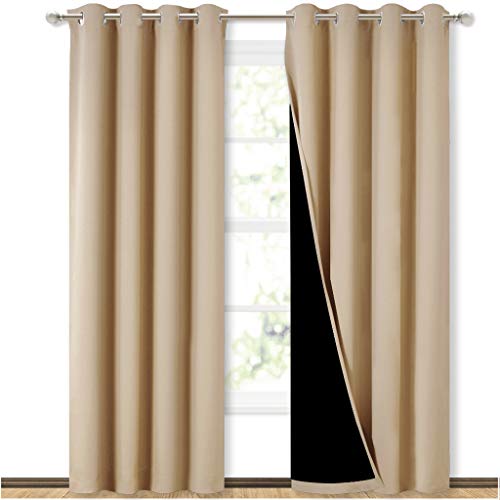

As an Amazon Associate we earn from qualifying purchases at no extra cost to you. Ratings are shown as listed on Amazon.
Standard Sizes
Ready-made panels come in a few stock widths. This table shows how many of each you need for common double-window rod lengths at 2x fullness (closed curtains that still show gentle folds).
| Double window frame width | Rod length (with 8 in per side) | Total fabric needed at 2x | Using 52 in panels | Using 72 in panels | Using 100 in panels |
|---|---|---|---|---|---|
| 60 in (152 cm) | 76 in (193 cm) | 152 in (386 cm) | 3 panels | 2 panels (tight) | 2 panels (full) |
| 66 in (168 cm) | 82 in (208 cm) | 164 in (417 cm) | 3 to 4 panels | 3 panels | 2 panels |
| 72 in (183 cm) | 88 in (224 cm) | 176 in (447 cm) | 4 panels | 3 panels | 2 panels |
| 80 in (203 cm) | 96 in (244 cm) | 192 in (488 cm) | 4 panels | 3 panels | 2 panels |
| 96 in (244 cm) | 112 in (284 cm) | 224 in (569 cm) | 4 to 5 panels | 3 to 4 panels | 2 to 3 panels |
| 108 in (274 cm) | 124 in (315 cm) | 248 in (630 cm) | 5 panels | 4 panels | 3 panels |
Stock panel widths in the US are 40, 42, 50, 52, 54, 72, 84, 100, and 120 inches. Lengths are 63, 84, 90, 96, and 108 inches. A two-pack of 52 x 84 inch blackout panels costs roughly $30 to $40, so covering a 72-inch double window at 2x fullness runs about $60 to $80 in 52-inch panels or $50 to $90 in a pair of 100-inch panels.
How to Measure Your Space
- Measure the outer trim, edge to edge. Include both windows and the center mullion. This is your frame width. Write it in inches.
- Decide on extension. Add 6 to 12 inches per side. Use 6 inches when wall space is limited, 10 to 12 inches when you want fully open panels to clear the glass. Wide windows stack more fabric, so lean toward the larger number.
- Add for finials. Finials add 2 to 4 inches per end. Confirm total rod length fits between corners and adjacent windows.
- Choose fullness. Multiply the rod length (not the window width) by 1.5 for sheers you will not close, 2 for standard drapery, or 2.5 for blackout panels and a luxurious look.
- Divide by stock panel widths. Round up. Odd numbers are fine if you center one panel over the mullion and split the rest, but even numbers look more symmetrical when closed.
- Measure length from the rod. Mount the rod 4 to 8 inches above the trim, then measure from the top of the rod to where you want the hem: 0.5 inch above the floor for a clean float, 1 to 2 inches for a puddle, or 1 inch below a sill for a short panel. Grommet panels need about 1 inch added because the fabric rises above the rod.
- Check rod capacity. Four blackout panels weigh 8 to 12 pounds combined. Use a 1-inch or larger rod with a center bracket on any span over 60 inches.
By Room or Use Case
Living room double window, decorative panels
Two 72-inch or two 100-inch panels at each side, tied back during the day. At 2x fullness on an 88-inch rod you want at least 176 inches total; two 100-inch panels (200 inches) give a generous look. Length 96 inches with the rod mounted near the ceiling on an 8-foot wall.
Bedroom double window, blackout
Go to 2.5x fullness so closed panels overlap in the center by 4 to 6 inches and hug the wall at the edges. For a 72-inch window that means 220 inches of fabric: four 52-inch panels plus a little extra from wraparound brackets, or two 120-inch panels. Choose 84- or 90-inch lengths for standard windows so panels touch the floor and block light at the bottom.
Double window over a kitchen sink
Use short 63-inch or sill-length panels, or a cafe curtain on a sash rod. Fullness can drop to 1.5x because these are mostly decorative. Two 52-inch panels on a 76-inch rod is common.
Double French doors or door-and-window combo
Doors need panels that clear the handle swing. Door-mounted panels are narrow, 25 to 30 inches wide by 72 inches long, and one 26 x 72 inch sheer panel per door lite (about $18) covers the glass without dragging. If you run a rod above both doors instead, treat the pair like a 72-inch double window and use two 72-inch panels that stack fully off the glass.
Sliding glass door beside a window
Combine them under one rod if the gap is under 12 inches. Measure the full span, add 12 inches on the door’s opening side, and use four panels so two can stack on the fixed side.
Layered sheers and blackout
Use a double rod. Sheers on the inner rod at 1.5 to 2x fullness, blackout on the outer at 2 to 2.5x. For an 88-inch rod that is roughly three 44-inch sheers plus two 100-inch blackout panels. Semi-sheer double-window sets sold as two panels for about $26 typically total 100 to 108 inches, which is fine for the sheer layer but too thin to serve as the only layer.
Common Sizing Mistakes
- Buying one two-pack and calling it done. Two 52-inch panels total 104 inches, barely 1.2x on a 88-inch rod. Closed, they pull flat with no folds and gap in the middle.
- Multiplying by the window width instead of the rod length. The rod is wider, so the fabric requirement is higher.
- Splitting panels at the mullion. Treating each half as its own window with its own rod visually chops the wall. One rod, one treatment.
- Ignoring stack-back. Four blackout panels stack 10 to 16 inches per side when open. Without 10 inches of rod extension they cover glass all day.
- Mixing panel widths carelessly. A 72-inch and a 52-inch panel on opposite sides look lopsided when open. Keep both sides equal.
- Short rod diameter. A 5/8-inch rod bows across 88 inches with anything heavier than sheers. Use 1 inch minimum with a center bracket.
- Forgetting grommet rise. Grommet panels sit about 1 inch above the rod, so an 84-inch panel hangs to roughly 83 inches below the rod top.
FAQ
How many curtain panels do I need for a double window?
Usually four 52-inch panels or two 100-inch panels for a 72- to 80-inch double window at standard fullness. Multiply your rod length by 2, then divide by the panel width and round up. Sheers you never close can get by with three 52-inch panels.
Can I use 52-inch panels on a 72-inch window?
Yes, but you need four of them, not two. Two 52-inch panels give 104 inches of fabric on a rod that should be about 88 inches long, which is too flat. Four give 208 inches, or about 2.4x fullness, which looks right and closes with overlap.
What is the standard curtain width for a 60-inch window?
With 8 inches of rod extension on each side (76-inch rod), you need 152 inches at 2x fullness. Three 52-inch panels (156 inches) or two 84-inch panels (168 inches) work. Two 72-inch panels (144 inches) is acceptable for lightweight fabric.
Should double window curtains touch the floor?
In living rooms and bedrooms, yes: hem 0.5 inch above the floor for a clean line or 1 to 2 inches on the floor for a soft break. Sill-length or apron-length (4 inches below the sill) suits kitchens and bathrooms, or anywhere a radiator or counter sits below the window. Most 2026 ready-made lines still top out at 108 inches, so measure your rod height before assuming floor-length is available.