Key takeaways
- Plan helmet storage near an apartment door with a location worksheet, separate wet-return routine and model-specific care checks.
A useful place for a bicycle helmet near an apartment door keeps it easy to collect without turning it into a catch-all basket or exposing it to heat, moisture and household chemicals. Start with the helmet’s care instructions, then choose a location inside the apartment that also works when coats, bags and shoes are in use.
The storage arrangement cannot establish whether a helmet is fit for riding. Questions about impact damage, replacement or condition belong to the manufacturer’s inspection and replacement guidance.
Check the environment before choosing a holder
Trek’s helmet-care guidance recommends a cool, dry location out of sunlight and warns against excessive heat. It also warns that certain chemicals, including petroleum products, cleaners, paints and adhesives, can damage a helmet without obvious visible evidence. These are practical reasons to assess the shelf’s surroundings before deciding that an empty space is suitable.
Look at the proposed spot at different times during an ordinary day. A shaded shelf in the morning may receive direct sun later. A cupboard used for paint, spray products or cleaning supplies is a different environment from a dedicated helmet shelf. Record what is actually stored nearby rather than relying on the room’s label.
A location close to the exit can be helpful without being directly beside the door. If the immediate entryway has no appropriate spot, a nearby indoor shelf may provide a better routine than squeezing the helmet into a damp shoe compartment.
Give the whole helmet a place
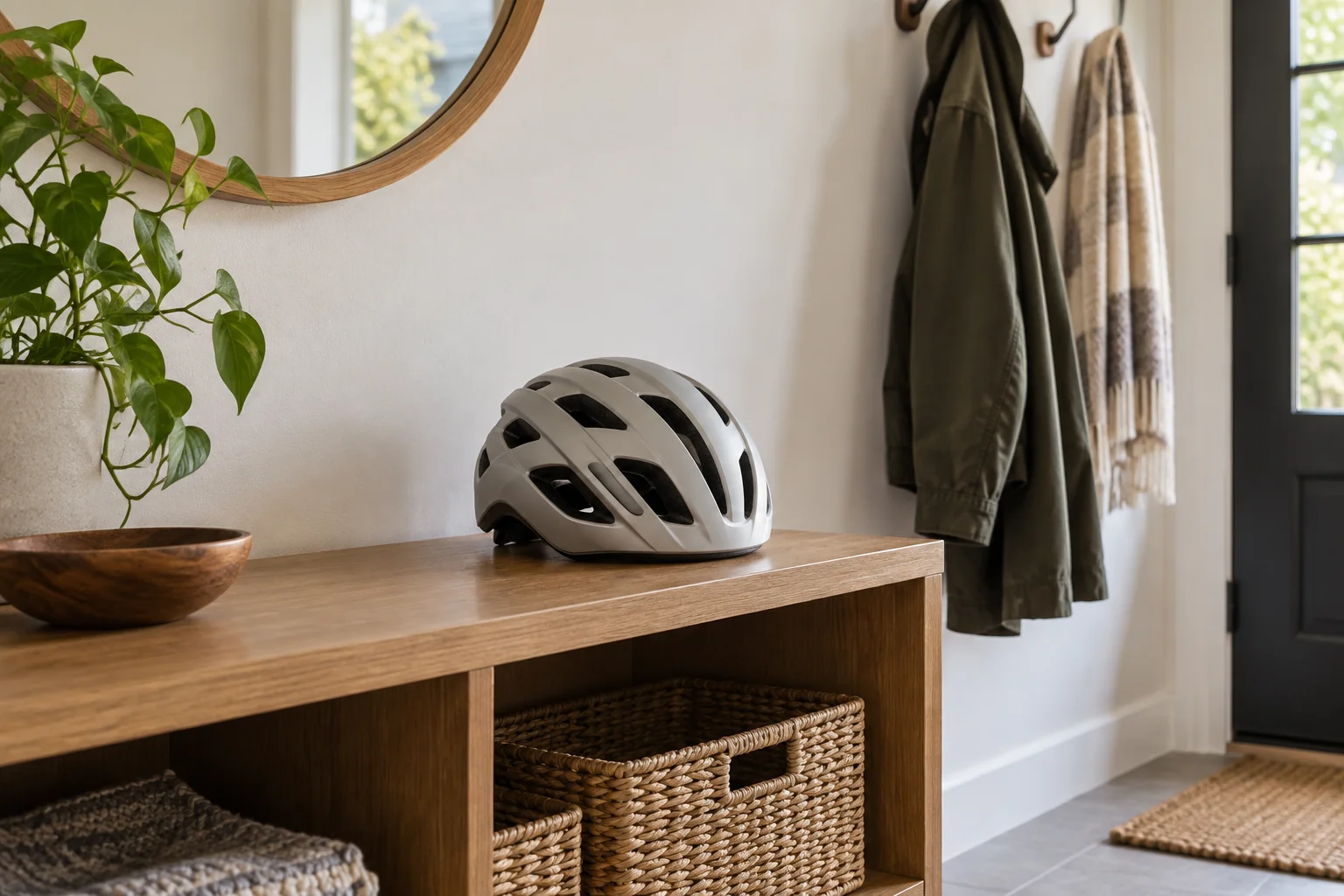
Consider the helmet’s actual shape, including any visor, adjustment system or attached accessories. Set it down as permitted by its instructions and check that nothing bears on a protruding component. Do not use the helmet as a container for keys, tools or a heavy lock.
A shelf or individual compartment can be evaluated without inventing a universal hook arrangement. If considering a purpose-made holder, check its instructions and the helmet maker’s guidance. Do not assume that a chin strap, vent opening or adjustment cradle is an approved suspension point merely because it fits over a hook.
Try the location with neighboring coats and bags present. A shelf that works only when the entryway is empty may become a daily conflict. Give the helmet a recognizable boundary so someone putting away groceries does not gradually push it beneath other objects.
| Question | Record | Next action |
|---|---|---|
| Whose helmet and which model? | Owner and care-guide location | Confirm model-specific instructions |
| What surrounds the spot? | Sunlight, heat, damp items, chemicals | Reject unsuitable surroundings |
| How is it supported? | Shelf or confirmed compatible holder | Check contact with protruding parts |
| What happens after a wet ride? | Separate drying and return step | Follow the helmet’s care instructions |
| Does everyday access work? | Door, bags, coats and household users | Move the location if access conflicts |
| What remains uncertain? | Condition or storage question | Contact the manufacturer |
Separate returning home from final storage
A wet helmet should not automatically disappear into a closed container with wet gloves simply because that is the usual storage position. Follow its care instructions and give it an appropriate drying step before returning it to its usual place. Do not improvise a radiator, hair dryer or other heat treatment to speed up the routine.
Keep the landing area understandable to other household members. A simple note in the household routine can distinguish “being cared for” from “ready to collect.” That distinction is more useful than a decorative label that says only “cycling.”
If accessories are removable according to their instructions, assign them their own appropriate storage position. Record which accessory belongs to which helmet where mix-ups are likely. Avoid attaching new adhesive labels directly to the helmet shell merely to solve an organization problem.
Worked example: an entry shelf shared by two riders
In a fictional apartment, two riders initially use a basket beside the door. One helmet rests under a folded coat, while a second is placed with damp gloves. The household replaces that shared pile with two defined positions on an existing appropriate indoor shelf.
Each rider checks their own helmet instructions. Wet equipment follows a separate care and drying routine, and the shelf is kept away from the cupboard containing cleaning sprays. A blank card on the shelf identifies each position without being stuck to the helmet itself.
The household then runs through an ordinary arrival: open the door, set down a bag, remove the helmet and put away a coat. When the coat blocks the lower position, they move that position instead of expecting everyone to keep the coat elsewhere every day. No fixed shelf height or capacity is inferred from this example.
Keep access and condition questions separate
Check that the arrangement does not interfere with the apartment door or necessary circulation. Shared corridors and building facilities may have their own rules, so do not treat an indoor organization idea as permission to install storage outside the apartment.
When a helmet has been dropped, struck or otherwise raises a condition concern, do not solve the problem by returning it neatly to the shelf. Follow the maker’s relevant guidance and keep the unresolved issue clear to its user. A tidy location does not provide an inspection result.
The final arrangement should answer three everyday questions: where does this helmet belong, what happens when it comes home wet, and can it be collected without moving other people’s belongings? A simple, consistently used location often serves those needs better than a complicated display.