Key takeaways
- Slips and Falls Prevention: Securely anchors lightweight rugs, runners, and throw mats in high-traffic zones like hallways, kitchens, and entryways.
- Scratch Defense: Creates a physical barrier that prevents coarse jute, sisal, or synthetic backings from scratching the wood’s polyurethane topcoat.
- Extended Rug Lifespan: Absorbs foot traffic impact, preventing the rug’s fibers from breaking down and extending its overall life by up to 50%.
- Acoustic Dampening: Reduces the hollow, echoing sound of footsteps, which is particularly beneficial in multi-story homes or apartments.
- Easier Maintenance: Holds the rug flat and allows for better airflow, making vacuuming significantly easier because the rug won’t get sucked up into the vacuum roller.
- Underfoot Comfort: Adds a layer of luxurious density, making thin flatweaves and low-pile rugs feel much softer to walk on.
The Short Answer
Yes, you absolutely need a rug pad on hardwood floors—with exactly one condition. You can only skip a rug pad if your area rug comes with a manufacturer-certified, built-in, non-abrasive backing made of 100% natural rubber or soft felt. Because over 95% of retail rugs feature rough jute, stiff polypropylene, or harsh chemical latex backings, going without a pad is a guaranteed way to ruin your floors.
Without that protective barrier, every single step you take on your rug micro-grinds abrasive fibers against your floor’s delicate polyurethane finish. Over time, this friction acts like fine-grit sandpaper, stripping away the protective sheen and leaving behind dull, scratched, and permanently discolored patches that can cost thousands of dollars to refinish.
Our top picks

As an Amazon Associate we earn from qualifying purchases at no extra cost to you.
What You Actually Get
To understand why a rug pad is necessary, you have to look at what happens beneath the surface of your flooring. Hardwood floors are a major financial investment, often costing between $10 and $20 per square foot to install. A high-quality rug pad acts as a cheap insurance policy, offering several critical layers of protection and comfort that you simply cannot get from an area rug alone.
First and foremost, you get friction protection. When you walk across an unpadded rug, it shifts. Even if it only moves a millimeter at a time, that microscopic movement creates friction. Natural rug backings like jute and sisal are incredibly coarse. Synthetic backings on machine-woven rugs are often coated in clay fillers and chemical adhesives to keep the tufts in place. A rug pad grips both the floor and the rug, locking them together to eliminate this abrasive movement entirely.
Second, you get impact absorption. Hardwood is resilient, but it is not impervious to dents. Heavy foot traffic, dropped toys, high heels, and heavy furniture legs put immense localized pressure on wood fibers. A cushioned felt or hybrid felt-and-rubber pad acts as a shock absorber. It disperses the energy of every step, reducing the wear on both the wood and the rug’s own fibers, which prevents the rug from crushing and balding over years of use.
Third, you protect your home from chemical discoloration. Many homeowners buy cheap, generic plastic rug pads thinking they are doing the right thing. However, low-grade PVC pads often contain chemical plasticizers. These chemicals off-gas and migrate into the polyurethane finish of your hardwood, causing a permanent chemical reaction that turns the wood a sickly yellow or dingy gray. High-quality pads made of natural rubber or heat-compressed felt do not off-gas, keeping your floor’s color pristine.
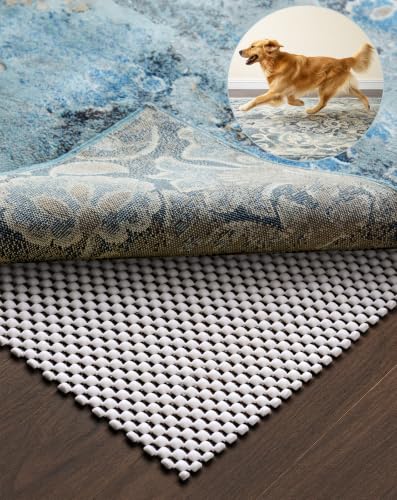
As we design modern, open-concept living spaces in 2026, keeping our homes quiet and safe is more important than ever. By adding a pad, you also gain significant sound dampening—often reducing footstep noise transmission by 10 to 15 decibels—while securing lightweight rugs to prevent dangerous slips and trips. Entry-level options like the Veken Non Slip Rug Pad ($5.99 for a 2×3 ft size) or the slightly thicker GORILLA GRIP® Slip Resistant Pad ($7.99 for a 2×3 ft size) provide immediate, low-profile safety for small accent rugs, while thicker felt-and-rubber combo pads (running from $30 to $150 for larger room sizes) offer the ultimate structural cushioning for your main living areas.
Pros
- Slips and Falls Prevention: Securely anchors lightweight rugs, runners, and throw mats in high-traffic zones like hallways, kitchens, and entryways.
- Scratch Defense: Creates a physical barrier that prevents coarse jute, sisal, or synthetic backings from scratching the wood’s polyurethane topcoat.
- Extended Rug Lifespan: Absorbs foot traffic impact, preventing the rug’s fibers from breaking down and extending its overall life by up to 50%.
- Acoustic Dampening: Reduces the hollow, echoing sound of footsteps, which is particularly beneficial in multi-story homes or apartments.
- Easier Maintenance: Holds the rug flat and allows for better airflow, making vacuuming significantly easier because the rug won’t get sucked up into the vacuum roller.
- Underfoot Comfort: Adds a layer of luxurious density, making thin flatweaves and low-pile rugs feel much softer to walk on.
Cons
- Upfront Cost: Adds an extra expense to your decorating budget, ranging from under $10 for small accent sizes up to $150 or more for premium, thick 9×12 felt pads.
- Door Clearance Issues: Thick felt cushioning (1/4 inch to 1/2 inch) can raise the profile of your rug enough to block low-clearance doors from opening smoothly.
- Trapped Dust and Grit: Fine dust particles can still sift through the rug fibers and settle beneath the pad, requiring you to occasionally lift the pad to sweep or vacuum.
- Risk of Cheap Materials: Choosing a cheap, low-quality PVC pad can lead to chemical staining or sticking, which defeats the entire purpose of floor protection.
Who Should Buy It
You should absolutely buy a rug pad if you have newly installed, refinished, or high-end hardwood floors (such as solid oak, walnut, maple, or cherry). If you have kids, pets, or elderly family members in the home, a slip-resistant pad is a vital safety upgrade to prevent accidental falls on slick surfaces. It is also a must-buy for anyone using thin flatweave rugs, dhurries, or runners, which are naturally prone to bunching, sliding, and curling at the corners.
Who Should Skip It
You can safely skip a rug pad if your area rug is already anchored by massive, heavy furniture—such as a solid wood dining table or a king-size bed frame weighing over 300 pounds—where slipping is physically impossible, and the rug has a soft, non-abrasive cotton or flexible fabric backing. You might also skip it if you are using a cheap, temporary rug on older, already-damaged rental floors where you are not concerned about minor scuffs or long-term wood preservation.
Cheaper Alternatives
If you are on a tight budget, you might be tempted to look for household workarounds. While some of these DIY solutions can stop a rug from sliding, they often come with severe trade-offs that can permanently damage your hardwood floors.
| Option | Cost | Trade-off |
|---|---|---|
| Double-Sided Carpet Tape | $8 – $15 per roll | Leaves a sticky, gummy residue on the hardwood floor that is incredibly difficult to clean. Can strip away the wood’s protective polyurethane finish during removal. Offers zero cushioning. |
| Silicone or Acrylic Caulk Lines | $4 – $8 per tube | Applying lines of wet caulk to the back of the rug and letting it dry creates a grippy texture. However, if the caulk is not completely cured, it can chemically bond with and ruin your hardwood floor finish. |
| DIY Craft Felt or Fleece Fabric | $5 – $12 (by the yard) | Buying cheap felt fabric from a craft store provides decent cushioning underfoot, but fabric has no grip. The rug will still slide easily across the floor, creating a major slipping hazard. |
| Basic PVC Mesh Pads | $5 – $15 (e.g., Veken 2×3 for $5.99) | Extremely affordable and highly slip-resistant. However, they offer minimal cushioning and cheap versions can off-gas, potentially causing yellowing on polyurethane finishes over time. |
FAQ
Will a cheap rug pad ruin my hardwood floors?
Yes, it can. Low-cost rug pads made of cheap imported PVC or synthetic plastics often contain chemical plasticizers. Over time, these chemicals escape (a process called off-gassing) and react with the polyurethane finish on your hardwood floors. This chemical reaction can cause the pad to stick permanently to the floor, or leave behind a stubborn, yellow-brown grid pattern that cannot be washed away and requires professional sanding to fix.
How thick should a rug pad be for hardwood floors?
The ideal thickness depends on your rug and its location. For high-traffic areas, hallways, and under doors where clearance is tight, a thin, low-profile pad (1/16 to 1/8 inch thick) made of natural rubber is best. For living rooms, bedrooms, and dens where comfort is a priority, a thicker hybrid felt-and-rubber pad (1/4 to 3/8 inch thick) offers the perfect balance of plush cushioning and non-slip safety without creating a tripping hazard.
Can I use double-sided tape directly on my hardwood to stop a rug from slipping?
You should never apply standard double-sided tape or duct tape directly to your hardwood floors. The adhesives used in these tapes are designed to be permanent. Over time, the adhesive cures and hardens, chemically bonding with the wood’s finish. When you eventually pull the tape up, it will likely pull the polyurethane finish right off the wood, leaving you with raw, unprotected spots that are highly vulnerable to water damage and staining.
How do I know if my rug pad is safe for polyurethane finishes?
Look for rug pads specifically labeled as “safe for polyurethane finishes” or “100% natural rubber.” Natural rubber and heat-pressed felt are organic materials that do not contain the volatile plasticizers found in cheap synthetic vinyl or PVC. Always read the manufacturer’s warranty on both your flooring and your rug pad to ensure compatibility before installation.