Our Top Picks
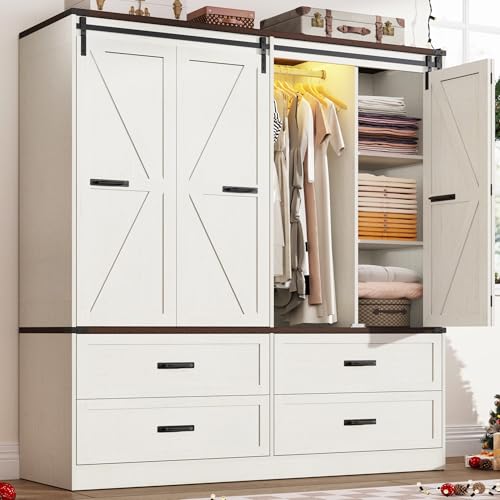 Farmhouse 4 Doors Armoire Wardrobe Closet w/Folding Sliding19.7"D x 63"W x 73"H19.7 x 47 x 73 inches128 poundsCheck on Amazon
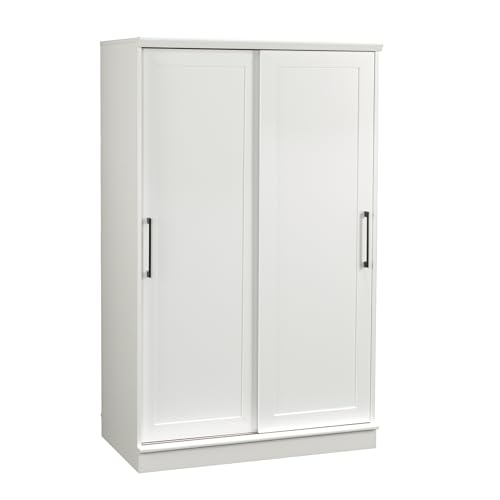 Sauder Homeplus Wardrobe Cabinet with Sliding Doors22.99 x 39.13 x 64.02 inches144.61 poundsCheck on Amazon
For narrow bedrooms where a hinged door would hit the bed, a sliding-door wardrobe such as an IKEA PAX frame with sliding doors is the usual answer, while a bypass door kit suits owners who already have a closet opening and want to replace swinging doors. This guide compares the main sliding-door options by room size, door material, track quality and care, using the makers’ own stated specifications.
At a Glance
| Option | Best for | Key stated traits | Limits |
|---|---|---|---|
| IKEA PAX with sliding doors | Fitted wall in a small room | Modular frames; sliding doors in several finishes, including mirror options in some markets | Doors cover only part of the opening at a time; assembly is long |
| Freestanding sliding-door wardrobe (Songmics, Homfa style) | Rentals and quick setup | Panel frames, hanging rails and shelves, sliding doors on top tracks | Lower weight capacity; tracks can derail if overloaded |
| Bypass closet door kit (Johnson Hardware, Stanley style) | Existing closet opening | Door panels on upper and lower tracks, sold in standard widths | Only half of the opening is open at once |
| Mirrored sliding doors (Renin style) | Dressing area and light reflection | Framed mirror panels on tracks | Heavier panels; frame quality varies |
| Fitted carpentry with sliding doors | Sloped ceilings and alcoves | Custom tracks and panels | Premium tier, longer lead time |
How Sliding Doors Work
Sliding wardrobes use top-hung or bottom-rolling doors in parallel tracks. Because panels glide past each other, they need no swing space, which makes them useful in rooms under roughly three metres wide or where the wardrobe faces the bed. The trade-off is access: because the doors overlap, you can only reach half or two-thirds of the interior at once, so frequently used items should go in the most accessible zone.
Farmhouse 4 Doors Armoire Wardrobe Closet w/Folding Sliding Barn Door and Lights, LED Armoire Closet w/Drawers for Bedroom, Freestanding Wooden Wardrobe Storage Closets w/Hanging Rod,Antique White
Chosen because it specifies LED Armoire Closet w/Drawers for Bedroom and Freestanding Wooden Wardrobe Storage Closets w/Hanging Rod.
View on AmazonSauder Homeplus Wardrobe Cabinet with Sliding Doors, White Finish
Chosen because it specifies White Finish.
View on Amazon
Tvilum Wardrobe with 2 Sliding Doors - Clothing Storage for Bedroom, White | Hanging Rod, Shelves
Chosen because it specifies Clothing Storage for Bedroom and White.
View on AmazonTop-Hung vs Bottom-Rolling
Top-hung systems carry the door weight on the upper track, so the floor track is only a guide. Reviewers generally report smoother running on well-fixed top-hung systems. Bottom-rolling doors are common on budget kits; the lower track can collect dust and needs regular vacuuming. Both types need the door height matched to the opening, and makers state tolerance limits, so measure the opening in three places.
Door Materials
- Engineered wood panels: light and economical, with printed or foil finishes.
- Mirror: brightens a room but is heavier and needs sturdy rollers; makers list per-door weight limits.
- Glass or frosted glass: adds a modern look, shows fingerprints and is heavier.
- Aluminium frames: lighter than wood and often used around mirrored or glass inserts.
Main Options in Detail
IKEA PAX With Sliding Doors
The maker lists PAX frames in a grid of widths and heights, and sliding doors are sold in matching widths. Reviewers like the interior organisers, which include rails, drawers, trays and shoe shelves. The common complaints are the number of parts and the care needed to align the tracks. Follow the instruction manual exactly and anchor tall frames to the wall as the maker directs.
Freestanding Sliding-Door Wardrobes
Brands such as Songmics and Homfa sell panel-built wardrobes with two or three sliding doors. These are budget-tier pieces suited to guest rooms and rentals. The makers state shelf and rail loads, and reviewers say overloading the doors or rail causes sagging. They are lighter than furniture-grade units, so wall anchoring is especially important.
Bypass Door Kits for Existing Openings
For a closet that already has an opening, kits from makers such as Johnson Hardware or Stanley supply the track and hanging hardware, sometimes with panels. They are a low-cost fix for a swinging door that blocks the room, but the opening remains half-covered at all times. Measure width and height carefully and note any ceiling slope or skirting depth that could interfere with the track.
Mirrored Sliding Doors
Mirrored doors from makers such as Renin combine a frame with a mirror panel. They save buying a separate full-length mirror and bounce light around a small room. Mirrors are heavy, so installers often advise two people and the maker’s mounting hardware only. If a mirror cracks, treat it as a hazard and replace the panel.
Measuring and Fit Notes
- Width: measure the opening at the top, middle and bottom; use the smallest figure.
- Height: compare ceiling height with the wardrobe plus clearance for lifting into position.
- Depth: standard hanging depth is roughly 55 to 60 centimetres according to most closet makers; sliding tracks add a few centimetres.
- Floor: an uneven floor causes sticking doors; use the maker’s levelling feet or shims.
- Skirting boards: some units need a recess or notch, and makers include templates.
Care and Safety
- Vacuum the bottom track monthly to avoid dirt jams.
- Wipe tracks with a dry or lightly damp cloth; avoid oil sprays unless the maker permits them.
- Do not overload door-mounted rails; makers specify limits.
- Anchor tall wardrobes to the wall with the supplied brackets.
- Keep children away from the track area, since fingers can be trapped between panels.
Budget Tiers
- Budget: freestanding sliding-door wardrobes and bypass kits.
- Mid-range: modular systems with matching sliding doors and organisers.
- Premium: fitted carpentry with soft-close tracks and custom interiors.
Pick X If…
| Pick this | If you… |
|---|---|
| Modular system with sliding doors | Want a fitted look in a small room and plan to use drawers and trays |
| Freestanding sliding wardrobe | Rent, move often or need a quick solution |
| Bypass door kit | Already have an opening and only need to replace swinging doors |
| Mirrored sliding doors | Need a full-length mirror and extra light |
| Fitted carpentry | Have a sloped ceiling or an odd alcove |
Alternatives
- Bifold doors: open wider than sliders but need some swing space.
- Curtain-fronted wardrobe: a low-cost, space-saving option for a spare room.
- Hinged modular wardrobe: full access to the interior when there is clearance.
Planning Your Layout Behind Sliding Doors
Because sliding doors reveal only a portion of the interior, layout matters more than with hinged doors. Put daily items, such as shirts and trousers, behind the section that opens most often, and keep occasional items, such as formal wear, at the ends. Many planners place drawers behind the middle panels so that the doors slide past the drawer fronts, but the maker’s instructions will state the clearance needed to open drawers while a door is in front.
Door Count and Width
Two-door wardrobes give access to half of the opening at a time; three-door versions give access to a third but make each door narrower and lighter. Reviewers say narrower doors move more smoothly and are easier to lift into the track, while wider doors look cleaner but weigh more. For a wide wall, combining several modular frames with multiple door pairs is common.
Soft-Close and Quality Hardware
Some makers list soft-close dampers or self-closing mechanisms on mid-range and premium tracks. These reduce slamming and protect mirrors from impact. On budget units, rollers are often plastic, and reviewers report wheels wearing after heavy use. If the maker sells replacement rollers, buying a spare set is a practical precaution, and it is worth noting the roller type before purchase.
Installation Tips
Assembly is more forgiving if you confirm that the top track is level before hanging the doors. Use a spirit level and adjust with the maker’s adjusters. Hang the inner doors first, then the outer ones, unless the instructions say otherwise. Tighten fixings gradually rather than fully at first, so you can square the frame. Keep packaging until the doors run smoothly, in case a panel needs to be returned.
Rooms Where Sliding Doors Fit Best
Narrow bedrooms, hallways, attic rooms and studio apartments are common cases. Sliding doors also suit alcoves with sloped ceilings if the maker offers bespoke heights. In a nursery, they prevent doors swinging into cribs, but the track still needs child-safe handling, so keep fingers away and anchor the frame as the maker instructs.
Frequently Asked Questions
Are sliding wardrobes better than hinged ones?
They are better when swing space is limited, because the doors move along tracks instead of opening outward. The downside is that you can only see and reach part of the interior at one time.
Why do sliding wardrobe doors jam?
The usual causes are dirt in the lower track, uneven floors, overloaded doors or misaligned hardware. Clean the track, level the base and follow the maker’s alignment instructions before replacing parts.
Can sliding doors be fitted to an existing closet?
Yes, bypass door kits are designed for standard openings. Measure the width and height in several places and choose a kit that lists your size range.
Are mirrored sliding doors heavy?
They are heavier than wood or foil panels, and makers list per-door weight limits and mounting requirements. Use the supplied hardware and have a second person help lift panels into place.
How much space do sliding doors save?
They remove the clearance a hinged door needs, which is roughly the door width. In a narrow bedroom this can allow a bed or chair closer to the wardrobe.
Do tall sliding wardrobes need to be anchored?
Yes, makers provide wall brackets or straps for tall units and instruct owners to use them. If you are not sure about the wall type, ask a qualified installer for the correct fixings.