Our Top Picks
 Amdermi Montessori Kids Wardrobe and Toy Storage Organizer55" x 15" x 51" (L x W x H)55 x 15 x 51 inches30.5 poundsCheck on Amazon
The best children’s wardrobe for most families is a modular or freestanding unit that can be anchored to the wall, with adjustable shelves and hanging rails that can be lowered for small children and raised later: modular systems such as IKEA’s PAX suit growing kids and odd room shapes, compact two-door wardrobes suit small bedrooms, and fabric or open-rail options suit tight budgets and playrooms. Safety comes first: any tall furniture in a child’s room should be secured to the wall.
Children’s Wardrobe Types at a Glance
| Type | Best for | Key points | Limits |
|---|---|---|---|
| Modular wardrobe system (for example IKEA PAX) | Growing children, awkward rooms | Frames in set widths and heights, interior organizers, sliding or hinged doors sold separately | Needs assembly and wall anchoring; many pieces to plan |
| Standard two-door wardrobe | Small bedrooms | Hanging rail plus a shelf or drawer, one carcass | Fixed layout, less adaptable |
| Three-door or combination wardrobe with drawers | Shared rooms, larger clothing needs | Hanging space plus drawers in one unit | Large footprint, heavier |
| Armoire-style wardrobe | Rooms without closets | Freestanding, often with a mirror or drawer base | Tall and heavy, anchoring essential |
| Fabric wardrobe with rail | Budget tier, renters, temporary use | Lightweight frame and cloth cover, easy to move | Less durable, less stable if overloaded |
| Open clothes rail or low rack | Toddlers learning to dress themselves | Child-height rail, easy reach | No dust protection, less storage |
| Wardrobe bed or loft bed with wardrobe | Very small rooms | Sleeping area above, storage below | Height limits; follow age guidance on bunk or loft use |
Safety First: Tip-Over Prevention
Tall chests and wardrobes can tip if a child climbs on open drawers or doors. Safety groups and regulators, including the US Consumer Product Safety Commission, urge families to anchor clothing storage units to the wall, and the US has a federal clothing storage unit stability standard (the STURDY Act, referencing ASTM F2057). Look for a product page that states compliance with the applicable standard, and use the wall anchor included in the box. If the supplied hardware does not suit your wall type (drywall, plaster, masonry), buy anchors designed for it and follow the maker’s instructions. Do not place a TV or heavy objects on top of a wardrobe, and avoid placing it where a child can use the doors as a ladder. If you are unsure how to install an anchor, a qualified handyperson can help.
Amdermi Montessori Kids Wardrobe and Toy Storage Organizer with Bins, Wooden Toddler Dress Up Clothes Rack, Open Closet with Shoe Shelves for Childrens Bedroom and Playroom, Natural Wood
Chosen because it specifies Wooden Toddler Dress Up Clothes Rack and Natural Wood.
View on Amazon
VEVOR Kids Dress Up Storage, with Mirror, Wooden Kids Dress Up Rack, Toddler Wardrobe Closet for Little Girls, Storage Armoire, Costume Organizer, Children Playroom Furniture, for Bedroom, Natural
Chosen because it specifies with Mirror and Wooden Kids Dress Up Rack.
View on Amazon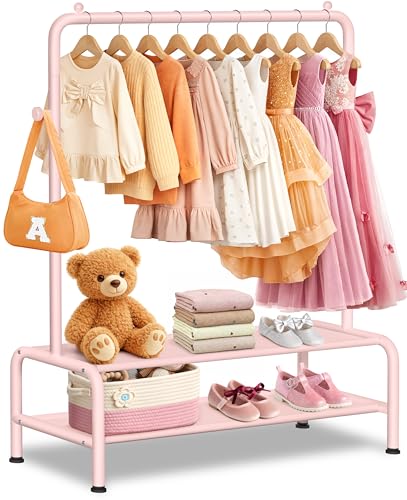
mirolam Kids Clothing Rack - Dress Up Storage - Dress Up Rack for Little Girls - Small Kids Costume Wardrobe with 2 Fabric Shelves - Princess Room Bedroom Decor
Chosen because it specifies Dress Up Storage and Dress Up Rack for Little Girls.
View on Amazon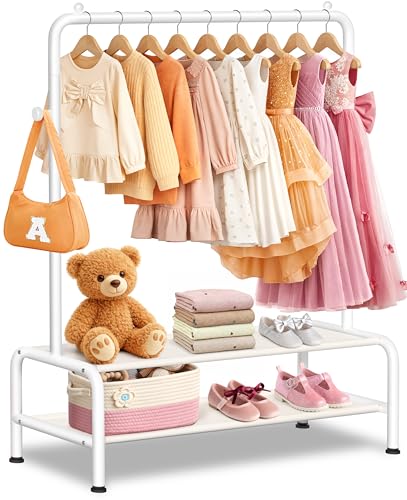
Kids Clothing Rack - Dress Up Clothes Rack - Baby Toddler Closet - Mini Freestanding Coat Racks with 2 Fabric Shelves - Small Kids Costume Wardrobe - Garment Rack for Hanging Clothes Organizer
Chosen because it specifies Dress Up Clothes Rack and Baby Toddler Closet.
View on AmazonSizing and Layout
- Hanging rail height: Children’s clothes are short. A rail 90 to 110 cm from the floor, or a space that allows double hanging, is common. Some systems let you move the rail as the child grows.
- Width: Modular systems like PAX are sold in set widths, typically 50, 75 and 100 cm per frame per the maker, which makes it possible to build to your wall width. Check the current catalog for the exact options.
- Depth: Standard wardrobes are around 50 to 60 cm deep so that hangers fit. Shallower units may not hang clothes straight.
- Door type: Sliding doors save floor space, but hinged doors give full access. Make sure swing paths do not hit the bed or radiator.
- Ceiling height: If you are choosing a tall modular unit, compare its height with your ceiling, and leave space for installation.
Materials and Finish
Most children’s wardrobes use particleboard or MDF with melamine or laminate finishes; some use solid pine or other softwood. Makers sometimes list low-emission (E1 or CARB Phase 2 compliant) boards for formaldehyde, and finishes labeled as child-safe or conforming to toy-grade paint rules for painted furniture. Take such claims from the maker’s own listing. Rounded corners, soft-close hinges and finger-pinch-resistant doors are useful features for small children, and are worth looking for on product pages.
Storage Inside the Wardrobe
Choose a layout based on age. For toddlers, a low rail, bins and open shelves that they can reach. For primary school children, double hanging plus drawers or pull-out baskets. For teenagers, longer hanging, shoe storage and shelves for folded items. Interior organizers (drawer inserts, pull-out trays, hanging shelves) can be added to a modular frame as the child grows.
Makers and Lines to Look At
IKEA’s PAX is the most widely discussed modular system, and its Kids range of storage accessories is often used in children’s rooms. IKEA also sells smaller wardrobes in its PLATSA and other lines. Other common sources are Hemnes-style freestanding wardrobes, children’s furniture lines from Pottery Barn Kids and Crate and Kids, and flat-pack wardrobe makers such as South Shore and Sauder. Lineups change, so check each maker’s listing for the current model, and read independent reviewers such as Wirecutter and Good Housekeeping for durability comparisons.
Budget Tiers
- Budget: Fabric wardrobes with metal frames, open rails and basic flat-pack two-door units. Fine for short-term use, but check stability and anchor a freestanding frame wherever the maker provides a means.
- Mid-range: Modular systems and flat-pack wardrobes with laminate finishes, adjustable shelves and soft-close options. This tier suits most families.
- Premium: Solid wood or higher-grade veneer wardrobes with dovetail drawers, designed to last through childhood and beyond.
Pick X If …
| Pick this | If … |
|---|---|
| Modular system with adjustable rail | The child will grow and you want to reconfigure the layout |
| Compact two-door wardrobe | The room is small and clothing needs are modest |
| Wardrobe with drawers | You want one piece that replaces a dresser |
| Fabric wardrobe | It is temporary or you are renting |
| Open low rail | A toddler is learning to dress independently |
| Solid wood armoire | You want a long-lasting piece and can anchor it properly |
Alternatives
- Built-in closet organizers: Rail and shelf kits for an existing closet can be the safest approach because they are fixed to the structure.
- Low dressers and bins: For young children, low storage with anchor straps and open bins avoids tall furniture altogether.
- Wall-mounted rails and hooks: Let children hang their own coats at a reachable height.
Buying Checklist
- Measure the wall, ceiling and door swing space.
- Decide whether a fixed or modular layout suits the child’s age range.
- Look for a stated safety standard and included wall anchor.
- Read the assembly time and whether two adults are needed.
- Prefer rounded edges and soft-close features for small children.
- Confirm the return policy for flat-pack furniture, as boxes can be heavy.
Planning for Different Ages
A wardrobe for a young child works best when the child can reach part of it: a low rail, open bins and a few easy shelves encourage independence. For a school-age child, plan for school uniforms, sports kits and shoes, with hanging space for coats and a drawer or basket zone for folded clothes. Teenagers usually need longer hanging space, a mirror, and more shelves. Because needs shift every few years, a modular frame with movable rails and shelves can stretch across all these stages. Shared rooms may call for two separate compartments so each child has their own space, and labels or color-coded bins help younger children keep track. Whatever you pick, revisit the layout each year and move items down or up as height changes.
Frequently Asked Questions
Do I need to anchor a children’s wardrobe to the wall?
Yes, safety organizations advise anchoring any tall furniture, particularly in a child’s room. Use the hardware supplied, or anchors rated for your wall type. If you are unsure, ask a qualified installer.
What size wardrobe is best for a small child’s room?
A compact two-door wardrobe around 80 to 100 cm wide is common. Measure the room and door swing before you buy. Modular systems let you build to the exact width.
Is a modular wardrobe like PAX good for kids?
Many parents choose it because rails, shelves and drawers can be moved as children grow. It does need careful planning and assembly, and the frame should be fixed to the wall as the instructions say.
What materials are safest for a child’s wardrobe?
Look for low-emission boards and finishes, as stated by the maker, such as E1 or CARB Phase 2 compliant. Solid wood is another choice, though it costs more. Good ventilation helps with any new furniture smell.
How high should the hanging rail be?
For toddlers and young children, around 90 to 110 cm from the floor is common, or use a low rail. Some wardrobes have adjustable rails. Raise it as the child grows.
Can I use a fabric wardrobe in a child’s room?
Yes for light use, especially while renting. Watch the weight limit, keep the load low and balanced, and avoid letting children climb on it. Read the maker’s guidance.