Key takeaways
- Pro: Conforms to your body almost immediately with no break-in period
- Pro: Stays cool during extended sitting sessions
- Con: Fill compresses faster than any other option on this list
A reading nook chair is one of the most oversold categories in furniture. You see photos of people curled up in something that looks like a cloud, buy it, and then spend your first reading session trying not to sink so deep that your lumbar spine curves into a shape no orthopedist would endorse. The real problem is not comfort in the abstract — it is sustaining a semi-upright posture for an hour with a book or tablet without your neck or lower back giving out.
What separates a genuinely good reading nook chair from a decorative mistake comes down to three things: the ratio of structural support to plush softness, whether the seat depth lets your feet or ottoman actually take load off your legs, and how easy the chair is to get out of when you need to stand up in the middle of a page. The bean bags that look perfect in lifestyle photography often trap you. The oversized chaise lounges that promise recliner-level support can swallow a smaller frame. Below are eight chairs we compared across body types and reading positions, ranked by how well they solve the actual problem rather than the visual one.
Our top picks




As an Amazon Associate we earn from qualifying purchases at no extra cost to you.
Quick Picks
| Product | Best for | Price |
|---|---|---|
| Hobestluk Large Bean Bag | Casual lounging on a tight budget | $95.74 |
| Tiita Lazy Chair with Ottoman | Small spaces needing a footrest | $112.99 |
| MAXYOYO Adjustable Backrest Chair | Switching between upright and reclined reading | $168.99 |
| MAXYOYO Modern Metal Frame Chair | Structured support in a compact footprint | $104.99 |
| Welnow Lazy Chair with Ottoman | Reliable comfort without frills | $112.99 |
| VINGLI 56″ Oversized Reading Chair | Tall users who need full-body length support | $359.99 |
| Chorlenimi 67″ Chaise Lounge | Maximum recline with zero assembly | $199.99 |
| Amsleekey 64″ Chaise with Cup Holders | Entertainment rooms with built-in convenience | $299.98 |
How We Picked
We evaluated each chair on four criteria that directly affect reading sessions: support-to-softness balance (how long before slouching becomes painful), practical seat depth relative to the advertised dimensions, footprint efficiency (how much floor space is genuinely usable versus how much the chair visually dominates), and ease of ingress and egress. A chair that requires a two-handed push-up to exit is a poor reading companion regardless of how good it looks in a photo. We also weighted whether the design accommodates multiple body sizes or is forgiving only for a narrow range.
The 8 Best Reading Nook Chairs in 2026
Hobestluk Large Bean Bag Sofa
This is the most affordable option that actually delivers on its visual promise, and it wins that award for a reason. The expanded polystyrene fill conforms to your body with surprising speed, and the fabric shell stays cool enough that you are not sweating after thirty minutes. For anyone furnishing a dorm, studio, or kid-adjacent reading corner where the chair will take a beating, it is genuinely hard to beat at this price. The real weakness is longevity: fill compresses noticeably within months of daily use, and once it does, you are sitting on a lumpy shell with no structural rescue. Skip this if you need a chair you can read in for two consecutive hours without shifting positions, or if you value lumbar support over enveloping softness.
- Pro: Conforms to your body almost immediately with no break-in period
- Pro: Stays cool during extended sitting sessions
- Con: Fill compresses faster than any other option on this list
Tiita Lazy Chair with Ottoman
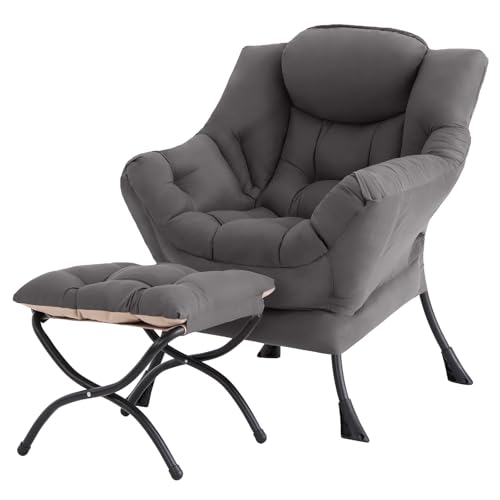
The Tiita earns a place here because the ottoman is not an afterthought. Many lazy chairs ship with a tiny footrest that serves decorative purposes, but this one supports your calves at a height that genuinely relieves lower back pressure during seated reading. The dark grey upholstery hides wear well, and the overall dimensions fit a corner next to a bookshelf without dominating the room. The downside is that the armrests are low, which means you cannot brace yourself when standing up — a real annoyance if you are reading in bed-adjacent positions and your legs are stiff. Skip this if you are over six feet tall, because the seat depth starts to feel short once your knees pass the front edge.
- Pro: Ottoman height and size work as true leg support, not decoration
- Pro: Compact footprint fits tight corners without feeling cramped
- Con: Low armrests make standing up a two-handed operation
MAXYOYO Adjustable Backrest Chair
This is the most versatile chair on the list. The adjustable backrest mechanism lets you move between a nearly upright posture for focused reading and a laid-back recline for audiobooks or phone scrolling. The ottoman tucks underneath when not in use, which matters if you are sharing a room. Build quality is solid for the price — the frame does not creak, and the hinge mechanism holds position without drifting down under load, which is the most common failure point in adjustable chairs. The tradeoff is bulk: this chair occupies significantly more floor space than its stated dimensions suggest because of the recline arc. Skip this if your reading nook is smaller than roughly a five-by-five corner, or if you dislike the visual weight of a recliner-style form.
- Pro: Backrest holds position firmly without slowly drifting downward
- Pro: Ottoman tucks flush for space efficiency when upright
- Con: Recline arc adds considerable depth to the overall footprint
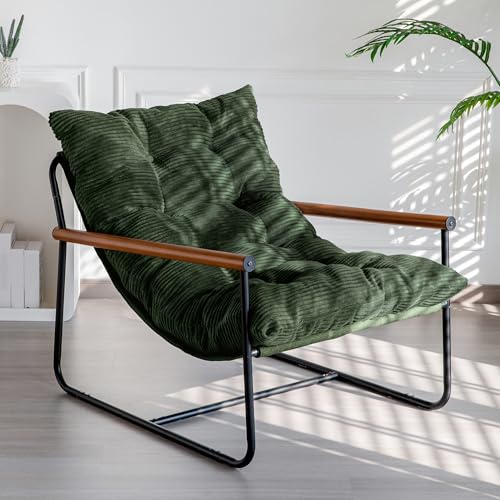
MAXYOYO Modern Accent Chair with Metal Frame
The metal frame here is the whole story. Where the other chairs on this list rely on foam density and fabric tension to provide structure, this one uses a visible metal base to deliver genuine postural support. You sit up straighter without thinking about it, which makes it the best pick for people who read at a desk chair height and want something more comfortable without losing alignment. It is also the easiest to get out of. The downside is that the firmness that makes it structurally excellent also makes it less forgiving — there is no cloud-sinking pleasure here, and the seat does not conform to you. Skip this if your priority is enveloping softness or if you want to lie down, because the frame does not recline.
- Pro: Metal frame delivers real postural support for extended reading
- Pro: Easiest egress on the list — no sinking or struggling to stand
- Con: Firm seat offers zero give, which feels cold to some users
Welnow Lazy Chair with Ottoman
Functionally this is a near-twin to the Tiita above, with slightly different proportions and fabric weight. It performs almost identically in use: the ottoman supports your legs at the right height, the seat is deep enough for cross-legged positions, and the upholstery tolerates long sitting without overheating. Where it edges ahead is in the slightly higher backrest, which gives a bit more head and neck contact during reclined reading. It edges behind in armrest comfort — the sides are less padded, so resting your forearms for long periods becomes noticeable. Skip this if you are sensitive to shoulder pressure or if you plan to read with a laptop on your lap, because the armrests will dig in at that angle.
- Pro: Higher backrest supports head and neck during reclined reading
- Pro: Seat accommodates cross-legged and tucked positions comfortably
- Con: Armrests are thinner, making laptop-in-lap sessions uncomfortable
VINGLI 56″ Oversized Reading Chair
This is the chair you buy if you are tall and tired of everything else in this category ending at your mid-shin. The 56-inch length lets a person over six feet fully extend their legs while still reading, and the corduroy fabric has a tactile warmth that works well in cooler rooms. The included throw pillows are functional lumbar support, not just staging props. The price is the obvious barrier, but the value proposition holds if you have struggled with other chairs for this specific reason. The downside is weight and presence: this chair visually dominates a room and is genuinely heavy to move for cleaning. Skip this if you are under five-eight, or if you rent and cannot spare the floor space — it reads more like a sofa fragment than a nook chair.
- Pro: Full leg support for tall readers without a separate ottoman needed
- Pro: Throw pillows serve as effective lumbar support, not decoration
- Con: Heavy and visually commanding — takes over smaller rooms
Chorlenimi 67″ Chaise Lounge
No assembly and 67 inches of length make this the most low-effort large-format reading chair available. The boneless construction means there is no frame to fight against — the entire structure is high-density foam that supports without rigidity. The three included pillows let you adjust head, shoulder, and lumbar contact points independently, which is a genuinely thoughtful feature for people who change positions frequently during a reading session. The tradeoff is that the lack of a frame means it will not hold its original shape as long as structured alternatives, and getting out of it from certain angles requires a momentum maneuver. Skip this if you want something that will still feel like new after two years of daily use, or if you have any mobility concern that makes floor-level egress difficult.
- Pro: Three adjustable pillows allow independent body-position support
- Pro: Zero assembly and lightweight enough to rearrange when cleaning
- Con: Frameless foam loses shape faster than structured chairs
Amsleekey 64″ Chaise Lounge with Cup Holders
The cup holders make this the most practical entertainment-adjacent reading chair here. If your nook doubles as a movie or gaming setup, the built-in arms eliminate the side table that usually ends up in the way. The wood frame underneath gives it structural confidence that purely foam chairs lack, and the upholstery feels premium against skin without being slippery. The 64-inch length sits in the sweet spot — long enough for most adults to fully extend but not so long that it requires a dedicated wall. The main drawback is firmness: the wood frame does not yield, and the seat cushion, while thick, is dense enough that it takes a few sessions to feel broken in. Skip this if you want immediate cloud-like softness or if you prefer a fabric that is machine-washable, because the upholstered panels are not removable.
- Pro: Cup holders eliminate side tables and keep your drink within reach
- Pro: Wood frame provides consistent structure that foam-only chairs lack
- Con: Dense cushion requires a break-in period before feeling comfortable
Buying Guide
Seat Depth Determines Whether You Actually Relax or Just Endure
Read the actual seat depth measurement, not the total width. A chair with a 25-inch seat depth that you sink into will leave your knees above hip level, tilting your pelvis and pulling on your lower back within twenty minutes. For reading, you want depth that lets your back rest against the chair while your feet or an ottoman touch the ground. If you are under five-four, anything over 23 inches of usable depth requires an ottoman. If you are over six-two, anything under 25 inches will leave your legs unsupported regardless of what the backrest does.
Ottoman Height Matters More Than Ottoman Size
A lazy chair with an ottoman only works if the ottoman brings your knees to hip level or slightly below. A low ottoman means your legs angle upward and gravity pulls your lower back into a posterior tilt, which is the opposite of what you want for sustained reading. Measure the distance from the chair seat to the top of the ottoman — if it is more than two inches above the seat surface, your posture will collapse into slouching. The Tiita and Welnow both get this height relationship right out of the box.
Fabric Choice Affects Long Sessions More Than You Expect
Corduroy and brushed microfiber stay cooler during long sessions than velvet or faux leather, and they also resist the sliding position that makes you shift constantly. If you read in warm rooms or wear lighter clothing, avoid anything with a slight sheen — your body will migrate to the lowest point and your pillows become load-bearing in ways they were not designed for. Matte, textured fabrics with a small amount of stretch hold position best across multiple sitting angles.
Our Verdict
Our top pick is the MAXYOYO Adjustable Backrest Chair because it solves the most common real-world failure: inability to change position without getting up. The firm hinge mechanism, integrated ottoman, and upright-to-reclined range make it the best single-chair solution for someone who reads for an hour at a time and wants the option to shift angles. Our budget pick is the Tiita Lazy Chair with Ottoman — it nails the leg-support geometry and fits small spaces at a fair price. And the one condition under which a different chair wins: if you are over six feet tall, buy the VINGLI 56″ Oversized Reading Chair and stop compromising. Nothing else in this category lets a tall person fully extend their legs while maintaining a reading posture without a separate ottoman.
FAQ
Can I use a reading nook chair for napping?
Only if it reclines or is long enough to support your full body without your head hanging. The MAXYOYO Adjustable Backrest and the two chaise lounges (Chorlenimi and Amsleekey) handle this well. Bean bags and standard lazy chairs will leave your neck unsupported after about ten minutes of dozing.
How much floor space does a reading nook chair need?
Between 16 and 40 square feet depending on the model. The compact chairs (Tiita, Welnow, MAXYOYO Metal Frame) occupy roughly 16 to 20 square feet including ottoman clearance. The oversized chaises need closer to 35 to 40. Always account for the recline arc, which adds depth beyond the listed dimensions.
Do bean bag chairs last as long as structured chairs?
No, and the gap is larger than most people expect. Structured frames hold their shape for years. Bean bag fill compresses within months of daily use and cannot be fully restored, though you can buy replacement filler. At this price range, expect the Hobestluk to feel noticeably less supportive after a year of regular use.
Is a chair better than a sofa for a reading nook?
For most people, yes. A chair keeps you in a single, intentional position that supports reading posture. A sofa lets you sprawl, which feels great for the first twenty minutes and terrible for the next forty. If your nook is truly for reading rather than general lounging, a dedicated chair with proper support geometry outperforms any sofa option.