
Key takeaways
- Set Name: Expandable Set
- Item Dimensions L x W: 4.88"L x 1.78"W
- Handle Diameter: 1 inch
Legs respond to loading patterns, not to exercise lists. There are really only five things your lower body does under a dumbbell: it squats, it hinges, it works in a split stance, it balances on one leg, and it pushes through the ankle. Get a pair of weights that lets you train all five honestly, and you have covered more ground than most people manage with a rack of machines. The trap is buying one heavy pair, going all-in on goblet squats, and never touching a single-leg RDL because 30 pounds in one hand is either too much or comically too little.
That is why the light-to-moderate neoprene pair is quietly one of the most useful things you can own. A 10-pound dumbbell is a warm-up for a squat and a genuinely brutal load for a slow, paused curtsy lunge or a 20-rep set of B-stance hip thrusts. Below, I have broken the leg patterns down by what load they actually want, matched them to a kit that covers the range, and flagged where a light pair stops being enough. If you train at home on a hard floor and want something you can leave under the couch, this is the honest version of that conversation.
Our top picks


 Amazon Basics Neoprene Dumbbell Hand Weights for
- Set Name: Expandable Set
- Item Dimensions L x W: 4.88"L x 1.78"W
- Handle Diameter: 1 inch
 Women's Health The Woman's Guide To Strength
- Target Audience: Adult
- Recommended Uses For Product: Health & Fitness
- Format: Notebook
 YOLEO Adjustable Weight Bench for Home Gym
- Item Dimensions D x W x H: 41"D x 12.6"W x 42.5"H
- Material: Alloy Steel


As an Amazon Associate we earn from qualifying purchases at no extra cost to you. Ratings are shown as listed on Amazon.
Quick Comparison
| Movement Pattern | Example Exercise | Typical Load Demand | Practical Dumbbell Range | Covered by Amazon Basics Neoprene Pair? |
|---|---|---|---|---|
| Bilateral squat | Goblet squat, dumbbell front squat | High — two legs share the load | 20–50 lb | Partly (use 20 lb with tempo and pauses) |
| Hip hinge | Romanian deadlift, single-leg RDL | Moderate to high; single-leg version much lower | 10–40 lb per hand | Yes for single-leg and tempo work |
| Split stance | Reverse lunge, Bulgarian split squat | Moderate — one leg does most of the work | 8–25 lb per hand | Yes, fully |
| Single-leg balance | Step-up, skater squat, B-stance hip thrust | Low to moderate; stability is the limiter | 5–20 lb per hand | Yes, fully |
| Ankle drive | Standing calf raise, tibialis raise | Low load, very high reps | 5–15 lb per hand | Yes, ideal |
How to Choose
- Buy for your weakest pattern, not your strongest. Most people can squat far more than they can control on one leg. If a single pair has to do everything, size it for split-stance and single-leg work — around 10 to 20 pounds each — and make squats harder with tempo, pauses, and higher reps instead of more iron.
- Check the coating against your floor and your hands. Neoprene grips sweaty palms without the sandpaper feel of steel knurling, and it will not gouge laminate or hardwood when you set a dumbbell down mid-lunge. Bare cast iron does both of those things badly.
- Insist on a shape that will not roll. Flat-sided or hex-style ends matter more than you think for legs: step-ups, push-up-to-row hybrids, and floor-based hip thrusts all involve a dumbbell parked next to your foot. Round dumbbells wander.
- Think in pairs and jumps, not single weights. Two dumbbells beat one for hinges and lunges because the load stays symmetrical. If you can, plan a ladder — a 5, a 10, and a 15 or 20 — so you have a small enough jump to actually progress rather than doubling the weight and stalling.
- Match the purchase to your rep style. If you like sets of 15 to 25 with slow eccentrics, light neoprene weights will keep you honest for months. If you are chasing five-rep strength on bilateral squats and deadlifts, accept that a light pair is a supplement and budget separately for something heavy.
Top Picks Reviewed
Amazon Basics Neoprene Dumbbell Hand Weights for Exercise and Muscle Toning
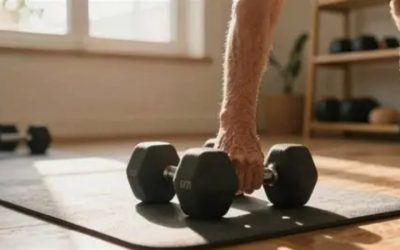
These are the plain, unglamorous workhorses of home leg training, and they earn their place. The neoprene shell gives you a tacky, forgiving grip that holds even when your hands are slick after a set of walking lunges, and the color coding means you can grab the right pair without squinting at stamped numbers. Because the ends are flattened rather than round, they sit still on the floor between sets and stay put on your hips during B-stance thrusts. The available weights run from very light singles up through the mid-teens and twenties depending on the pair you pick, which lines up almost perfectly with what split-stance and single-leg work actually demands — a 12- or 15-pound pair held at your sides turns a Bulgarian split squat into a genuinely hard set of eight. Where they hit their ceiling is bilateral loading: a pair of 20s is not going to overload a strong squat pattern, and you will need to shift toward 1.5-rep schemes, three-second lowers, and paused bottom positions to keep progressing. For step-ups, curtsy lunges, single-leg RDLs, high-rep calf raises, tibialis raises, and every rehab-flavored glute drill worth doing, they are close to ideal. They are also quiet, stackable, and easy to store, which for apartment training matters more than any spec sheet.
Frequently Asked Questions
Can I really build leg muscle with light dumbbells?
Yes, provided you take sets close to failure. Growth tracks effort and volume more than absolute load, and single-leg work halves the load requirement automatically. A set of 18 slow reverse lunges per leg with a 15-pound pair leaves most people breathing hard and sore two days later.
How heavy should my first pair be?
If you are new to loaded lower-body work, start with 8 to 12 pounds each. That is heavy enough to feel real in a lunge and light enough that your balance, not your strength, decides when the set ends — which is exactly what you want while you learn the positions.
Should I hold dumbbells at my sides or at my chest?
At your chest for squats and step-ups, since the front load helps you stay upright and keeps your heels down. At your sides for lunges, hinges, and calf raises, where hanging weight adds load without fighting your balance.
How do I keep progressing once the weight feels easy?
Change the variable that is not load. Add a three-second lowering phase, pause two seconds at the bottom, elevate your front or rear foot, shift from a reverse lunge to a deficit reverse lunge, or add reps until you hit 20 and then make the movement harder. All of these raise difficulty without a new purchase.
Final Thoughts
Pick your dumbbells around the patterns you are worst at, and a modest neoprene pair suddenly looks like the smartest buy in the room. Squats and hinges will eventually outgrow them, but split-stance, single-leg, and calf work never will — and those are precisely the movements most home programs skip. Start with the pair that lets you train all five patterns this week, get strong enough that the weight feels light everywhere, then add a heavier set for bilateral lifts once you have genuinely earned it.
Write Your Review
No reviews yet. Be the first to share your experience!