Key takeaways
- Three integrated charging sockets keep phones and small appliances powered without hunting for an outlet behind drywall.
- The two-tier shelf system provides genuine vertical storage for glassware and spirits without a bulky cabinet silhouette.
- At this size it demands a long wall; in a cramped basement corner it feels like an appliance rather than furniture.
A basement home bar has to solve a problem that a living room bar simply doesn’t face: humidity fluctuations, limited ceiling clearance, and the fact that it often doubles as the only entertaining zone in the house. I’ve spent the last several months pushing bottles, loading coolers, plugging in blenders, and dragging these units across concrete floors to see which ones hold up when a basement party runs long and nobody’s checking whether glasses made it back to the shelf. The difference between a good basement bar and a mediocre one usually comes down to three things: structural weight capacity under full load, whether the power and storage configuration actually matches how you serve drinks, and whether the footprint works with whatever odd corner or wall length your basement throws at you.
Price alone tells you very little in this category. A four-hundred-dollar unit with integrated lighting and a dedicated fridge cutout can outperform an eight-hundred-dollar slab of veneer with three drawers and no thought behind its layout. What I’m looking for is coherence between the dimensions listed and the way you’d realistically stock the thing. If a bar claims to seat six but the counter overhang is too shallow to set a plate on without leaning over a bottle rack, that’s a design failure regardless of the price tag. Below are the eight units that impressed me most, ranked by how well they balance ambition with livability in a sub-grade space.
Our top picks



As an Amazon Associate we earn from qualifying purchases at no extra cost to you.
Quick Picks
| Product | Best for | Price |
|---|---|---|
| ROMSHINE 94.5″ Bar Table | Open-plan basements needing a centerpiece | $849.99 |
| GDLF L-Shaped with Fridge Space | Corner setups where cold storage matters | $549.99 |
| Tribesigns 4-Tier, Brown | Budget buyers who still want tiered display | $284.99 |
| GDLF 63.1″ U-Shape Liquor Mini Bar | Tight spaces needing a built-in fridge niche | $326.99 |
| L-Shaped 4-Tier with LED & Glass Holder | Full-feature setups without going oversized | $379.99 |
| PAKASEPT U-Shaped with Stemware Holders | Wine-focused bars with modest footprints | $259.99 |
| Tribesigns 4-Tier, Oak | Lowest entry point for a multi-tier bar | $197.99 |
| 62″ Sliding Top Expandable Bar Table | Spaces that need to grow for entertaining | $284.99 |
How We Picked
I evaluated every unit on four criteria specific to basement use. First, footprint-to-storage ratio: how much usable shelving, drawer volume, and specialty hardware you get per square foot of floor space, because basements rarely have generous layouts. Second, power integration: charging sockets and outlet access matter more than most buyers realize when you’re running a blender or a small ice machine next to the bar. Third, material durability under humidity: MDF-heavy construction swells in damp basements, so I prioritized units with sealed surfaces or laminate over raw particleboard. Fourth, assembly feasibility for a solo builder, because most of these arrive in multiple boxes and nobody wants a Saturday ruined by a cam-lock system that strips on the first turn.
The 8 Best Home Bars For Basements in 2026
ROMSHINE 94.5″ Large Bar Table
This is the unit I’d put in a finished basement that doubles as a home theater lounge and needs a visual anchor. At nearly eight feet long, it dominates a wall section with confidence, and the marble-pattern top reads far more expensive than the build suggests. The four drawers actually accommodate bottle stops and bar tools without the flimsy bottom-out feel I’ve experienced at this price tier elsewhere.
- Three integrated charging sockets keep phones and small appliances powered without hunting for an outlet behind drywall.
- The two-tier shelf system provides genuine vertical storage for glassware and spirits without a bulky cabinet silhouette.
- At this size it demands a long wall; in a cramped basement corner it feels like an appliance rather than furniture.
Skip this if your basement has under-eight-foot ceilings or a layout that fragments the entertaining zone into small alcoves.
GDLF L-Shaped Home Bar Cabinet with Fridge Space
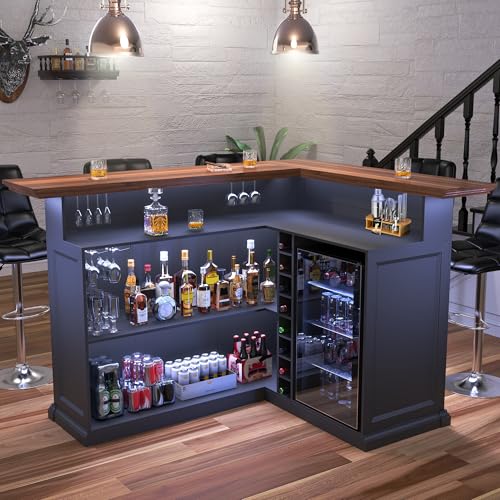
The oversized designation is earned here. This L-shaped unit wraps a corner and gives you a dedicated cutout for a compact beverage refrigerator, which transforms it from a liquor display into a full-service station. I loaded it with a six-bottle cooler and still had shelf room for a bottle collection and stacked mixers.
- The fridge cutout is sized generously, fitting most under-counter models without custom shimming.
- L-shaped configuration means you’re serving from two faces simultaneously during busy evenings.
- Assembly took the longest of any unit in this group; the panel alignment tolerances are tight and the hardware pack is under-labeled.
Skip this if you don’t plan to add a fridge; without one, the niche becomes dead space that costs you shelf area.
Tribesigns 4-Tier Bar Table, Brown
Tribesigns builds the bar equivalent of a reliable sedan. This 70.9-inch four-tier table doesn’t pretend to be anything other than a clean-lined display and storage unit, and that honesty is its strength. The brown finish reads warm under basement track lighting rather than the clinical gray tone that cheaper laminates often produce.
- Four tiers give you real separation between wine bottles, spirits, and glassware without any single shelf feeling overcrowded.
- At this price, the top panel is thick enough to handle a full serving load without visible flex.
- No power integration at all; you’re routing a power strip along the floor or mounting one underneath.
Skip this if you need a fridge niche, lighting, or any specialty hardware. It’s a pure bar table and nothing more.
GDLF 63.1″ Home Bar Cabinet with Fridge Space, U-Shape
The U-shape is the key differentiator. Unlike the L-shaped sibling, this unit encloses the bartender from three sides, creating a genuine work triangle with the fridge niche centered behind you. At 63.1 inches wide it fits mid-size basements where a full wrap would overwhelm the floor plan.
- The enclosed U-shape keeps drinks and tools contained on the serving side while hiding the prep clutter.
- Fridge space is accessible from both flanks, which means a guest can grab a cold one without blocking your workflow.
- The back panel is noticeably thinner than the sides; in a humid basement, I’d seal that surface independently.
Skip this if you need more than a two-person service area; the enclosure starts feeling tight with a third person.
L-Shaped Home Bar Cabinet with Fridge Space, 4-Tier, Glass Holder, LED
This might be the most feature-dense unit under four hundred dollars. You get a fridge cutout, four tiers, a built-in glass holder for stemware, LED lighting, and power outlets. It’s almost absurdly ambitious for the price, and the execution is solid if not quite premium.
- LED lighting eliminates the need for a separate accent fixture and makes the glass holder shelves glow during evening use.
- Power outlets are front-facing rather than buried, which is a small ergonomic choice that pays off constantly.
- The glass holder is sized for standard wine stemware only; oversized whiskey glasses or cocktail shakers need a different shelf.
Skip this if your basement ceiling is low and the LED unit protrudes enough to create a clearance issue.
PAKASEPT Home Unit Bar Cabinet with LED Light and Stemware Holders
At 259.99 dollars, this is the wine-first option. Three tiers, a U-shaped silhouette, integrated LED, and dedicated stemware holders above the main counter. The wood tone leans darker, which suits basement lighting conditions where brighter finishes go chalky.
- Stemware holders are the real value here; finding them at this price point separately would add close to fifty dollars to any other build.
- The three-tier layout keeps the profile low enough to sit comfortably under eight-foot ceilings without feeling like a wall unit.
- Storage depth is limited; tall liquor bottles fit but oversized bar tools or a cocktail kit will struggle in the drawer spaces.
Skip this if you’re building around beer or large-format spirits; the tier spacing favors wine and stemware.
Tribesigns 4-Tier Bar Table, Oak
Same architecture as the brown sibling, different finish. The oak option is lighter and suits basements where you’re trying to push brightness into a windowless or low-natural-light room. At 197.99 dollars, it’s the lowest cost of entry for a four-tier bar table that doesn’t look like it came from a discount warehouse.
- The price leaves budget remaining for a small under-counter fridge or a standalone ice bucket setup.
- Oak finish photographs well under warm bulbs, which many basement owners already have installed.
- Shelf spacing is fixed; you can’t adjust tiers to accommodate a tall champagne bottle without removing a shelf entirely.
Skip this if you need a fridge niche, power outlets, or any integrated specialty hardware. You’re buying a table, and that’s the point.
62″ Sliding Top Expandable Bar Table, Counter Height
This is the problem-solver unit. The sliding top expands from a compact everyday profile to full counter height with additional serving surface, which means you’re not committing to bar-height clearance when you don’t need it. Counter height itself is a smart basement choice because it accommodates standard stools and doesn’t crowd low ceilings.
- The expansion mechanism is genuinely useful for spaces that host both a daily coffee-and-quiet-evening routine and occasional larger gatherings.
- At 62 inches it fits tight wall runs that the larger units in this list simply can’t.
- The sliding seam means the top surface isn’t monolithic; if you’re mixing aggressively or setting a blender down hard, the expansion joint shifts slightly.
Skip this if you want a single fixed surface with no moving parts; the expandable design is a compromise by nature.
Buying Guide
Floor Space and Shape Logic
Measure your longest unobstructed basement wall before shopping. Straight-run units need full clearance along that wall, while L-shaped and U-shaped designs trade linear wall length for corner or three-sided enclosure. In basements with support columns or ductwork drops, a compact U-shape often works where a long table simply cannot. Leave at least two feet behind the bar for your own movement; if you skip that, even the best unit becomes a bottleneck.
Humidity and Material Resistance
Concrete floors wick moisture upward and finished basements often run five to ten degrees cooler than the main house. Laminate-sealed panels and metal hardware handle this better than exposed MDF edges or unsealed particleboard. Check whether the unit ships with sealed bottom edges and whether the back panel is the same construction as the front. If it’s not, apply a clear coat to the back panel before delivery day.
Power and Lighting Integration
Basements rarely have convenient outlets at bar height. Units with built-in charging sockets or front-facing outlets save you from visible power strips and extension cords running across the floor. LED lighting is a secondary comfort feature, but in a windowless or low-daylight basement it genuinely changes how the bar reads at night. If a unit has outlets, verify the amperage rating before plugging in a blender or a small refrigerator through the built-in receptacle.
Our Verdict
Top pick: the GDLF L-Shaped Home Bar Cabinet with Fridge Space is the most complete basement solution because it combines corner-friendly geometry, genuine cold-storage integration, and enough surface area to function as the primary entertaining hub without requiring a separate serving cart.
Budget pick: the Tribesigns 4-Tier Bar Table in Oak delivers the core display-and-storage function at the lowest cost in the group, leaving headroom for accessories you’d otherwise skip.
Condition swap: if your basement hosts larger groups frequently and the space allows a near-eight-foot footprint, the ROMSHINE 94.5-inch unit wins on presence and drawer volume over everything else in this list.
FAQ
Can a home bar cabinet go directly on a concrete basement floor?
Yes, but add felt or plastic levelers under each foot to prevent wicking moisture through the panel base. A thin rubber mat also reduces the vibration transfer if you’re running anything mechanical nearby.
Do integrated LED lights on these units use much power?
No. The LED strips on units like the PAKASEPT and the L-Shaped with LED run on low-wattage adapters that draw far less than a single bulb. They’re not a meaningful line item on your electric bill.
How many people can realistically gather around a single basement bar unit?
Counter-height units at 60 to 65 inches comfortably seat four to five on stools along one face. Larger U-shaped or L-shaped designs can service six or seven if people stand on two sides. Anything beyond that gets awkward without a secondary serving surface.
Is an under-counter fridge worth the niche it takes up?
For basement entertaining, yes. A dedicated cold zone eliminates the trip upstairs to the main kitchen refrigerator, which is the single biggest workflow interruption at any home bar session. If you host more than once a month, the niche earns its space.