Key takeaways
- Searchable PDF: the most useful format for receipts, contracts and records.
- Blank-page removal: prevents empty reverse sides from appearing in duplex batches.
- Automatic rotation and deskew: saves cleanup time when pages enter slightly crooked.
- Color dropout: can remove forms’ colored backgrounds, although it may also remove important highlights.
- Barcode or separator support: valuable for sorting larger batches into separate files.
The best document scanner for most home offices is a duplex sheet-fed model rated around 35–40 pages per minute, with a 50–100-sheet feeder, reliable blank-page removal, and bundled OCR; choose the Fujitsu ScanSnap iX1600 for the simplest everyday workflow, the Brother ADS-4700W for heavier batches, or the Epson WorkForce ES-580W when paper capacity and network scanning matter most.
Best document scanners reviews: the short list
| Scanner | Speed | Duplex and feeder | OCR and workflow | Approximate footprint | Typical market range |
|---|---|---|---|---|---|
| Fujitsu ScanSnap iX1600 | 40 ppm / 80 ipm | Automatic duplex; 50 sheets | Excellent one-button workflows and searchable PDF creation | 11.5 x 6.3 inches | Usually $350–$500 |
| Brother ADS-4700W | 40 ppm / 80 ipm | Automatic duplex; 80 sheets | Strong OCR workflow, touchscreen, Ethernet and Wi-Fi | 10.2 x 7.1 inches | Usually $400–$600 |
| Epson WorkForce ES-580W | 35 ppm / 70 ipm | Automatic duplex; 100 sheets | Searchable PDFs, text recognition and broad cloud workflow support | 11.6 x 6.6 inches | Usually $350–$500 |
| Canon imageFORMULA R40 | 40 ppm / 80 ipm | Automatic duplex; 60 sheets | Useful OCR and straightforward desktop scanning | 9.9 x 9.9 inches | Usually $300–$450 |
Pages per minute refers to single-sided pages. Duplex speed is usually expressed as images per minute because both sides count: a 40 ppm / 80 ipm scanner can process a 20-sheet, double-sided document in roughly 30 seconds under ideal conditions. Real batches take longer when pages are mixed, wrinkled, stapled, or full of photographs.

ScanSnap iX1300 Wireless or USB Double-Sided Color Document Scanner, Black
Included for 'Best Document Scanners: Reviews and Buying Advice' because the listing specifies Black, details this guide uses to compare options.
View on Amazon
Epson Workforce ES-400 II High-Speed Color Duplex Desktop Document Scanner
Included for 'Best Document Scanners: Reviews and Buying Advice' as a relevant option in this category; details come from the product listing.
View on Amazon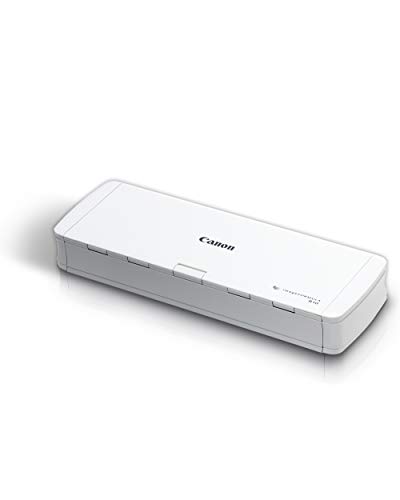
Canon imageFORMULA R10 - Portable Document Scanner, USB Powered, Duplex Scanning, Document Feeder, Easy Setup, Convenient, Perfect for Mobile Users, White
Included for 'Best Document Scanners: Reviews and Buying Advice' because the listing specifies Portable Document Scanner and USB Powered, details this guide uses to compare options.
View on Amazon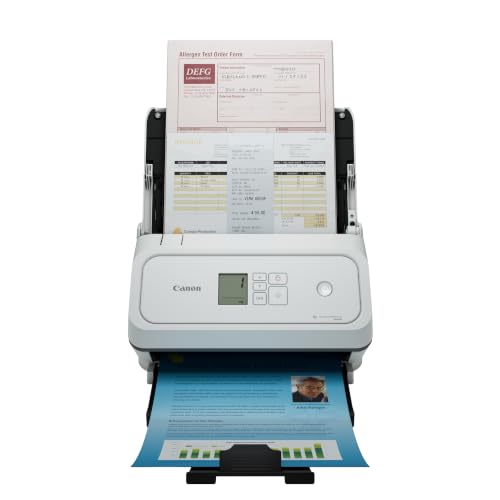
Canon imageFORMULA R40II Office Document Scanner - Duplex Scanning, Easy Setup, Scans a Wide Variety of Documents, Scans to Cloud
Included for 'Best Document Scanners: Reviews and Buying Advice' because the listing specifies Duplex Scanning and Easy Setup, details this guide uses to compare options.
View on AmazonWhich scanner fits your situation?
| Your situation | Best fit | Why | What to accept |
|---|---|---|---|
| Small apartment or shared desk | ScanSnap iX1600 | Compact vertical design and simple presets make it easy to put away after use | Its 50-sheet feeder is less suitable for large filing projects |
| Kids, receipts and mixed household paperwork | Brother ADS-4700W | Good feeder capacity, fast duplex scanning and a practical touchscreen | Costs more and needs a little more clearance for daily use |
| Monthly tax or insurance archive | Epson ES-580W | The 100-sheet feeder reduces reloads during long batches | Its rated speed is slightly lower than the 40 ppm models |
| Occasional home-office scanning | Canon imageFORMULA R40 | Fast duplex scanning without paying for a business-oriented feature set | Its nearly square footprint can be awkward on a shallow desk |
| Multiple computers or a home network | Brother ADS-4700W or Epson ES-580W | Network features make it less dependent on one permanently connected computer | Network setup takes longer than USB setup |
Head-to-head: what matters beyond the speed rating
Fujitsu ScanSnap iX1600: best for low-friction home filing
The iX1600 is a strong choice when the main goal is turning household paperwork into searchable files without learning complicated scanning software. Its automatic duplex feeder handles ordinary letter-size documents quickly, and its color touchscreen supports repeatable destinations and scan profiles. That is useful when one family member wants PDFs saved to a computer while another sends scans to a shared folder.
The trade-off is capacity. A 50-sheet feeder is adequate for bills, school forms and short contracts, but a 150-page double-sided archive requires several reloads. The unit is also taller when its input and output trays are open, so do not judge the space required from the closed dimensions alone.
Brother ADS-4700W: best for faster household batches
The ADS-4700W is the better pick when several people will use the scanner or when documents accumulate in sizeable weekly batches. Its 80-sheet feeder is more forgiving, and its 40 ppm / 80 ipm rating puts it in the same speed class as the Fujitsu and Canon. Wi-Fi, Ethernet and USB connections provide more placement flexibility than a USB-only setup.
Its strengths are practical rather than decorative: a touchscreen, separation controls and support for common office workflows. The feeder still prefers reasonably flat paper. Receipts, curled pages and documents with adhesive labels should be straightened and fed carefully to reduce misfeeds.
Epson WorkForce ES-580W: best for capacity
The ES-580W gives up a little rated speed for a 100-sheet automatic document feeder. That difference matters less than capacity when you are scanning a stack of tax records, medical paperwork or old correspondence. It also supports searchable PDF workflows and network-oriented use, making it suitable for a home office shared by several devices.
Large feeders do not eliminate preparation. A stack should be squared, checked for staples, and divided if pages vary greatly in thickness. Overfilling the feeder can cause skewing even when the stated capacity is not exceeded.
Canon imageFORMULA R40: best value-oriented desktop option
The imageFORMULA R40 offers the speed many home users actually need: 40 pages per minute with automatic two-sided scanning. Its 60-sheet feeder is enough for routine documents, and Canon’s software supports text recognition and searchable files.
Measure the desk carefully before buying. The scanner’s footprint is close to square, unlike the longer, narrower profile of some competing models. It may fit better on a deep desk than on a narrow console, even though its total surface area is not dramatically larger.
OCR: the feature that makes a scan useful later
Optical character recognition converts an image of text into selectable, searchable text. For household records, OCR is often more important than a small difference in scan speed. It lets you search a folder for a policy number, invoice total or doctor’s office instead of opening files one by one.
- Searchable PDF: the most useful format for receipts, contracts and records.
- Blank-page removal: prevents empty reverse sides from appearing in duplex batches.
- Automatic rotation and deskew: saves cleanup time when pages enter slightly crooked.
- Color dropout: can remove forms’ colored backgrounds, although it may also remove important highlights.
- Barcode or separator support: valuable for sorting larger batches into separate files.
OCR accuracy depends on the source. Clean black text at 300 dpi usually performs well; faint thermal receipts, handwriting, stamps and low-contrast carbon copies remain difficult for every scanner. Scan important records in color first, then create smaller monochrome copies only if storage is a concern.
Desk footprint, clearance and placement
A scanner that measures roughly 10–12 inches wide and 6–10 inches deep still needs operating space. Leave about 3 inches behind it for cables and ventilation, 8–12 inches in front for the output tray, and enough height above the feeder to lift its cover. On a 24-inch-deep desk, a narrow scanner can usually remain connected with room for a keyboard; a square model may force the monitor farther back.
Do not store a sheet-fed scanner directly beside a busy printer if paper dust is heavy. Keep it level, away from radiators and direct sunlight, and close the feeder when it is not in use. If it must be put away after every session, favor the lighter, simpler model you will actually reconnect. A scanner that remains accessible often saves more time than one with a larger theoretical capacity.
Buying advice: a practical checklist
- Choose automatic duplex scanning; manually flipping pages is slow and error-prone.
- For occasional documents, 25–40 ppm is sufficient. For archives, prioritize an 80–100-sheet feeder.
- Confirm that the included software creates searchable PDFs rather than only image files.
- Check whether you need Wi-Fi or Ethernet. USB is simpler, but network scanning is convenient for shared rooms.
- Measure the open tray position, not just the closed chassis.
- Look for replaceable rollers and separation pads; these wear before the scanner electronics.
- Use a flatbed or carrier sheet for photographs, passports and fragile originals. A document feeder is not a universal replacement for a flatbed scanner.
How to scan a household archive without creating a mess
- Sort documents by type and remove staples, clips and sticky notes.
- Choose a naming pattern such as 2026-04-18_Insurance-Policy.pdf.
- Scan a five-page test batch and check that both sides, page order and OCR are correct.
- Feed the main batch in manageable groups, even when the tray can hold more.
- Open several files afterward to verify legibility before recycling the originals.
- Keep a second copy of important files on a separate drive or trusted backup service.
For most homes, the deciding question is not whether a scanner can reach its advertised speed. It is whether its duplex feeder, OCR workflow and physical size match the amount of paper you handle. Choose the ScanSnap iX1600 for simplicity, the Brother ADS-4700W for shared high-volume use, the Epson ES-580W for maximum feeder capacity, or the Canon imageFORMULA R40 for fast everyday scanning in a compatible desk layout.