Key takeaways
- Apartment sofa: 68 to 72 inches wide. Seats two to three people with tighter proportions than a standard 80 to 90-inch sofa. The best all-around option for studios and small living rooms.
- Loveseat: 52 to 67 inches wide. Seats two people shoulder-to-shoulder. Ideal when you need to pair it with a chair or keep a wall open for a desk or dining table.
- Compact settee: 45 to 58 inches wide. More upright, often with a single cushion and firmer sit. Works for entryways, bedroom corners, or as secondary seating.
- Loveseat sleeper or small sleeper sofa: Usually 70 to 72 inches wide. Adds a twin or full pull-out but needs 48 to 54 inches of clearance in front to unfold.
What's inside
Small couches for small spaces are apartment sofas and loveseats between 52 and 72 inches wide with a shallow seat depth of 20 to 22 inches, low or narrow arms, and raised legs that save floor space while seating two people comfortably.
If your room is under 150 square feet, staying under that 72-inch width is what keeps walkways clear and prevents the sofa from dominating the layout. The right choice comes down to three visual tricks — arm style, seat depth, and leg height — plus a few hard measurements most listings skip.
What Counts as a “Small Couch”?
Retailers use different names for the same footprint. Understanding the categories helps you filter correctly:
- Apartment sofa: 68 to 72 inches wide. Seats two to three people with tighter proportions than a standard 80 to 90-inch sofa. The best all-around option for studios and small living rooms.
- Loveseat: 52 to 67 inches wide. Seats two people shoulder-to-shoulder. Ideal when you need to pair it with a chair or keep a wall open for a desk or dining table.
- Compact settee: 45 to 58 inches wide. More upright, often with a single cushion and firmer sit. Works for entryways, bedroom corners, or as secondary seating.
- Loveseat sleeper or small sleeper sofa: Usually 70 to 72 inches wide. Adds a twin or full pull-out but needs 48 to 54 inches of clearance in front to unfold.
For seating comfort, look for an interior seat width (between the arms) of at least 42 inches for a loveseat and 60 inches for an apartment sofa. Anything less feels cramped for two adults.
Measure Before You Buy: The 4 Numbers That Matter
A sofa that fits through the door still might not fit the room. Check these before ordering:
| Room Size | Max Sofa Width That Feels Balanced | Walkway Clearance to Leave | Coffee Table Gap |
|---|---|---|---|
| 10 x 10 ft (100 sq ft) studio zone | 52 – 62 inches | 30 – 36 inches for main path | 14 – 18 inches from sofa front |
| 10 x 12 ft (120 sq ft) small living room | 62 – 68 inches | 30 inches minimum | 16 – 18 inches |
| 12 x 12 ft (144 sq ft) apartment living room | 68 – 72 inches | 36 inches if path is behind sofa | 16 – 18 inches |
| 11 x 14 ft narrow / railroad layout | 60 – 68 inches, low arms preferred | 30 inches on one long side | 14 – 16 inches, consider a 30-inch round table |
Other critical fits:
- Doorway and hallway width: Most apartment doorways are 29 to 32 inches wide and hallways are 36 inches. Measure the narrowest point including handrails. A 72-inch sofa with fixed legs often needs a diagonal depth under 29 inches to pivot through a 30-inch door. If not, look for removable legs or a modular design that ships in two boxes.
- Seat height: Standard is 17 to 19 inches. Match it to your coffee table height — a table should be within 1 to 2 inches of seat height for comfortable reach. If you use the sofa at a dining or work table, 18 to 19 inches works better with low-profile tables.
- Seat depth: 20 to 22 inches is the small-space sweet spot. Deeper than 23 inches pushes short users’ feet off the floor and eats 4 to 6 extra inches of room depth. Shallower than 20 inches feels upright and less loungy.
- Weight limit and frame load: Most compact sofas are rated for 500 to 650 lbs total distributed weight, with per-seat limits around 250 to 300 lbs. Kiln-dried hardwood frames carry more over time than engineered wood at the same rating.
How Arm Style, Depth, and Leg Height Make a Room Look Bigger
1. Arm Style
Arms account for 6 to 12 inches of total width. That is wasted space in a small room if you choose the wrong profile:
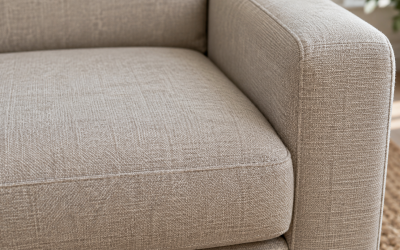
- Narrow square / track arms (3 to 5 inches wide): Maximize interior seating and create clean lines. Best for modern small rooms where every inch counts.
- Angled or flared arms: Visually lighter than a full roll but add 2 to 3 inches of width. Good if you want more lounging comfort without the bulk of a traditional roll arm.
- Armless or single-arm: Saves 4 to 8 inches total. Useful for floating in the middle of a studio but less comfortable for napping.
- Rolled arms: Add 8 to 12 inches total width and height. They look cozy but make a sub-72-inch sofa seat one person less comfortably.
2. Seat Depth and Back Height
A shallow 21-inch depth plus a lower back (28 to 32 inches tall) reveals more wall, which makes ceilings feel higher. A high 34 to 36-inch back with a deep 23-inch seat blocks sightlines and can make a 10×12 ft room feel boxy. If you like to curl up, choose a 21-inch depth with loose back pillows you can remove rather than a permanently deep frame.
3. Leg Height and Visibility
Legs that lift the frame 5 to 7 inches off the floor let you see continuous flooring underneath, which tricks the eye into reading more square footage. Avoid a skirted or block base that sits directly on the floor — it reads as a solid mass. Dark legs on a light floor and vice versa also define the footprint without adding visual weight. For rugs, ensure front legs sit on the rug with at least 6 inches of rug visible in front of the sofa to anchor the zone.
Which Small Couch Fits Your Situation?
Use this matrix to narrow quickly instead of scrolling endless listings:
| Your Situation | Best Width and Type | Priority Features | What to Avoid |
|---|---|---|---|
| Studio where sofa faces the bed | 62 – 68 inch apartment sofa | Legs 5+ inches, narrow track arms, tight back (no loose pillows that migrate) | Deep 24-inch seats, sleepers that need 54 inches of floor to open |
| Small living room for 2 + guests | 68 – 72 inch apartment sofa + compact armchair | Interior width 60+ inches, removable cushions for cleaning | Matching loveseat set that blocks the entry path |
| Renter who moves often | Modular or tool-free assembly loveseat, 58 – 68 inches | Ships in boxes under 70 lbs each, doorway depth under 30 inches, replaceable covers | One-piece 150+ lb frames with non-removable legs |
| Kids and pets | 60 – 72 inches, tight-weave fabric | Performance woven fabric, double-stitched seams, sinuous spring + high-density foam | Linen, velvet, or loose fiber-filled cushions that sag quickly |
| Back pain or long sitting | 66 – 72 inches with 21-22 inch depth | Firm foam 1.8+ density, seat height 18-19 inches, medium-firm lumbar support | Soft sink-in foam below 1.5 density, very low 15-inch seats |
| Need a guest bed | 72-inch twin sleeper or daybed-style loveseat | Fold-flat mechanism, 4+ inch mattress, wall clearance 48 inches | Pull-outs wider than your wall can accommodate when open |
Frame, Fabric, and Cushion Trade-Offs
Compact sofas cut size, not necessarily quality. Here is how construction choices play out in small spaces where the sofa gets daily use:
| Material / Construction | Pros | Cons | Price Range (General Market) |
|---|---|---|---|
| Solid kiln-dried hardwood frame | Strongest joints, resists wobble, lasts 7-12 years, supports higher weight limits | Heavier (90-140 lbs total), usually $700–$1,400 for small size | usually $700–$1,400 |
| Plywood / engineered wood frame | Lighter (65-95 lbs), lower cost, adequate for light daily use | Can loosen at joints in 2-4 years under heavy use; keep away from humidity | usually $300–$700 |
| Metal frame | Very durable, slim profile, easy to move | Firmer sit, colder feel, less traditional look | usually $400–$800 |
| Performance woven fabric (polyester blend) | Resists pilling, pet claws, and stains; tight weave hides wear | Less breathable than natural fibers, can feel slick | usually $450–$900 |
| Linen or cotton blend | Breathable, soft, casual look | Wrinkles, absorbs stains, shows wear faster on seat edges | usually $400–$800 |
| High-density foam (1.8-2.2 lb/cu ft) | Holds shape, better support for daily sitting | Firmer at first, needs breaking in | included in above ranges |
| Low-density foam (1.4-1.5 lb/cu ft) with fiber wrap | Plush initial feel, lower cost | Sags and needs fluffing within 12-18 months | usually $300–$600 |
For most small apartments, a plywood or hardwood frame with sinuous springs and 1.8 density foam offers the best balance of weight, durability, and cost. If you expect to move within two years, prioritize a lighter modular frame and washable covers over a heavy solid-wood investment piece.
Assembly, Moving, and What Wears First
Listings rarely mention logistics that matter in tight buildings:
- Box size and weight: A one-piece apartment sofa typically ships at 85 to 140 lbs and requires a freight delivery window. A modular loveseat ships in two to three boxes of 45 to 70 lbs each that fit in a standard elevator and through a 29-inch doorway without tilting.
- Assembly time: Tool-free modular assembly takes 15 to 30 minutes with no tools. Traditional assembly with bolts and legs takes 30 to 60 minutes and often needs two people to align the back.
- What wears first: In compact sofas, the seat cushion foam softens first, then the fabric on the inside arm where people slide in, then the suspension springs. Look for reversible seat cushions and arm covers you can rotate to double the lifespan.
- Clearance for recliners or sleepers: A small reclining loveseat needs 6 to 10 inches behind it to recline. A twin sleeper needs 48 inches in front plus walking room. If you cannot provide that, choose a stationary loveseat with an ottoman that doubles as a chaise.
- Renters’ tip: Measure elevator interior (often 36 x 78 inches) and stairwell turn. If either is tight, a sofa-in-a-box design with a back that assembles inside the room is worth the slight premium.
Small-Space Layout Tips That Cost Nothing
- Pull the sofa 2 to 3 inches off the wall. That shadow line makes the wall feel longer and improves airflow for fabric longevity.
- Center a 55 to 60-inch sofa on a 90-inch wall, leaving 15 to 18 inches on each side for a floor lamp or plant instead of pushing a 72-inch sofa wall-to-wall.
- Use a round coffee table 30 to 32 inches in diameter instead of a 48-inch rectangle. You keep the 16-inch reach distance but free up corner walkways.
- Mount curtains 4 to 6 inches above the window frame and keep sofa back below window sill height to preserve natural light.
FAQ
Is a 72-inch couch big enough for two people to stretch out?
For sitting upright, yes — a 72-inch width with narrow arms gives about 60 to 63 inches of interior seating, enough for two adults. For both to lie down, no. At least one person will need to angle or use an ottoman. If napping is frequent, consider a 68 to 72-inch sofa with a reversible chaise ottoman instead of a deeper sofa that eats floor space.
What is the best seat depth for a small living room?
20 to 22 inches. It supports most adults 5’2″ to 6’0″ without needing a throw pillow behind the back, while saving 3 to 5 inches of floor depth compared to a standard 23 to 25-inch sofa.
Do loveseats look cheap in a living room?
Not if proportions are right. A 60-inch loveseat with 5-inch legs, track arms, and a 32-inch back height reads intentional and tailored. Add a single armchair and a 30-inch round table to fill the room without crowding it.