Key takeaways
- Keep a useful reserve of empty moving boxes by purpose, flat dimensions and available storage, with a clear route for passing on unwanted extras.
What's inside
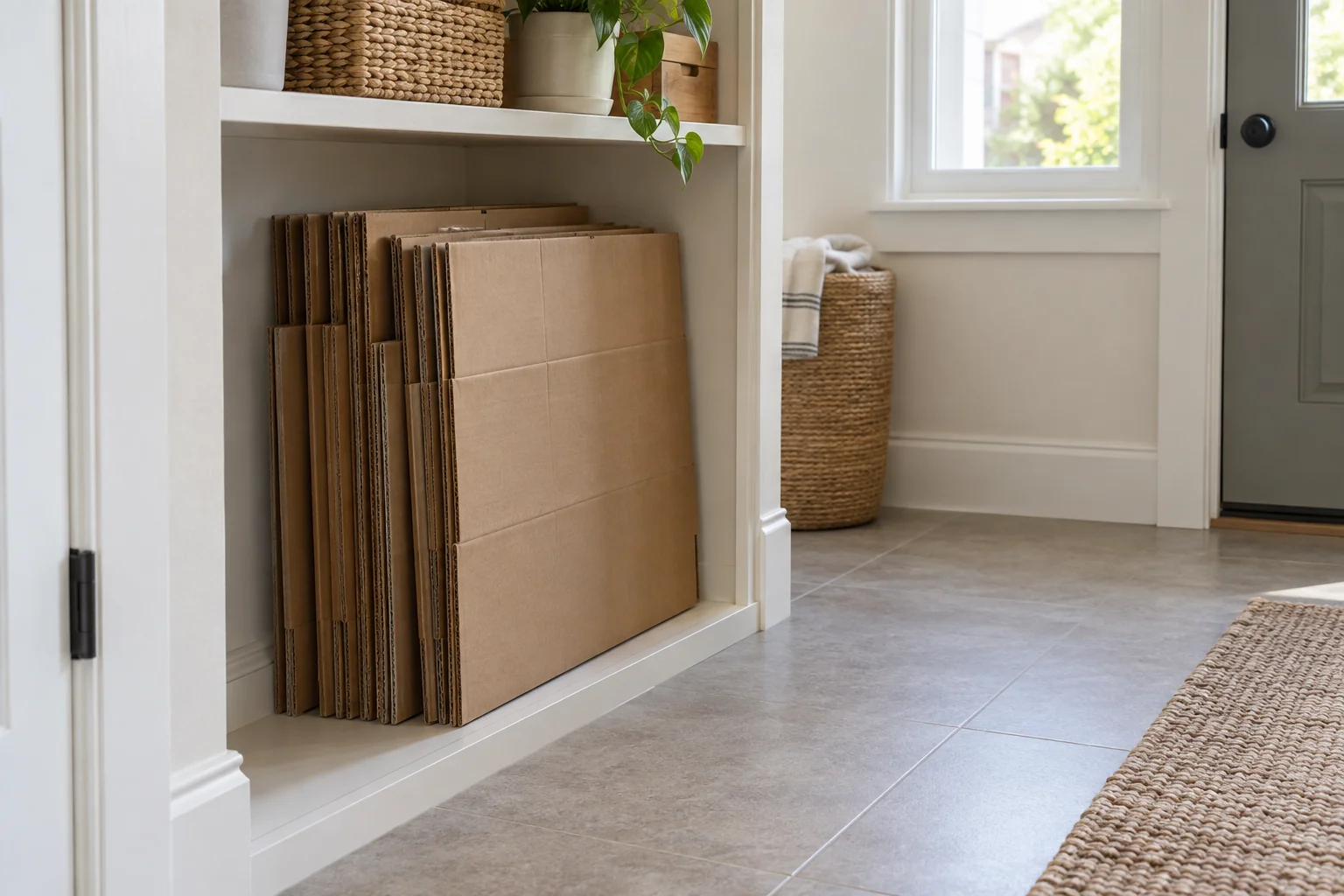
Store empty moving boxes by deciding which ones have a realistic next use, flattening suitable cartons and assigning the remaining bundle a limited storage space. Keeping every box from a move can quietly consume the cupboard you need for daily life. The aim is a small, usable reserve, not a permanent cardboard archive.
Separate ordinary corrugated cartons from shaped packaging that serves a specific product. A television’s fitted inserts and a general moving box do not present the same keep-or-release decision. Check any relevant return or transport instructions before discarding product-specific packaging.
Give each box a reason to stay
Sort boxes into three groups: needed for a known move or shipment, required for a particular item, and kept only because they might be useful. Write the expected use beside the first two groups. The third group is where a small apartment usually needs a firm capacity limit.
Inspect the boxes before reserving storage. Set aside cartons that are damp, contaminated, badly crushed or torn rather than planning to rely on them later. Do not interpret a clean-looking exterior as proof that a used box retains its original load rating. Reuse suitability depends on condition and the next task.
Keep labels containing personal information out of shared view. Remove or obscure them as appropriate before giving boxes away. Check local recycling instructions for boxes you cannot reuse, especially where coatings, food residue or attached materials affect acceptance.
Flatten suitable cartons without destroying useful parts
Ordinary taped cartons can often be opened along their taped seams and folded flat using their existing creases. Follow the particular box’s construction; do not tear a reusable glued joint simply to make the carton lie flatter. Use any cutting tool according to its instructions and keep the work on a stable surface.
Keep matched pieces together when a box uses a separate lid, sleeve or fitted insert. If flattening would damage packaging needed for a product, retain it in its intended shape or reconsider where it can reasonably be stored. An unusable flat carton is not a successful space saving.
Measure the bundle in its stored form
A box labeled with assembled length, width and height will have a different outline when flattened. Measure the actual flat shape and the thickness of the proposed bundle. Check the cupboard opening as well as the space inside; a large flat panel may fit inside but be awkward to turn through the opening.
| Group | Next use | Storage decision |
|---|---|---|
| Known upcoming move | Specific date or planning window | Keep useful sizes within the assigned space |
| Product-specific packaging | Identified item and transport need | Keep matching parts together without damaging them |
| General spare cartons | No definite task yet | Retain only the agreed small reserve |
| Damaged or unsuitable boxes | No reliable reuse plan | Check an appropriate local disposal route |
Choose a dry, accessible location where the bundle cannot topple into a passage. Do not create storage against heaters, across required access or in a shared corridor. Follow the building’s storage rules and any relevant appliance clearance instructions. The fact that a gap exists does not make it an acceptable cardboard storage area.
A fictional capacity decision
Imagine a household with twelve spare cartons but only one low cupboard compartment available. The flattened bundle fits six cartons comfortably while leaving the cupboard door operable. Four of those six suit a planned shipment; two are retained as general spares. The other usable boxes are offered for reuse instead of being pushed behind furniture.
This example deliberately starts from available storage rather than a universal number of boxes. Another household may need none, while someone with a confirmed move may temporarily reserve more. The important part is naming the reason and the space together.
Pass on usable extras
U-Haul describes its box reuse stations and Exchange service as ways for movers to share used moving supplies. Those are examples of alternatives to indefinite home storage. Check the relevant location or service before making a trip, and offer an honest description of condition and quantity.
If another person agrees to collect the boxes, set a collection window and a fallback. Do not turn an unanswered offer into weeks of boxes waiting by the door. Keep the exchange within a location and arrangement acceptable to the household and building.
Review the reserve when its purpose changes
After the planned shipment, move or return period, reassess the boxes linked to that event. Remove the old purpose rather than silently converting every carton into a permanent spare. A review tied to an actual event is easier to remember than a vague intention to declutter someday.
Before using any stored carton, inspect it again and confirm it suits the new contents and shipping or moving requirements. Keeping it neatly does not certify its strength. Your finished system should make the useful boxes easy to retrieve and make the decision to release the rest equally clear.