
Key takeaways
- Maximum Weight Recommendation: 600 Pounds
- Warranty Type: Push up board
- Assembly Instructions Description: No assembly required
The mistake that wastes the most money in home fitness is buying in the wrong order. People start with the biggest, most exciting item — a bike, a bench — and then discover that the thing actually limiting their training was never equipment at all, it was a place to put a mat down. Meanwhile a fifteen-dollar set of ankle bands sits unopened because it did not feel like a real purchase. Six months later the bench holds laundry.
A better approach is to sequence the buys against how quickly each one gets used up. Bands and boards give you dozens of exercises immediately and cost almost nothing per movement, but they cap out fast on lower-body strength. Adjustable dumbbells cost more but replace an entire rack and stay relevant for years. Cardio equipment is the largest single line item and the one most likely to go idle. This guide sorts the options by that sequence — what to buy first, what earns its place second, and what to hold off on until the habit is real.
Our top picks
 MQRW Push Up Board
- Maximum Weight Recommendation: 600 Pounds
- Warranty Type: Push up board
- Assembly Instructions Description: No assembly required
 Pilates Bar Kit with Resistance Bands
- Recommended Uses For Product: At Home Pilates Workout
- Tension Supported: Heavy
- Number of Resistance Levels: 2
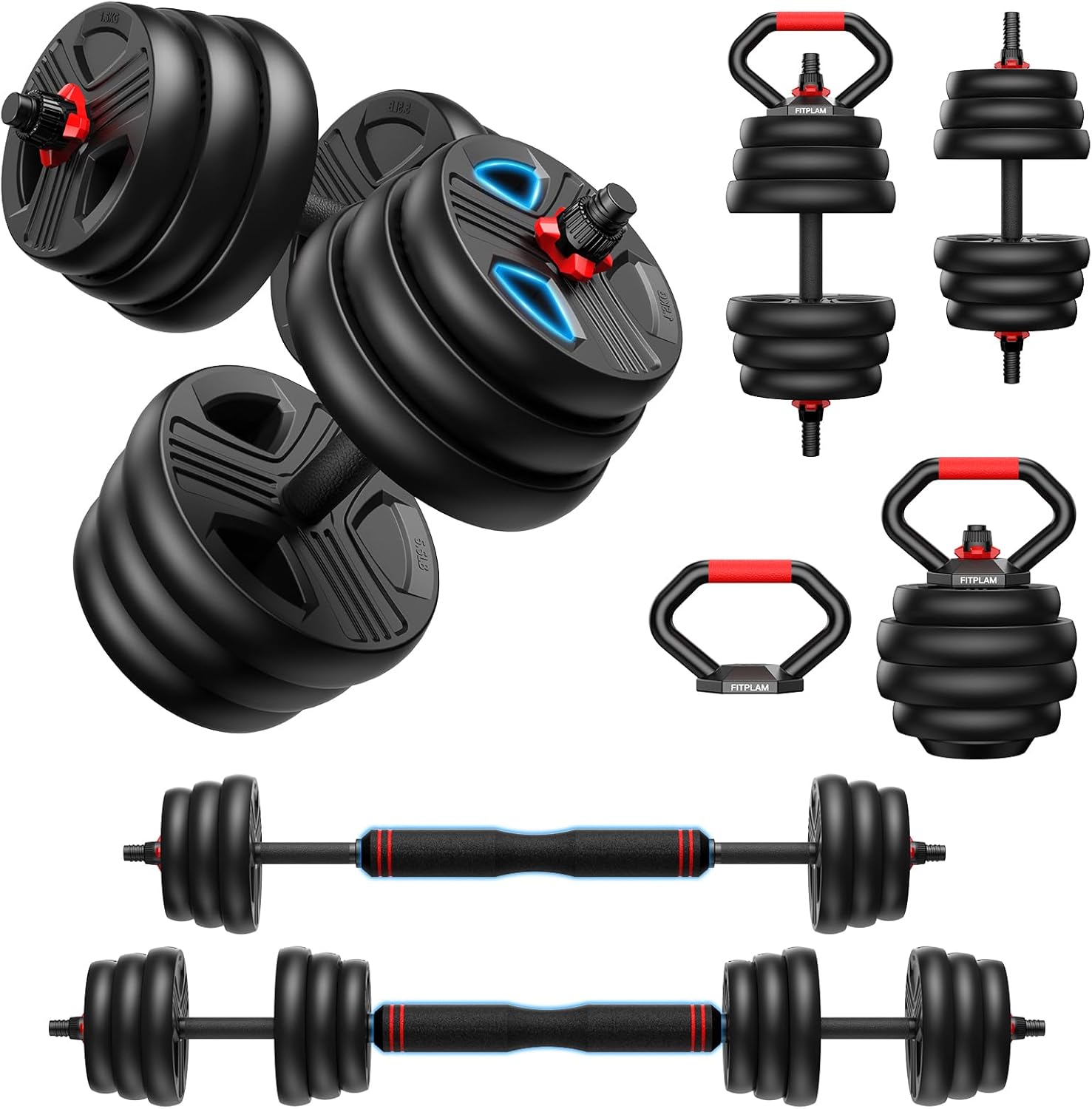 FITPLAM Adjustable dumbbell set
- Easily converts into dumbbells, kettlebells, barbells, weight plates,…
- Featuring a unique red-and-black double-lock system, the red…
- Customize your training intensity with adjustable weights options
| Product | Key specs | Amazon rating | |
|---|---|---|---|
| MQRW Push Up Board | Maximum Weight Recommendation: 600 Pounds Warranty Type: Push up board Assembly Instructions Description: No assembly required | 4.5★ | Check price |
| Pilates Bar Kit with Resistance Bands | Recommended Uses For Product: At Home Pilates Workout Tension Supported: Heavy Number of Resistance Levels: 2 | 4.6★ | Check price |
| FITPLAM Adjustable dumbbell set | Easily converts into dumbbells, kettlebells, barbells, weight plates,… Featuring a unique red-and-black double-lock system, the red… Customize your training intensity with adjustable weights options | 4.3★ | Check price |
 Ankle Resistance Bands with Cuffs Ankle Resistance Bands with Cuffs | – | Check price | |
 CURSOR FITNESS Exercise Bike CURSOR FITNESS Exercise Bike | – | Check price | |
 NICEPEOPLE Adjustable Weight Bench for Home Gym NICEPEOPLE Adjustable Weight Bench for Home Gym | Item Dimensions D x W x H: 46"D x 16.7"W x 17.2"H Material: Superior Alloy Steel | 4.5★ | Check price |
 Pedal Resistance Band with Handle Pedal Resistance Band with Handle | – | Check price | |
 XT Trainer XT Trainer | – | Check price |
As an Amazon Associate we earn from qualifying purchases at no extra cost to you. Ratings are shown as listed on Amazon.
Quick Comparison
| Product | Best For | Standout Feature | Watch Out For |
|---|---|---|---|
| MQRW Push Up Board with Pilates Bar Kit | The first purchase | Bundles a board, bar and bands in one buy | Accessory count inflates the perceived value |
| Pilates Bar Kit with Resistance Bands | Controlled full-body work | Bar gives bands a fixed path and better form | Band tension is the ceiling on progress |
| Ankle Resistance Bands with Cuffs | Cheapest useful glute work | Targets hips directly for very little money | Cuffs slide unless tightened properly |
| FITPLAM Adjustable Dumbbell Set | The second, bigger purchase | Steps from 20 lb up to 90 lb in one item | Plate changes interrupt fast circuits |
| NICEPEOPLE Adjustable Weight Bench | Unlocking pressing movements | 660 lb capacity with eight backrest angles | Pointless until you own real weight |
| CURSOR FITNESS Exercise Bike | Cardio in a shared building | Low-noise drive with a brake pad system | Largest footprint and highest idle risk |
How to Choose
- Exercises per dollar: Rank candidates by how many distinct movements they unlock. Bands and boards win overwhelmingly at the start.
- Time to plateau: Ask how long before you outgrow it. Band-based tools plateau in months on lower body; adjustable dumbbells take years.
- Dependency order: A bench does nothing without weights. Never buy the accessory before the thing it accessorises.
- Footprint per session: Divide the floor space by how often you will use it. A bike used twice a week is expensive real estate.
- Failure mode: Consider what happens if you stop training for a month. Small items go in a box; large items become furniture you resent.
Top Picks Reviewed
Buy First: MQRW Push Up Board with Pilates Bar Kit
Bundling a colour-coded push-up board with a pilates bar and a set of resistance accessories gives you an entire beginner programme for the price of a couple of takeaways. The board’s angled hand positions genuinely change which muscles do the work, and the bands cover rows, presses and leg work that bodyweight alone cannot.
Be sceptical of the accessory count. Bundles advertised with twenty pieces usually reach that number by counting each band, clip and strap separately, and the useful core is a handful of items. Judge it on the board and the bands, not the tally.
Best Cheap Lower-Body Tool: Ankle Resistance Bands with Cuffs
For hip and glute training specifically, cuffed ankle bands deliver more per dollar than anything else in a home setup. Kickbacks, lateral walks and standing abduction all become loaded exercises for a trivial cost and essentially no storage requirement.
The cuffs are the weak point. If they are not snug they migrate down toward the foot mid-set, which changes the resistance angle and quietly makes the exercise easier. Tighten them more than feels necessary at the start.
Buy Second: FITPLAM Adjustable Dumbbell Set
This is where a home gym stops being a starter kit. With configurations at 20, 35, 45, 55, 70 and 90 lb, a single adjustable set replaces most of a dumbbell rack and covers years of progression across presses, rows, squats and carries. Measured over that lifespan it is the best value item here.
Plate-and-collar designs are slower to change than selectorised ones, so circuit training with frequent weight changes becomes tedious. Programme it in straight sets rather than fast rotations and the drawback mostly disappears.
Buy Third: NICEPEOPLE Adjustable Weight Bench
Eight backrest positions and a 660 lb rated capacity turn a floor-based routine into a proper strength setup — incline presses, supported rows, step-ups and Bulgarian split squats all become available. It is the item that multiplies the value of weights you already own.
Which is exactly why it should not come first. A bench with no dumbbells is a chair. Buy it once you have enough load that floor-based pressing has become the limiting factor, not before.
Buy Last: CURSOR FITNESS Exercise Bike
A quiet indoor bike with a brake pad resistance system solves a real problem for anyone in an apartment or a shared house, where running is impractical and impact noise is a live issue. Cycling indoors is low-impact, easy to do while distracted, and genuinely repeatable.
It is also the biggest commitment on this list in both money and floor space, and cardio equipment has the highest abandonment rate in home fitness. Buy it once you have proven you will do the cardio — not as a way of persuading yourself that you will.
Frequently Asked Questions
What is the minimum useful home setup?
A mat, a set of resistance bands, and something for hip work. That combination covers a full-body routine and costs less than a month of most gym memberships.
Are adjustable dumbbells worth it over a fixed pair?
Yes, if you intend to get stronger. A fixed pair is one weight forever; an adjustable set spanning 20 to 90 lb covers nearly every dumbbell exercise you would program at home.
Do I need a bench, or can I use the floor?
The floor covers pressing to a limited range and most rowing variations. A bench adds incline work, full range on presses, and a stable platform for split squats — useful, but only once you have weight to put on it.
How do I keep noise down for neighbours?
Put everything on a dense mat, choose belt or pad resistance over anything with impact, and keep dumbbells off the floor with a controlled set-down. Most complaints come from dropped weights rather than from exercise itself.
Final Thoughts
Spend in the order that matches how fast each item pays back. Start with the push-up board bundle and cuffed ankle bands, because they unlock the most movements for the least money and storage. Add the FITPLAM adjustable dumbbells when bands stop being challenging, then the bench once the weights justify it, and only reach for the exercise bike after you have shown yourself the cardio habit is real.

Write Your Review
No reviews yet. Be the first to share your experience!