Key takeaways
- 14,000 BTU output makes it viable for rooms well above the small-bedroom range.
- Three-in-one design reduces the need for separate dehumidifier or fan purchases.
- Portable units inherently lose efficiency through single-hose heat recirculation, raising operating costs compared to window-mounted alternatives of similar capacity.
Choosing an air conditioner on a tight budget is one of the most common homeowner dilemmas that leads to expensive mistakes. A unit that is too weak for the room runs continuously and defeats the purpose of saving money, while a unit that is oversized wastes cash upfront and short-cycles without properly dehumidifying. The eight models gathered here represent the range of options a buyer encounters when searching for the best economical air conditioners in 2026, from a $12.88 desk gadget to a $449.99 window unit with integrated heating.
What separates a genuinely economical pick from a cheap disappointment comes down to three things: whether the BTU rating actually matches the square footage the manufacturer claims, how much control the buyer has over fan speed and timer settings, and whether real owners report reliable operation beyond the first season. A unit at $171 with solid owner feedback beats a unit at $59.99 that evaporates its water tank in two hours and provides no real cooling. This roundup weighs published specifications against aggregate owner sentiment to help you avoid that trap.
Our top picks


As an Amazon Associate we earn from qualifying purchases at no extra cost to you. Ratings are shown as listed on Amazon.
Quick Picks
| Product | Best for | Price |
|---|---|---|
| Garvee 14,000 BTU 3-in-1 Portable | Large rooms without window access | $308.80 |
| Frigidaire 5,000 BTU Window | Small bedrooms on a strict budget | $171.00 |
| Garvee 14,000 BTU 4-in-1 Portable | Open-plan living areas or home offices | $239.99 |
| GE 6,000 BTU Window | Medium rooms where energy savings matter | $190.91 |
| Midea 12,000 BTU Window with Heat | Year-round comfort in one unit | $449.99 |
| Midea 5,000 BTU Window | The lowest true-cooling window option | $157.99 |
| 2026 New 4-in-1 Portable Mini AC | Personal desk cooling with low noise | $59.99 |
| BSUIAK 4-in-1 Mini AC Unit | Impulse purchase for a single workstation | $12.88 |
How We Picked
We narrowed this category using four criteria that consistently determine whether a budget air conditioner delivers value or becomes a garage ornament. First, BTU-to-square-footage alignment: a unit must plausibly cool the area its listing claims, or the efficiency numbers become meaningless. Second, energy-saving features such as auto-restart, timer controls, and dedicated eco modes that reduce standby consumption. Third, owner-reported noise levels, because a loud unit in a bedroom gets used less and saves nothing. Fourth, long-term reliability signals in reviews, including compressor performance after one or more full seasons and filter availability.
The 8 Best Economical Air Conditioners in 2026
Garvee 14,000 BTU 3-in-1 Portable Air Conditioner
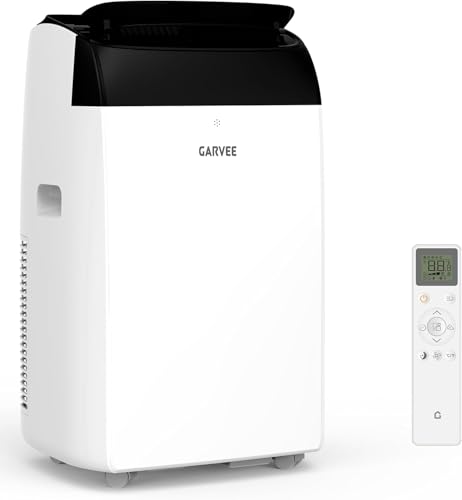
This portable unit targets renters and homeowners who lack a suitable window but still need genuine compressor-driven cooling. At 14,000 BTU and $308.80, it occupies the middle of the portable market and offers three functions in one chassis, which means a buyer can dehumidify and fan without switching machines through the shoulder months.
- 14,000 BTU output makes it viable for rooms well above the small-bedroom range.
- Three-in-one design reduces the need for separate dehumidifier or fan purchases.
- Portable units inherently lose efficiency through single-hose heat recirculation, raising operating costs compared to window-mounted alternatives of similar capacity.
Skip this if you have a usable window and want lower electricity bills over a multi-season ownership.
Frigidaire 5,000 BTU Window-Mounted Air Conditioner
For a bedroom or home office under 150 square feet, this unit delivers straightforward compressor cooling at $171 with none of the smart features that inflate prices elsewhere. Its two fan speeds and auto-restart cover the essentials, and Frigidaire’s long track record in window ACs gives buyers confidence that replacement parts and support will remain available years down the line.
- Quiet operation suits bedrooms and light-sleeping environments without disturbing household members.
- Auto-restart restores settings after a power outage, protecting food and comfort during storms.
- The 150-square-foot ceiling makes it unsuitable for open-concept living rooms or master suites above roughly 14 by 12 feet.
Skip this if your target room exceeds 150 square feet or you need remote control access from across the space.
Garvee 14,000 BTU 4-in-1 Portable Air Conditioner (750 Sq. Ft.)
Priced $69 below its sibling above, this Garvee model claims coverage up to 750 square feet and adds remote control, a 24-hour timer, and a window installation kit for venting the exhaust hose. The four-in-one configuration bundles cooling, heating, dehumidifying, and fan modes, making it a seasonal-all-purpose device for open-plan spaces where a fixed window unit is impractical.
- The 24-hour timer lets owners schedule cooling around work hours to avoid running the compressor all day.
- Included window kit removes the guesswork and extra expense of sourcing compatible venting accessories.
- Claimed 750-square-foot coverage is optimistic for a single portable unit; owners in rooms beyond 400-500 square feet may find it struggles on the hottest days.
Skip this if you need confirmed cooling for a room truly approaching 750 square feet; a dedicated window unit with matching BTU will perform better per dollar.
GE 6,000 BTU Electronic Window Air Conditioner
At $190.91 this GE unit occupies the sweet spot between tiny bedroom coolers and larger living-room machines, rated for rooms up to 250 square feet. The digital controls, remote, energy saver mode, and 24-hour timer give it more daily-use flexibility than basic mechanical models at similar price points, and GE’s easy install kit reduces the frustration that often accompanies first-time window AC mounting.
- Energy saver mode cycles the fan independently of the compressor, cutting electricity use during mild weather.
- The remote control adds convenience for a medium-sized room where walking to adjust settings defeats the purpose.
- The 6,000 BTU rating leaves little headroom; rooms with large south-facing windows or high ceilings will push this unit to its limit.
Skip this if your room has significant heat gain from windows, poor insulation, or more than one occupants generating body heat.
Midea 12,000 BTU Window Air Conditioner with Heat
This is the most expensive unit in the roundup at $449.99, but it is also the only one providing both cooling and heating in a single window chassis, covering up to 550 square feet. For owners in climates with moderate heating seasons, replacing a separate space heater with this Midea simplifies the seasonal storage problem and may reduce total appliance spending over a few years.
- Integrated heat pump eliminates the need for a second appliance during shoulder-season temperature swings.
- Midea’s parent company supplies parts and firmware updates across its product line, improving long-term serviceability.
- The high upfront price stretches the definition of economical unless you would otherwise buy both an AC and a heater separately.
Skip this if you already own a reliable heater and only need summer cooling; a same-BTU cooling-only window unit will cost substantially less.
Midea 5,000 BTU Window Air Conditioner
At $157.99 this is the least expensive true compressor-driven window unit in our list, rated for rooms up to 150 square feet. The reusable filter, remote control, and electronic interface give it features that were rare at this price point just a few years ago, and owner feedback highlights its suitability for bedrooms where a quiet, low-profile machine matters more than raw power.
- The reusable filter avoids recurring consumable costs that add up over multiple seasons of ownership.
- Remote control at this price is unusually generous for a 5,000 BTU class unit.
- The 150-square-foot limit and 5,000 BTU output mean it will struggle in any room with direct afternoon sun or poor insulation.
Skip this if your room exceeds 150 square feet or you need to cool a living area with vaulted ceilings; look for at least 8,000-10,000 BTU instead.
2026 New 4-in-1 Portable Mini AC (Sound ≤30dB)
This $59.99 device uses evaporative cooling rather than a compressor, filling a gap for buyers who cannot vent a window unit and want something quieter than a standard portable AC. The stated ≤30 dB noise level, 1000 mL water tank, 12-hour runtime, three speed settings, two mist modes, USB power, timer, and seven-color LED indicate it is designed primarily as a personal desktop or bedside air circulator with a humidifying effect.
- The ≤30 dB rating makes it one of the quietest options here for light-sleeping environments or shared offices.
- USB power means it can run from a laptop, power bank, or car port, offering genuine location flexibility.
- Evaporative cooling only reduces perceived temperature; it will not lower a room’s actual air temperature the way a compressor unit does, so expectations must be adjusted accordingly.
Skip this if you need to bring down room temperature for a family gathering or a sun-exposed room; it provides personal relief, not environmental cooling.
BSUIAK 4-in-1 Portable Mini AC Unit
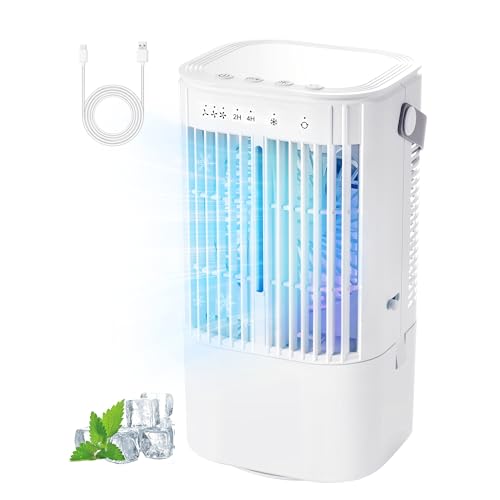
At $12.88 this is the cheapest item in the roundup, functioning as an evaporative desk cooler with a 1000 mL tank, three speeds, two-hour and four-hour timer options, and oscillating airflow. It is effectively a USB-powered fan with a water reservoir, useful for one person sitting within arm’s length in an office cubicle or while camping.
- The sub-$15 price makes it a zero-risk trial purchase for anyone unsure whether evaporative cooling suits their needs.
- Oscillating airflow covers a wider personal zone than a fixed-direction mini fan, improving comfort without raising power draw.
- Build quality and long-term durability at this price point are inconsistent in owner reviews; several report units failing within a single season.
Skip this if you need any expectation of multi-season reliability or room-level cooling; it is a single-season personal gadget, not an air conditioner in the traditional sense.
Buying Guide
Match BTU Rating to Room Size, Not Marketing Claims
The most common and costly mistake in budget air conditioning is buying a unit whose BTU output does not correspond to the room’s actual cooling load. Use the manufacturer’s square-footage figure as a starting point, then adjust upward if the room receives direct sunlight, has ceilings above nine feet, contains large electronics, or regularly holds more than two occupants. A 5,000 BTU unit in a 200-square-foot room with south-facing windows will run its compressor continuously without reaching the set temperature, increasing electricity costs and shortening component life.
Prioritize Energy-Management Features Over Comfort Add-Ons
When comparing two units at a similar price, the one with a dedicated energy saver mode, a programmable timer, and auto-restart will typically cost less to operate over a full season than one with a touchscreen and Wi-Fi. Window units are inherently more efficient than portables of equal BTU because they exhaust heat directly outside rather than partially recirculating it. If your search for the best economical air conditioners leads you toward portables, at minimum choose a model that ships with a complete window venting kit so no warm air leaks back into the room through improvised sealing.
Read Owner Feedback for Noise and Filter Access
Spec sheets rarely capture how a unit sounds at three in the morning in a quiet bedroom, or how awkward the filter panel is to remove once the chassis is mounted in a window. Filter the aggregate review set to one- and two-star ratings mentioning “noise,” “leaking,” or “filter,” then check whether recent comments show improvement. A unit that owners report as needing a full restart or a drip tray emptied nightly introduces friction that erodes value regardless of the sticker price.
Our Verdict
For most buyers seeking genuine compressor cooling at a fair price, the GE 6,000 BTU Window Air Conditioner at $190.91 is the top pick: it covers a medium room, includes remote and energy-saver controls, and comes from a brand with reliable long-term support. For the absolute lowest entry point into true cooling, the Midea 5,000 BTU Window at $157.99 wins the budget category with its reusable filter and remote. If year-round heating and cooling in one appliance is your priority and your budget stretches to $450, the Midea 12,000 BTU with Heat displaces the need for a separate heater and justifies its premium.
FAQ
Do portable air conditioners use more electricity than window units?
Yes, typically by a noticeable margin at equivalent BTU ratings, because single-hose portables draw room air to exhaust heat, creating negative pressure that pulls warm outdoor air back in through gaps. A window unit of the same capacity will deliver more net cooling per kilowatt-hour consumed.
How many BTU do I need for a 300-square-foot room?
Roughly 8,000 to 10,000 BTU as a starting guideline, though rooms with large sun-exposed windows or high ceilings may require more. The GE 6,000 BTU unit here covers up to 250 square feet, which is close but not generous for a 300-square-foot space.
Is an evaporative mini cooler worth buying as a primary cooling solution?
No. Evaporative units lower perceived temperature through moisture and airflow at the operator’s immediate position but do not reduce a room’s ambient temperature. They serve as supplementary personal comfort devices, not replacements for compressor-based air conditioners.
Should I choose a unit with a reusable filter or a disposable one?
A reusable filter eliminates recurring consumable costs and reduces maintenance friction over multiple seasons, making it the better choice for economical ownership. Disposable filters are simpler to swap but add ongoing expense that narrows the price gap between budget and premium units over three to five years of use.