Key takeaways
- Width: a 65-inch TV is about 57 inches wide — measure your console or wall space, not just the diagonal.
- Stand footprint: many affordable OLEDs use pedestal feet near the panel edges, needing a console nearly as wide as the TV itself. Center-stand designs (common on Sony) are friendlier to narrower furniture.
- Wall mounting: budget OLEDs are thin (often under 2 inches deep at the panel) but heavier at the electronics section. Use a mount rated for the VESA pattern (typically 300×200 on 55–65″ sets) and into studs, not drywall anchors alone.
- Clearance: leave 3–4 inches behind the set for cable bends and ventilation; OLEDs run warm and heat shortens panel life.
The best affordable OLED TV in 2026 is, for most buyers, a 55- or 65-inch B-series or last-generation mid-range panel — you get the same infinite contrast and per-pixel lighting as flagship sets, and you mainly give up peak brightness and a few gaming extras. Below we break down which models deliver the most for the money, how they differ, and which one fits your room and habits.
What “Affordable” Means for OLED in 2026
OLED pricing has settled into a predictable pattern. Entry-level OLEDs (55-inch) typically run $800–$1,100, while 65-inch versions sit around $1,100–$1,600. Mid-range models from a year or two ago often drop into that same band, making them the real value picks. Anything under $700 at 55 inches is worth a careful look — it may be a discontinued panel, which can still be a great buy if the warranty is intact.

LG 65-Inch OLED AI 4K B6 Series Smart TV, 2026 Model
Included for 'Best Affordable OLED TVs' because the listing specifies 2026 Model, details this guide uses to compare options.
View on Amazon
Sony 77 Inch BRAVIA XR8B OLED 4K HDR Smart Google TV (K-77XR8B)
Included for 'Best Affordable OLED TVs' as a relevant option in this category; details come from the product listing.
View on Amazon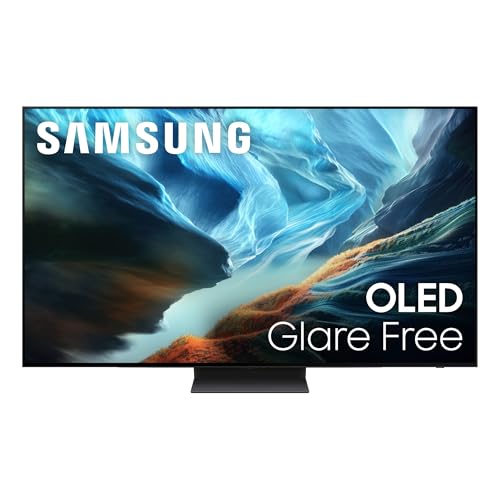
Samsung 65-Inch Class S90H Series, OLED, 4K, Smart TV, 2026 Model
Included for 'Best Affordable OLED TVs' because the listing specifies OLED and Smart TV, details this guide uses to compare options.
View on AmazonThe main thing you sacrifice at this price is brightness headroom. Entry OLEDs typically peak around 600–800 nits in HDR highlights, versus 1,000–1,400+ nits on flagship MLA or QD-OLED panels. In a dim or moderately lit living room, you will barely notice. In a sun-drenched room with the TV opposite a window, you will.
The Standout Affordable OLED Models
LG B4 / B5 — Best overall value
LG’s B-series is the benchmark affordable OLED. It uses the same panel type as the C-series but with a slightly less powerful processor and lower peak brightness (roughly 650–750 nits in HDR). You still get four HDMI 2.1 ports, 4K/120Hz, VRR, ALLM, and webOS — the most complete feature set per dollar. The 55-inch B4 frequently sells near the bottom of the OLED price range, and the B5 continues the same formula.
Samsung S85D / S85F — Best for bright rooms on a budget
Samsung’s entry OLED uses a WOLED panel (like LG’s) rather than the pricier QD-OLED found in the S90/S95 series. Peak HDR brightness lands around 700–800 nits with slightly better color volume in mid-tones. Tizen is a capable smart platform, and you get 4K/120Hz gaming — though only on some sizes, so check the spec sheet for the exact screen size you’re buying. No Dolby Vision support, which matters if you stream a lot of Dolby Vision content on Netflix or Disney+.
LG C4 (65″, discounted) — Best stretch buy
As a previous-generation mid-ranger, the 65-inch C4 often sells in the same bracket as the smaller B-series. You get meaningfully higher brightness (around 900–1,000 nits), better processing for upscaling cable and streaming, Dolby Vision gaming, and a more premium stand. If the price gap over a B5 is under $200, the C4 is the smarter buy.
Sony A80L / A80 series leftovers — Best for movie purists
Sony’s older A80-series sets linger at clearance prices. They run dimmer than rivals (around 600–700 nits) and only offer two HDMI 2.1 ports — one of which doubles as the eARC port — but Sony’s motion handling and color accuracy out of the box are arguably the best at this price. Google TV is a solid platform. Gamers with a console plus a PC should note the port limitation.
Head-to-Head Comparison
| Model | Peak HDR brightness (approx.) | Smart platform | Gaming features | Dolby Vision | Typical warranty |
|---|---|---|---|---|---|
| LG B4/B5 | 650–750 nits | webOS | 4K/120Hz, VRR, ALLM, 4× HDMI 2.1 | Yes | 1 year |
| Samsung S85D/F | 700–800 nits | Tizen | 4K/120Hz (size-dependent), VRR | No | 1 year |
| LG C4 (discount) | 900–1,000 nits | webOS | 4K/144Hz, VRR, 4× HDMI 2.1, DV gaming | Yes | 1 year |
| Sony A80 series | 600–700 nits | Google TV | 4K/120Hz, VRR, 2× HDMI 2.1 | Yes | 1 year |
Picture quality differences between these sets are smaller than spec sheets suggest. All deliver perfect blacks and pixel-level dimming. The real separators are HDR punch, the number of full-bandwidth HDMI ports, and whether Dolby Vision matters to you.
Match the TV to Your Situation
| Your situation | Best pick | Why |
|---|---|---|
| Dark or dim living room, movies at night | LG B-series or Sony A80 | Peak brightness barely matters; Sony’s processing shines for films |
| Bright room with windows opposite the TV | Samsung S85 or discounted LG C4 | Extra nits help fight glare; also consider an anti-glare screen position |
| PS5 + Xbox + gaming PC | LG B or C series | Four HDMI 2.1 ports mean no cable swapping |
| Mostly Netflix, Disney+, Apple TV+ | Any LG or Sony | Dolby Vision support matters; Samsung lacks it |
| Renter / frequent mover | 55-inch models | ~35–40 lb boxed weight is a one-person job; 65″ boxed is ~55–65 lb and awkward solo |
| Static content all day (news, PC monitor use) | Consider a discounted set with extended warranty | Burn-in risk is low but real over years; coverage buys peace of mind |
Room Fit and Placement Realities
Listings won’t tell you how these fit a real room. For a 55-inch 4K OLED, comfortable viewing distance is roughly 6–8 feet; for 65 inches, 7–9 feet. In a typical 10×12 ft living room with the sofa against one wall, a 65-inch set fits perfectly.
- Width: a 65-inch TV is about 57 inches wide — measure your console or wall space, not just the diagonal.
- Stand footprint: many affordable OLEDs use pedestal feet near the panel edges, needing a console nearly as wide as the TV itself. Center-stand designs (common on Sony) are friendlier to narrower furniture.
- Wall mounting: budget OLEDs are thin (often under 2 inches deep at the panel) but heavier at the electronics section. Use a mount rated for the VESA pattern (typically 300×200 on 55–65″ sets) and into studs, not drywall anchors alone.
- Clearance: leave 3–4 inches behind the set for cable bends and ventilation; OLEDs run warm and heat shortens panel life.
Warranty and Longevity
Every major brand includes a standard one-year warranty; LG has historically extended panel-specific coverage on some models — check the current terms, as panel warranty is the valuable part on an OLED. Extended plans (typically $100–$200 for 3–4 years) are worth considering at this tier specifically because burn-in coverage varies: some plans cover it, most manufacturer warranties classify it as “image retention” and exclude it. If you’ll game with static HUDs for hours daily or use it as a PC monitor, read that clause before buying the plan.
Modern OLEDs handle burn-in far better than early sets thanks to pixel refreshers and logo dimming, and normal mixed viewing is unlikely to cause issues in the panel’s typical 30,000+ hour lifespan — that’s roughly 10 years at 8 hours a day.
FAQ
Is a cheap OLED better than a good LED/QLED?
For contrast, viewing angles, and response time — yes, decisively. A budget OLED beats even premium mini-LED sets on black levels and gaming responsiveness. Where high-end LED wins is raw brightness and zero burn-in risk, which matters in very bright rooms.
Do affordable OLEDs get bright enough for daytime viewing?
In most living rooms, yes. The 600–800 nit range handles typical daylight fine if the TV isn’t facing a window directly. If it is, position it perpendicular to the window or budget for the brighter discounted mid-range models.
Is last year’s model safe to buy?
Usually the best value in OLED. Year-over-year improvements are incremental — often 10–15% brightness and minor processing tweaks — while prices drop 30–40%. Just confirm the unit is new with full warranty, not open-box.