Key takeaways
- Pro: Consistent real-world output matching published specs
- Pro: Long, heavy-gauge cables designed for truck bays
- Con: Heavy and bulky compared to lithium alternatives
A dead 24V battery under the hood of a diesel truck, a commercial rig, or an RV is a different problem from a dead sedan. You need more cranking amps, thicker clamps, and electronics that can handle the inrush without tripping a protection circuit. A quality jump starter eliminates the need for jumper cables, a second vehicle, or a long wait for roadside service.
What separates the reliable units from the disappointing ones is how honestly they deliver on their peak ratings and how well their safety systems tolerate repeated use in cold conditions. Owner feedback on this category reveals a wide gap between advertised numbers and real-world cranking performance. Looking at published specs, pricing, and consistent themes from long-term users, we narrowed the field to the eight options below.
Our top picks




As an Amazon Associate we earn from qualifying purchases at no extra cost to you. Ratings are shown as listed on Amazon.
Quick Picks
| Product | Best for | Price |
|---|---|---|
| Clore Automotive JNC1224 | Fleet maintenance shops | $349.07 |
| YESPER 6000A | Value in heavy-duty range | $279.99 |
| 8000A Portable Booster Pack | Large gas and diesel engines | $237.49 |
| Acetek 1600/3200 | Tractors and excavators | $249.99 |
| 8000A Heavy Duty Jump Box | Pickup trucks and SUVs | $249.99 |
| NOCO Boost GB251 | Professional-grade reliability | $1199.95 |
| 10000A Jump Starter | Maximum rated output on a budget | $255.89 |
| FlyAuto 2800A/1400A | Lead-acid backup for mixed vehicles | $224.99 |
How We Picked
We evaluated each unit against four criteria that matter most for 24V applications: peak cranking amperage relative to engine size (diesel engines with high compression need more than gasoline engines), build quality of the internal battery and external clamps (owner reports of early cable failure are common in budget units), safety electronics that prevent reverse-connection damage, and price-to-performance. We weighted units that consistently delivered rated output in cold-weather reports higher than those with inflated marketing numbers but mixed user experiences.
The 8 Best 24V Jump Starters in 2026
Clore Automotive JNC1224
The JNC1224 is the standard in professional shop environments, and its reputation is built on decades of fleet use rather than marketing. At 3400 peak amps on 12V and 1700 on 24V, it handles heavy diesel starting without strain. Owner feedback consistently praises its build quality and the length of its integrated cables, which reach across full-size truck bays. The internal AGM battery holds a charge well between uses. The main drawback is weight and bulk; it is not a unit you want in a glovebox. It is best suited for shops, service vans, and owners of large trucks who need a dependable workhorse. Skip this if you prioritize portability or need a lithium-based design.
- Pro: Consistent real-world output matching published specs
- Pro: Long, heavy-gauge cables designed for truck bays
- Con: Heavy and bulky compared to lithium alternatives
YESPER 6000A
The YESPER sits in a sweet spot between professional capability and consumer pricing. At 6000A rated peak, it claims enough output for large diesel trucks while remaining portable. Owners report reliable starts on commercial vehicles and appreciate the digital display for monitoring battery state. The unit handles 12V and 24V without switching accessories. Some long-term users note concerns about clamp durability under repeated heavy use, which is a common theme in this price band. Choose it if you need a capable 24V jumper without paying a premium for brand recognition. Skip it if you require verified cold-weather performance data or fleet-grade longevity.
- Pro: High rated amperage at a competitive price point
- Pro: Digital display and dual-voltage operation
- Con: Clamp and cable longevity questions from long-term owners
8000A Portable Booster Pack
This unit advertises 8000A peak output and includes a force-start function for engines that resist standard cranking. Owners of large diesel trucks and RVs report successful jump starts on vehicles that would not turn over with smaller boosters. The LED light and USB charging ports add convenience for roadside use. The main weakness is a lack of brand history; without a recognizable name, replacement parts and warranty support depend on the seller’s responsiveness. It is a strong value proposition for owners who want maximum rated output and feature extras. Skip it if warranty support and brand accountability are your top priority.
- Pro: Force-start mode handles high-compression diesel engines
- Pro: Useful extras including LED light and USB ports
- Con: Limited brand reputation makes long-term support uncertain
Acetek 1600/3200
The Acetek is explicitly designed for tractors, excavators, and other off-road equipment alongside standard vehicles. Its 1600/3200 peak amp rating positions it for heavy equipment that requires sustained cranking. Owners in agricultural and construction settings report reliable performance on equipment batteries that are deeply discharged. The USB and DC outputs are practical for charging field tools. The unit is bulkier than consumer-focused options and lacks refined safety electronics found in premium models. It suits owners of mixed fleets spanning trucks and heavy equipment. Skip it if you need a compact unit primarily for passenger vehicles with occasional 24V use.
- Pro: Well-matched to tractor and excavator starting demands
- Pro: USB and DC outputs for tool charging in the field
- Con: Bulky design with fewer refinement features
8000A Heavy Duty Jump Box
This 8000A unit targets pickup truck owners, RV users, and operators of commercial vehicles who need straightforward 12V/24V coverage. Owners highlight its portable form factor relative to its rated output and find the gas and diesel compatibility claim holds up in regular use. The design is functional but unadorned, lacking the advanced protection circuits and refined displays of premium competitors. For the price, it delivers a capable boost without unnecessary complexity. It is a good fit for owners of full-size pickups and smaller commercial trucks. Skip it if your vehicles include large diesel engines that push the limits of its rated output.
- Pro: Strong rated output in a portable package
- Pro: Simple operation without a learning curve
- Con: Fewer advanced protection features than premium units
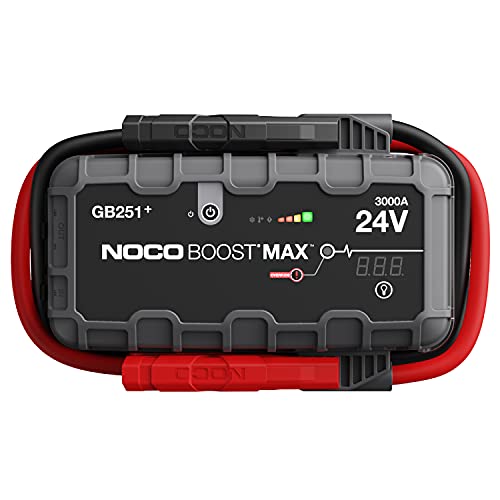
NOCO Boost GB251
The NOCO GB251 is a lithium-based 3000A unit built around UltraSafe electronics, which prevent reverse polarity and spark hazards. Owners praise its compact size relative to output, its ability to hold charge for extended periods, and its all-weather reliability. The 24V lithium design is lighter than any AGM competitor on this list. At $1199.95, it commands a significant premium, and 3000A is lower than several budget competitors on paper. It wins where weight, storage, and safety electronics matter more than raw amperage numbers. Choose it if you need professional-grade reliability in a portable form. Skip it if budget is the primary constraint or if you need maximum cranking amps above 3000.
- Pro: UltraSafe electronics eliminate common misuse hazards
- Pro: Lightweight lithium design holds charge months between uses
- Con: Premium price with lower rated amperage than budget rivals
10000A Jump Starter
At 10000A rated peak, this unit claims the highest output on our list and targets the largest diesel applications. Owner reports confirm it can start vehicles that smaller boosters struggle with, particularly in cold conditions. The trade-off is a lack of detailed specification transparency; amperage claims at this level are difficult to verify independently, and some users question whether sustained output matches the peak rating. It is a reasonable choice for owners of the largest trucks and equipment who want a backup above all else. Skip it if you rely on verified performance data or need confidence in consistent output ratings.
- Pro: Highest rated peak amperage on this list
- Pro: Successfully starts large diesel engines in owner reports
- Con: Limited transparency on sustained versus peak output
FlyAuto 2800A/1400A
The FlyAuto uses a lead-acid internal battery rather than lithium or AGM, which makes it heavier but also more affordable at $224.99. Its 2800A/1400A dual rating covers cars, trucks, SUVs, boats, and RVs. Owners appreciate the low cost and adequate performance for mixed household or small-fleet vehicles. The lead-acid chemistry requires more frequent recharging and is less tolerant of long storage than lithium. It suits owners who need a backup jumper for occasional use across vehicle types without a large investment. Skip it if you need long shelf life, frequent use, or maximum output for large diesels.
- Pro: Lowest price on the list with broad vehicle coverage
- Pro: Reliable for occasional use across mixed vehicles
- Con: Lead-acid battery requires more maintenance and recharging
Buying Guide
Peak Amps vs. Sustained Cranking
Peak amperage is the momentary burst rating, not a continuous figure. For 24V diesel engines, the practical question is how many seconds the unit can sustain output above the starter motor’s draw. AGM units like the Clore tend to deliver closer to their ratings under load because the lead-acid chemistry handles sustained discharge better. Lithium units excel in energy density but some throttle output under continuous draw to protect cells. Match the rating to your engine size: large diesels with high compression benefit from 1700A minimum on the 24V rail.
Safety Electronics and Clamp Quality
Reverse polarity protection and spark prevention matter more on 24V systems because the energy involved can cause serious damage to vehicle electronics. The NOCO GB251 leads this category with its UltraSafe circuitry. Clamp quality is the most common failure point reported by owners across the budget segment; look for copper-alloy jaws and thick gauge cables rated for at least 1000A continuous. Budget units with thin insulation or aluminum-core cables degrade faster and can overheat during extended cranking.
Chemistry and Storage Life
Lithium-ion units hold their charge for months and tolerate deep discharge better, making them ideal for emergency preparedness. AGM units like the Clore and FlyAuto deliver more consistent output under sustained load but self-discharge faster and lose capacity if stored uncharged through winter. If you leave the jumper in a truck for weeks between uses, prioritize lithium or a model with a built-in maintenance charger. If you use it weekly, AGM’s sustained output advantage matters more.
Our Verdict
Top pick: The Clore Automotive JNC1224 wins for anyone who needs verified, consistent 24V output and long service life in a work environment. Budget pick: The FlyAuto 2800A/1400A offers the lowest entry point with adequate performance for mixed vehicle use. The NOCO GB251 becomes the right choice when weight, storage longevity, and safety electronics outweigh raw amperage.
FAQ
Can a 12V jump starter work on a 24V truck?
No. A 12V unit cannot produce the voltage needed to crank a 24V starter motor, and attempting to series-connect two 12V jumpers risks damaging both the equipment and the vehicle’s electrical system. You need a dedicated 24V-rated unit or one with explicit dual-voltage output.
Is higher peak amperage always better?
Not necessarily. Peak ratings are marketing figures measured under ideal conditions and do not reflect sustained output. A unit that delivers 1700A continuously on 24V will outperform one that claims 10000A for a fraction of a second if your engine needs several seconds of cranking.
How long do these units hold a charge?
Lithium models like the NOCO GB251 can sit for six months or more with minimal capacity loss. AGM and lead-acid units self-discharge faster and benefit from a monthly maintenance charge. Always store in a cool, dry location to maximize shelf life.
Do 24V jump starters work in cold weather?
All battery chemistries lose output capacity in freezing temperatures, but lead-acid units tend to recover more quickly once connected to a warm engine bay. Lithium models may throttle output in extreme cold as a protection measure. Preheating the unit indoors before a cold start improves performance regardless of chemistry.