Key takeaways
- Small apartment, TV up to 55 inches: a 58-inch-wide credenza such as the Walker Edison Richmond sliding barn door or the Sauder Cottage Road credenza.
- Standard living room, TV 55 to 65 inches: the Sauder Select sliding-door credenza or the Bush Furniture Salinas 60W.
- Renters who may move often: IKEA BESTÅ with doors, because it is modular and can be rebuilt at a different width.
- Traditional or cottage rooms: IKEA BRIMNES with frosted glass doors, which keeps a lighter look than solid fronts.
- Heavier TVs, soundbars and consoles on the same surface: IKEA HEMNES, which is rated for a heavier top load than most budget cabinets.
The best TV cabinet for most living rooms is a closed-door unit that is 4 to 8 inches wider than the screen, holds at least twice the weight of the television, and leaves 2 to 3 inches of airflow behind the electronics. Doors are what separate a cabinet from an open stand: they hide cables, game consoles, routers and the visual noise that comes with them. This guide compares seven real cabinets by size, TV rating and construction, then walks through the measurements that decide whether a unit actually fits your room.
Quick Answer: Which TV Cabinet Fits Which Room
- Small apartment, TV up to 55 inches: a 58-inch-wide credenza such as the Walker Edison Richmond sliding barn door or the Sauder Cottage Road credenza.
- Standard living room, TV 55 to 65 inches: the Sauder Select sliding-door credenza or the Bush Furniture Salinas 60W.
- Renters who may move often: IKEA BESTÅ with doors, because it is modular and can be rebuilt at a different width.
- Traditional or cottage rooms: IKEA BRIMNES with frosted glass doors, which keeps a lighter look than solid fronts.
- Heavier TVs, soundbars and consoles on the same surface: IKEA HEMNES, which is rated for a heavier top load than most budget cabinets.
How to Size a TV Cabinet Correctly
Start with the screen’s actual width, not the diagonal. A 65-inch television is about 57 inches wide; a 55-inch model is about 48 inches wide; a 75-inch model is about 65 inches wide. The cabinet top should extend at least 3 to 4 inches past each side of the TV or its feet, otherwise the set looks perched and is easier to knock over. If the TV uses wide outrigger feet instead of a center pedestal, measure the foot span, because that is the number the cabinet top has to beat.
Next, check depth. Most flat panels need 12 to 15 inches of support depth for the feet, and a cabinet that is only 15 to 17 inches deep is fine for a modern TV but leaves little room behind for a power strip or streaming box. Cabinets in this guide run between 15 and 17 inches deep, so leave the TV pushed toward the front edge by about 1 inch and keep the back panel cutouts clear.
Finally, think about viewing height. The center of the screen should land roughly at seated eye level, which for most sofas is 40 to 42 inches from the floor. A cabinet that is 24 to 28 inches tall plus a 65-inch TV’s stand gap of 2 to 3 inches usually puts the middle of the screen at 40 to 45 inches, which is right. Taller cabinets above 30 inches push the screen high and tend to cause neck strain unless the sofa is very deep.
Room-Fit Table
| TV Size | Screen Width | Minimum Cabinet Width | Best Viewing Distance | Cabinet Height Range |
|---|---|---|---|---|
| 43 inch | about 37.5 in | 42 in | 5 to 7 ft | 24 to 30 in |
| 50 inch | about 43.5 in | 48 in | 6 to 8 ft | 24 to 30 in |
| 55 inch | about 48 in | 52 in | 7 to 9 ft | 24 to 28 in |
| 65 inch | about 57 in | 60 in | 8 to 10 ft | 22 to 28 in |
| 75 inch | about 65 in | 68 to 72 in | 9 to 12 ft | 20 to 26 in |
Door Types Compared
Door style changes how usable the cabinet is every day. Hinged solid doors give the cleanest look but need 12 to 14 inches of swing clearance in front, which matters if the sofa is close to the TV. Sliding doors need no swing space and suit narrow rooms, though they only open half the cabinet at a time. Glass doors keep remote signals flowing for older infrared gear, but they show clutter. Barn-door styles slide on a top track and are forgiving about alignment on uneven floors.
| Door Type | Swing Clearance | Remote Signal | Hides Clutter | Common Weak Point |
|---|---|---|---|---|
| Hinged solid | 12 to 14 in | Blocked when closed | Fully | Hinges loosen, doors sag |
| Sliding | 0 in | Blocked when closed | Half at a time | Track wear, door rattle |
| Glass or frosted glass | 12 to 14 in | Passes through clear glass | Partly | Glass edges, visible cables |
| Barn style | 0 in | Blocked when closed | Half at a time | Track alignment over time |
7 TV Cabinets Compared
1. IKEA BESTÅ TV Unit With Doors
The BESTÅ door version is listed at about 70 7/8 inches wide, 16 1/2 inches deep and 15 inches high in the low bench format, which makes it a long, low cabinet for 65 to 75 inch televisions. It is modular, so the frame, fronts, legs and drawers can be mixed, and the same boxes can be reassembled into a different width when you move.
Who it is for: renters, anyone who wants a very low profile, and people who like to customize fronts.
Pros: low height keeps the screen at a comfortable eye line; customizable fronts; cable cutouts; modular parts.
Cons: some buyers report that door fronts need careful alignment and can look uneven if the floor is not level; wall mounting hardware takes patience; the low height means the TV is close to the floor on small legs.
2. IKEA BRIMNES TV Unit With Glass Doors
BRIMNES comes as a TV unit with frosted glass doors and open shelving, listed at about 70 7/8 inches wide, 16 1/8 inches deep and 20 7/8 inches high, in black or white. Larger BRIMNES storage combinations extend to wide wall units for rooms with a full media wall. The glass fronts soften the look compared with solid doors and still conceal what is behind them.
Who it is for: traditional or transitional rooms and buyers who want a lighter look than flat panels.
Pros: frosted glass hides clutter without feeling heavy; budget-friendly; works with larger BRIMNES wall pieces.
Cons: particleboard construction needs a careful assembly; weight ratings are modest, so check the maximum TV weight for the specific size you choose; only one finish family.
3. IKEA HEMNES TV Unit
HEMNES is a solid-pine-detail design in 58 1/4 inch and 72 inch widths, both about 18 1/2 inches deep and 22 1/2 inches high. IKEA lists a maximum load of about 110 pounds for the unit, with maximum TV weights of about 55 pounds for the smaller size and about 90 pounds for the 72 inch size. It uses drawers and open shelves rather than hinged doors, so it is the best pick here if you prefer closed drawers over swinging doors, and it can be paired with HEMNES glass-door cabinets for a wall combination.
Who it is for: shoppers with heavier TVs and a traditional room.
Pros: sturdier load ratings than many cabinets; real-wood look; roomy depth.
Cons: drawers rather than doors, so it hides small items better than large boxes; heavy to move; the finish looks best in traditional rooms.
4. Bush Furniture Salinas 60W TV Stand
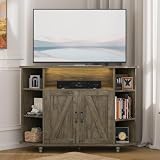
The Salinas is a farmhouse-style cabinet about 60 inches wide, 16 to 17 inches deep and just over 24 inches high. Retail listings put its TV rating at 65 to 70 inches and its surface load at roughly 75 to 80 pounds, with two cabinet doors that each cover an adjustable shelf and an open center bay for a soundbar or console. Check the exact stated rating on the specific finish you are buying, because retailers list slightly different numbers.
Who it is for: mid-size living rooms with a 55 to 65 inch TV.
Pros: adjustable shelves; open center for gear that needs airflow; several finishes including gray and antique white.
Cons: engineered wood top; the 60-inch width is tight for a 70-inch TV with wide feet; assembly takes a couple of hours.
5. Sauder Select Sliding-Door TV Credenza
The Sauder Select sliding-door credenza is listed at about 62 1/2 inches wide, 16 3/4 inches deep and 28 1/2 inches high, and rated for TVs up to 70 inches and about 95 pounds. Sliding doors suit narrower rooms, since there is nothing to swing into the walkway. It comes in finishes such as laurel oak and soft white.
Who it is for: tight rooms where swinging doors would hit furniture.
Pros: strong TV weight rating for the price tier; no door swing space needed; cord access.
Cons: only one side opens at a time; at 28 1/2 inches tall it lifts the screen higher than a low bench; engineered wood throughout.
6. Sauder Cottage Road Credenza With Doors
This compact credenza measures about 59 1/8 inches wide, 15 5/8 inches deep and 24 5/8 inches high, with three adjustable shelves, an enclosed back panel with cord access, and a rating for TVs up to 65 inches and about 70 pounds. Other Cottage Road models run smaller, from 42 inch glass-door stands up to roomier credenzas, so match the model number to the TV you own.
Who it is for: cottage and farmhouse rooms and buyers with a 55 inch TV.
Pros: low and shallow, good for small rooms; adjustable shelves; soft white finish brightens a room.
Cons: 70 pound TV limit rules out some heavier older sets; shallow depth leaves little cable slack.
7. Walker Edison Richmond Sliding Barn Door TV Stand
The 58 inch Richmond measures about 58 by 15.5 by 28 inches, weighs about 82 pounds, and has six cord ports and three adjustable shelves. The maker lists a top capacity of about 150 pounds and about 30 pounds per shelf, with a rating for TVs up to 65 inches. The sliding barn doors keep a rustic look in white and rustic oak.
Who it is for: farmhouse-style rooms, small spaces and heavier TVs.
Pros: high top capacity; multiple cord ports; no swing clearance needed.
Cons: shelves hold only about 30 pounds each; MDF and laminate construction; some Walker Edison variants have different specs, so confirm the model number.
Comparison Table
| Cabinet | Width | Depth | Height | Door Style | Stated TV Rating |
|---|---|---|---|---|---|
| IKEA BESTÅ with doors | about 70 7/8 in | 16 1/2 in | 15 in | Hinged | Check size-specific limit |
| IKEA BRIMNES glass doors | about 70 7/8 in | 16 1/8 in | 20 7/8 in | Frosted glass | Check size-specific limit |
| IKEA HEMNES | 58 1/4 or 72 in | 18 1/2 in | 22 1/2 in | Drawers, open shelf | 55 lb or 90 lb TV |
| Bush Furniture Salinas 60W | about 60 in | about 16 to 17 in | about 24 in | Hinged | 65 to 70 in, about 75 to 80 lb |
| Sauder Select sliding door | about 62 1/2 in | about 16 3/4 in | about 28 1/2 in | Sliding | 70 in, about 95 lb |
| Sauder Cottage Road 431260 | about 59 1/8 in | 15 5/8 in | 24 5/8 in | Hinged | 65 in, about 70 lb |
| Walker Edison Richmond 58 | 58 in | 15.5 in | 28 in | Sliding barn | 65 in, top about 150 lb |
Materials and Construction Trade-Offs
Almost every cabinet in this range is built from engineered wood: particleboard, MDF or fiberboard, wrapped in laminate, foil or paper. That is not a flaw at this size. A TV cabinet is a mostly static piece that does not take chair-leg abuse, and engineered wood stays flat and takes a painted or woodgrain finish evenly. What matters is the thickness of the top panel, the back panel, and the hardware.
| Material | Strength | Weight of a 60 in Unit | Moisture Tolerance | Typical Weak Point |
|---|---|---|---|---|
| Particleboard with laminate | Moderate | 60 to 90 lb | Low | Screw holes strip if reassembled |
| MDF with paint or laminate | Moderate to good | 70 to 110 lb | Low | Edges chip on impact |
| Solid wood or pine detailing | High | 90 to 140 lb | Moderate | Seasonal movement, cost |
| Metal frame with wood top | High | 50 to 90 lb | Good | Flexing doors, finish scratches |
Door hardware is the part that wears first. Cheap hinges loosen, so look for adjustable hinges with three-way adjustment, and for sliding doors check for a metal track rather than a plastic channel. Reassembling particleboard furniture usually weakens the screw holes, so if you move often, a modular system like BESTÅ is better than a unit that will be disassembled and rebuilt.
Safety, Airflow and Cable Management
Electronics produce heat, and a closed cabinet traps it. Leave at least 2 inches around consoles, and put game consoles and receivers in an open bay or behind a door you can leave ajar. Many cabinets in this guide offer an open center compartment specifically for this reason. A small USB-powered fan is cheap insurance for tightly packed media shelves.
Cable management is easier than it looks. Run all power into one surge-protected strip placed on the cabinet floor, use the back cutouts for HDMI and power, and bundle the cords with hook-and-loop ties rather than plastic zip ties so you can add devices later. Cabinets with enclosed back panels, such as the Sauder Cottage Road credenza, keep dust off cords but reduce airflow, so give consoles the open bay.
Tip-over safety matters, especially with kids. Anchor tall or light cabinets to the wall with the supplied strap, and mount a heavy TV on the wall or secure it to the cabinet top with an anti-tip strap. A fall from a cabinet can seriously injure a child, and anchoring takes five minutes.
Weight Limits: Read the Fine Print
Two numbers appear on most spec sheets: the maximum TV size and the maximum TV weight. Many modern televisions weigh less than 60 pounds, even at 65 inches, so the weight limit rarely rules out a unit. The bigger risk is stand footprint. A 65-inch TV with wide outrigger feet can overhang a 58 inch top. If your TV sits on a centered pedestal, the cabinet can be narrower than the screen without a problem, but a TV that overhangs the cabinet edges looks unstable and invites tipping.
Shelf ratings are lower than top ratings. A top that holds 150 pounds may have shelves that hold only 30 pounds each, which is enough for a soundbar and a game console, not for a stack of heavy A/V receivers. Spread heavy gear across the floor of the cabinet rather than loading one shelf.
Assembly and Moving Realities
- Box weight: a 60 inch cabinet ships in one or two boxes weighing 60 to 100 pounds. Plan on two people to carry it upstairs.
- Doorway width: boxes are usually 7 to 10 inches thick and 60 inches long, which passes through any standard 30 inch doorway but not tight stairwell turns.
- Assembly time: expect 1.5 to 3 hours for a door cabinet, longer for sliding track units.
- Floor level: doors only align if the cabinet sits level. Use the adjustable feet, or add felt shims, before hanging the doors.
- Wall mounting: if you mount the TV on the wall, the cabinet below only needs to hold your media gear, which opens up lower-rated options.
Decision Matrix: Match Your Situation
| Your Situation | Best Fit | Why |
|---|---|---|
| Small apartment, 50 inch TV | Sauder Cottage Road or Walker Edison Richmond | Compact 58 to 59 inch width, shallow depth |
| Kids and pets | Doors that latch, anchored cabinet | Hidden consoles and cords, tip-over risk reduced |
| Renter who moves yearly | IKEA BESTÅ | Modular and rebuildable at other widths |
| Very low sofa | BESTÅ low bench | 15 inch height keeps the screen at eye level |
| Large TV over 65 inches | IKEA HEMNES 72 inch or BESTÅ | Wider top, higher load rating |
| Farmhouse or cottage style | Salinas, Richmond, Cottage Road | Visual match plus adjustable shelves |
| Narrow room, no door swing | Sauder Select sliding | No swing clearance needed |
Common Mistakes to Avoid
- Buying by diagonal size only: always compare TV width and foot span against the cabinet top.
- Ignoring door swing: hinged doors need about 14 inches of open floor in front.
- Sealing in consoles: a closed cabinet traps heat; keep an open bay or leave a door ajar.
- Skipping the anchor: unanchored cabinets can tip when doors are open and a child climbs.
- Trusting a single spec line: retailers list slightly different ratings for the same unit, so confirm against the manufacturer’s page for the exact model number.
Frequently Asked Questions
How much wider should a TV cabinet be than the TV?
Aim for 4 to 8 inches wider than the screen, or at least as wide as the TV’s feet plus 2 inches on each side. For a 65-inch TV that is about a 60 to 66 inch cabinet.
Can I put a TV on a cabinet with a wall mount instead?
Yes. If the TV is wall-mounted above the cabinet, the cabinet only has to carry your devices, and a lower, longer unit looks balanced under the screen. Mount the center of the screen at about 40 to 45 inches from the floor.
Will glass doors let my remote work?
Clear glass lets infrared signals through, but frosted glass can scatter them. Bluetooth and Wi-Fi remotes work through any door. If you rely on an infrared remote, test the signal with the door closed before deciding to keep it shut.
Are engineered-wood cabinets durable enough?
For a TV cabinet, yes, provided you anchor it, avoid moisture, and do not overload the shelves. They tend to fail at edges and screw holes, not in the middle of the panel.
What is the ideal cabinet height?
For most sofas, 22 to 28 inches puts the screen center near seated eye level. Taller cabinets work only with a deep sofa or a TV on a very low stand profile.
Final Recommendation
For the widest range of rooms, IKEA BESTÅ with doors is the most flexible pick and works for both small and large TVs. For a 55 to 65 inch television in a traditional or farmhouse room, the Bush Furniture Salinas 60W, Sauder Cottage Road credenza or Walker Edison Richmond give solid storage in a compact footprint. Choose the Sauder Select sliding-door credenza when floor space is tight, and the HEMNES 72 inch unit when you have a heavy set and prefer drawers. Measure your TV width and foot span, check the door swing, anchor the cabinet, and leave room for airflow, and any of these cabinets will keep the living room looking tidy for years.