Key takeaways
- 1,200–1,600 watts: suitable for light duty, smaller portions, and intermittent use.
- 1,700–2,400 watts: the practical range for many cafés and small restaurants.
- 2,800–3,600 watts: appropriate for double presses and sustained, high-volume service.
The best commercial panini press for most cafés is a 1,800–2,200-watt clamshell unit with two independently heated, ribbed cast-iron plates measuring about 10 by 9 inches; choose a larger 2,800–3,600-watt model when lunch volume and recovery speed matter more than counter space and electricity use.
Buying the right press is less about choosing the hottest machine and more about matching plate area, electrical capacity, construction, and cleaning time to your service pattern. A compact press may be ideal for a coffee bar making 20 sandwiches per hour, while a wider double press can prevent a busy kitchen from building a queue.
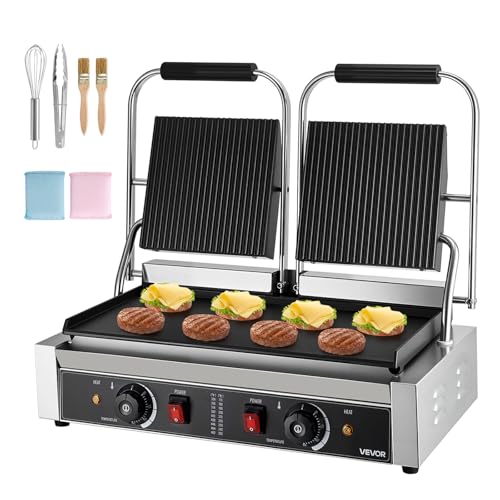
VEVOR Commercial Panini Grill, 3600W Electric Sandwich Panini Maker, Stainless Steel Double Sandwichs Press Grill with Handle and Temp Control, 19x9 in Flat Enamel Plate for Hamburger Steak Bacon
Included for 'Best Commercial Panini Press: Size, Power & Durability' because the listing specifies 3600W Electric Sandwich Panini Maker and 19x9 in Flat Enamel Plate for Hamburger Steak Bacon, details this guide uses to compare options.
View on Amazon
Kratos Commercial Electric Panini Sandwich Grill with Grooved Plates
Included for 'Best Commercial Panini Press: Size, Power & Durability' as a relevant option in this category; details come from the product listing.
View on Amazon
Kratos Commercial Electric Panini Sandwich Grill with Smooth Plates
Included for 'Best Commercial Panini Press: Size, Power & Durability' as a relevant option in this category; details come from the product listing.
View on AmazonBest commercial panini press choices by situation
| Operating situation | Recommended configuration | Why it fits | Watch-out |
|---|---|---|---|
| Small café or food truck | Single press, 1,500–1,800 watts, 8–10 inch plates | Fits limited counter space and handles one or two sandwiches per cycle | Temperature recovery slows during a rush |
| Busy café serving 30–60 sandwiches per hour | Single wide or double press, 1,800–2,400 watts, 10–14 inch plates | Balances throughput, footprint, and operating cost | Confirm the circuit can support the load |
| Restaurant or catering operation | Double press, 2,800–3,600 watts, two independent controls | Allows four or more sandwiches to cook at once and preserves one side if the other is idle | Usually needs a dedicated high-amperage circuit |
| Low-volume bar or office kitchen | Compact commercial-style press, 1,200–1,600 watts, nonstick aluminum plates | Quick warm-up and easier handling | May not tolerate continuous all-day production |
Plate size determines more than sandwich capacity
Plate dimensions describe the cooking surface, not necessarily the machine’s total footprint. An 8 by 9 inch plate generally accommodates one standard sandwich or two small café sandwiches. A 10 by 9 inch plate is a useful middle ground for baguette halves, ciabatta, and thick grilled sandwiches. Plates around 14 by 10 inches can handle two generously sized sandwiches side by side, but the press becomes considerably heavier and deeper.
Leave at least 3 inches of open space on each side for ventilation and cleaning access. Allow 6 inches above the handle and upper plate when fully open, and keep the rear of the machine away from splashing water and combustible materials. On a 24-inch-deep counter, a press with a 20-inch front-to-back footprint may leave too little working room for trays, tongs, and finished food.
Check the open height as well as the closed dimensions. Some clamshell models need 18–22 inches of vertical clearance when opened fully. If the unit sits beneath an overhead shelf, a floating or adjustable upper plate may be more practical than a press that opens to 90 degrees.
Wattage, temperature, and recovery speed
Wattage indicates how much electrical power the press can draw; it does not by itself guarantee better browning. Higher wattage normally helps the plates recover after cold bread and fillings are added. This matters when staff load sandwiches continuously rather than waiting between batches.
- 1,200–1,600 watts: suitable for light duty, smaller portions, and intermittent use.
- 1,700–2,400 watts: the practical range for many cafés and small restaurants.
- 2,800–3,600 watts: appropriate for double presses and sustained, high-volume service.
On a 120-volt supply, a 1,800-watt press draws about 15 amps, while a 3,000-watt press draws about 25 amps. That larger unit may require a 208- or 240-volt connection or a dedicated commercial circuit. Have an electrician verify the outlet, breaker, plug, and local code requirements before ordering. Avoid using an extension cord unless the manufacturer and an electrician specifically approve the arrangement.
Useful controls include separate thermostats, a broad adjustable range of roughly 200–570°F, an indicator light, and a mechanical timer or audible alert. Independent top and bottom temperature controls are valuable when the bread browns faster than the filling heats, or when the press is used for tortillas, vegetables, and chicken as well as panini.
Cast iron versus aluminum plates
| Plate material | Strengths | Trade-offs | Best fit |
|---|---|---|---|
| Cast iron | Excellent heat retention, strong searing, durable ridges, consistent marks during repeated batches | Heavy; slower to preheat; may require seasoning; rust is possible if left wet | High-volume kitchens prioritizing browning and long service life |
| Cast aluminum | Lightweight, quick to heat, generally easier to move and clean, efficient for moderate service | Can lose heat faster under heavy loading; softer surfaces may wear or warp if abused | Cafés, mobile service, and operators who clean and relocate equipment frequently |
| Aluminum with a nonstick coating | Fast release and simple cleanup with less oil | Coating can scratch, blister, or wear from metal utensils and abrasive cleaners | Lower- to medium-volume service with careful staff handling |
Cast iron is not automatically the better choice. A ribbed cast-iron press can weigh 45–70 pounds, making delivery, installation, and deep cleaning a two-person task. An aluminum model may weigh closer to 20–40 pounds and can be moved for closing or countertop sanitation. For nonstop production, however, cast iron’s thermal mass can produce more even results between loads.
Flat, ribbed, or mixed plates?
Ribbed plates create grill marks and allow some fat to drain, but they contact less of the bread’s surface. Flat plates brown more evenly and are useful for grilled cheese, wraps, and quesadillas. A combination of one ribbed plate and one flat plate offers versatility, although it may not produce identical marks on both sides.
For a menu built around ciabatta and focaccia, choose deep or adjustable grooves so the upper plate can accommodate uneven bread without crushing it. A floating upper plate is particularly useful because it distributes pressure over thick sandwiches. Look for a hinge that allows at least 2–3 inches of product thickness; fixed-height lids are less forgiving with tall fillings.
Durability details that listings often omit
The cooking plates usually outlast the parts that move or take abuse. Inspect the hinge, spring or counterbalance, thermostat knob, power cord, and grease channel before purchase. A loose hinge can create uneven pressure, while a damaged cord can take the entire machine out of service. Replaceable thermostats and accessible heating elements are preferable to sealed designs that require full replacement after a control failure.
Commercial stainless-steel housings resist dents and daily wiping, but stainless steel does not make a press waterproof. Grease can enter the hinge and electrical controls if staff spray the machine directly. A removable drip tray, rounded corners, welded seams, and plates that lift out—or can be wiped without reaching around exposed heating elements—reduce closing labor.
Plan for the real moving requirements. A press weighing more than 50 pounds may need two people to lift safely. Measure the doorway, service elevator, and counter route; a 24-inch-wide doorway is usually adequate for most countertop units, but packaging can add several inches. Put a heat-resistant mat beneath the machine and leave room to remove the drip tray without pulling the press forward.
Cleaning and food-safety trade-offs
At the end of each shift, unplug the press and follow the manufacturer’s cooling instructions. Scrape crumbs with a nonmetallic tool, empty the drip tray, and wipe the plates with a damp cloth or approved cleaner. Do not immerse the press or pour water over cast iron. Cast iron should be dried completely and lightly maintained according to its care instructions; nonstick surfaces need soft tools and nonabrasive products.
If the menu includes cheese, sugary sauces, or marinated vegetables, cleanup speed may matter more than maximum heat retention. In that case, removable aluminum plates or a well-designed nonstick surface can reduce labor. If the press will cook allergen-sensitive foods, establish a cleaning procedure and consider whether separate plates or a dedicated unit are necessary.
A practical buying checklist
- Measure the closed footprint, open height, counter depth, and ventilation clearance.
- Match wattage and voltage to a verified circuit rather than relying on a standard outlet.
- Choose plate dimensions based on the largest sandwich, not the average one.
- Select cast iron for heat retention and intensive production; select aluminum for lighter weight and easier cleanup.
- Prioritize a floating upper plate, adjustable thermostat, drip tray, and sturdy hinge.
- Confirm whether plates, thermostats, handles, and cords are replaceable.
- Allow enough surrounding counter space for raw ingredients, utensils, and a clean landing area.
For most commercial kitchens, the best commercial panini press is a 1,800–2,400-watt model with 10–14 inch plates, independent temperature control, a floating top, and a serviceable stainless-steel body. Move to a double 2,800–3,600-watt cast-iron press when volume justifies the electrical demand and weight; choose a lighter aluminum press when mobility, quick cleanup, and moderate production are the higher priorities.