Key takeaways
- The cabinet’s inside width at the top, middle, and bottom.
- The vertical distance from the cabinet floor to the underside of the countertop.
- The available clearance behind the sink for the faucet, supply lines, backsplash, and drain assembly.
Best Fireclay Farmhouse Sinks for Busy Kitchens
The best fireclay farmhouse sinks for busy kitchens are usually 30- to 36-inch single-bowl models with a 9- to 10-inch-deep basin, a rear-offset drain, a durable glazed finish, and enough cabinet reinforcement to support roughly 80–150 pounds before installation hardware and dishes are added.
Fireclay is a molded clay material fired at high temperature and covered with a glass-like glaze. It gives a farmhouse sink its solid feel, bright finish, and resistance to staining, but it is heavier and less forgiving of poor installation than stainless steel or composite granite. The right choice depends less on appearance than on how the sink fits your cabinet, counter, plumbing, and daily washing habits.

TUKTUK White Farmhouse Sink 33 inch Fireclay Apron Front Farm House Kitchen Sink Single Bowl Deep Drop In Undermount Reversible Heavy Duty Easy to Clean Porcelain Kitchen Basin Modern Luxury Accessory
Included for 'Best Fireclay Farmhouse Sinks for Busy Kitchens' as a relevant option in this category; details come from the product listing.
View on Amazon
GETPRO White Farmhouse Kitchen Sink 30 inch Fireclay Apron Front Farm Sink
Included for 'Best Fireclay Farmhouse Sinks for Busy Kitchens' as a relevant option in this category; details come from the product listing.
View on Amazon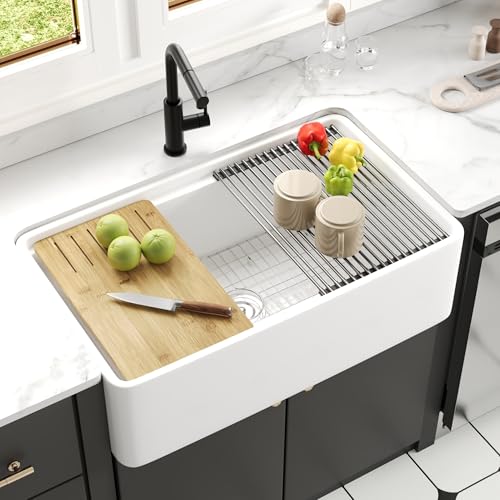
DeerValley Farmhouse Sink 33 Inch White Fireclay Apron Front Farm Sink
Included for 'Best Fireclay Farmhouse Sinks for Busy Kitchens' as a relevant option in this category; details come from the product listing.
View on Amazon
Couoko 33" White Fireclay Farmhouse Sink Workstation
Included for 'Best Fireclay Farmhouse Sinks for Busy Kitchens' as a relevant option in this category; details come from the product listing.
View on AmazonQuick comparison: which size and configuration fits your kitchen?
| Sink type | Typical exterior size | Usable basin | Approx. weight | Best for |
|---|---|---|---|---|
| Compact single bowl | 24–27 in. wide | 21–24 in. wide × 8–10 in. deep | 55–95 lb | Small kitchens, apartments, and 30-inch sink bases |
| Standard single bowl | 30–33 in. wide | 27–30 in. wide × 9–10 in. deep | 80–125 lb | Most family kitchens and large cookware |
| Large single bowl | 36 in. wide | 33–35 in. wide × 9–10 in. deep | 105–160 lb | Frequent cooking, sheet pans, and oversized pots |
| 60/40 or equal double bowl | 33–36 in. wide | Two basins, commonly 14–17 in. wide each | 100–170 lb | Separating washing, rinsing, or food preparation |
Exterior measurements are not the same as the opening cut into the counter. A sink may be 33 inches wide outside but require a cabinet opening determined by the manufacturer’s template. Always use the installation drawing, not a retailer’s rounded product title.
Best picks by kitchen situation
For a busy family kitchen: a 33-inch, 9-inch single bowl
This is the strongest all-purpose choice for most households. A single basin accepts a roasting pan, stockpot, and baking sheet without a center divider. Look for at least 27 inches of interior width and a gently sloped bottom so water and food particles reach the drain. A 33-inch sink generally needs a 36-inch sink base, although some compact designs fit a 33-inch cabinet.
For a small kitchen: a 24- to 27-inch model
A compact farmhouse sink preserves counter space while offering more usable width than many top-mount sinks. It is suitable for a 30-inch sink cabinet, but check the minimum cabinet width carefully. The trade-off is less room for two large pans at once. An 8- or 9-inch basin can also be easier on your back than a very deep 10-inch bowl.
For large cookware: a 36-inch single bowl
A 36-inch basin is useful when you regularly wash commercial-size pots or full-size baking sheets. It requires more than a wide cabinet: the counter must have sufficient uninterrupted space, and the sink can make the surrounding work area feel crowded. Leave approximately 18 inches of counter on one side for dirty dishes and at least 24 inches on the other for loading, draining, or setting down hot cookware whenever the layout allows.
For washing and rinsing separately: a double bowl
A divided fireclay sink provides a dedicated soaking or rinsing area, but each bowl may be too narrow for large pans. Check the width of the larger basin rather than relying on the overall sink width. A 60/40 layout is generally more practical than equal bowls when one side must accommodate cookware.
Construction details that matter more than appearance
Fireclay thickness
Many fireclay sinks have walls approximately ¾ to 1¼ inches thick, though the exact construction varies by model. Greater thickness can improve rigidity and reduce the chance of flexing during installation, but it also increases weight and may reduce the interior width within the same cabinet size. Thickness alone does not prove quality: consistent firing, a smooth glaze, a flat rim, and a well-supported base are equally important.
Inspect the product specification for the actual wall or body construction rather than confusing a deep basin with thick fireclay. A sink with an unusually thin rim or uneven underside may require more careful support and shimming.
Apron-front fit
Farmhouse sinks are available with flat, fluted, arched, reversible, and decorative apron fronts. The visible apron must fit the cabinet opening and the finished height of the cabinet face. Some models sit slightly proud of the cabinet, while others are designed for a flush installation. A replacement installation may require removing the existing cabinet’s false drawer front and trimming the cabinet face, doors, or countertop.
Measure three areas before choosing:
- The cabinet’s inside width at the top, middle, and bottom.
- The vertical distance from the cabinet floor to the underside of the countertop.
- The available clearance behind the sink for the faucet, supply lines, backsplash, and drain assembly.
For a new cabinet, a 36-inch base is the safer choice for a 33-inch sink. For a 30-inch sink, confirm whether the manufacturer permits installation in a 33-inch or 36-inch cabinet; the required clearance can differ by design.
Drain placement
A rear-center drain leaves more storage space below the bowl and gives large cookware a flatter area in front of the drain. A rear-offset drain moves plumbing to one side, which can create usable space beneath the sink for a pull-out bin or water filter. It can also improve drainage when dishes cover less of the drain opening.
Center drains are simpler to replace if your existing plumbing is already aligned. Offset drains may require extending the trap arm, changing the waste kit, or moving a cabinet shelf. Confirm that the drain position does not collide with a disposal, water lines, or a drawer box above the plumbing.
Finish durability and daily care
A good glazed finish resists ordinary food stains, heat from cookware, and mild household cleaners. White and off-white finishes make scratches and dark marks visible but are easy to assess while cleaning. Matte or colored finishes can disguise residue, but their appearance may change if abrasive cleaners are used.
Fireclay is hard but not indestructible. A heavy cast-iron pan dropped on the edge can chip the glaze or expose the clay body. Use a silicone or rubber sink grid that keeps cookware slightly above the bottom, and avoid steel wool, harsh scouring powders, and concentrated drain chemicals. Rinse coffee grounds, turmeric, and strong food dyes promptly rather than allowing them to dry on the surface.
Most wear occurs at the front rim, corners, drain opening, and areas where pans repeatedly strike the bottom. A grid protects the base, but it should be removed periodically so the sink and grid can dry and be cleaned separately.
Weight and cabinet support requirements
A fireclay sink may weigh 80–150 pounds empty; a large double bowl can weigh more. Add water and dishes, and the working load can exceed 200 pounds. The countertop should not be expected to carry that load by itself. The sink base normally needs a continuous support platform, side cleats, or a manufacturer-approved steel support frame beneath the sink ledge.
- Use solid, level supports on both sides and beneath the sink, not only adhesive or countertop clips.
- Support the front and rear portions of the bowl so the sink cannot settle or twist.
- Allow for a waterproof, removable support platform where possible.
- Verify that the cabinet floor, side panels, and countertop can carry the combined sink and water load.
- Have a second adult help move the sink; a 100-pound ceramic fixture is awkward even when it is not especially large.
Before delivery, measure the narrowest doorway and hallway. A sink that is 36 inches wide may need to be carried vertically, and packaging can add several inches to every dimension. Do not remove the packaging until the model, finish, and dimensions have been checked.
Decision guide before you buy
| Your priority | Recommended specification | Compromise to expect |
|---|---|---|
| Frequent large-pan washing | 33–36 in. single bowl, 27+ in. interior width | Higher weight and more counter space required |
| Small apartment kitchen | 24–27 in. bowl, 8–9 in. depth | Less room for simultaneous soaking and rinsing |
| Existing cabinet replacement | Sink matched to the cabinet’s exact minimum width and apron height | Countertop and cabinet modifications may still be necessary |
| Back or shoulder sensitivity | 8–9 in. depth, rear drain, sink grid | Less capacity for very tall stockpots |
| Maximum under-sink storage | Rear-offset drain and compact trap layout | Plumbing may need relocation |
| Children or heavy daily use | Rounded corners, protective grid, thick and evenly glazed body | More cleaning beneath the grid |
Final buying checklist
Choose the largest basin your cabinet and counter can support without sacrificing practical landing space. Confirm the minimum cabinet width, actual cutout, apron height, drain location, faucet-hole arrangement, basin depth, sink weight, and support method in the installation document. For most busy kitchens, a 33-inch single-bowl fireclay sink with a rear drain and a 9-inch basin offers the best balance of cookware capacity, cabinet compatibility, and manageable installation. A smaller 27-inch model is the better decision when cabinet space, counter clearance, or lifting weight is the limiting factor.