Key takeaways
- Choose a dense, low-profile weave for dining rooms and busy living areas.
- Prefer stitched, braided, or bound edges over a perimeter that relies only on adhesive.
- Use a rug pad, especially on smooth wood, tile, or laminate floors.
- Measure door clearance, furniture placement, and chair pull-out space before ordering.
- Expect some early fiber release, but reject rugs with bald spots or loose perimeter threads.
- Keep pure jute in dry rooms and blot spills instead of wet-cleaning the entire rug.
- Select a jute blend when softness, consistency, or improved stain tolerance matters more than an entirely natural fiber.
The best jute area rugs are densely woven, tightly finished at the edges, and matched to rooms where natural texture matters more than stain resistance or plush softness.
Jute is a plant-based fiber valued for its warm color, low-gloss texture, and relatively affordable price. It is not the right choice for every room: untreated jute absorbs moisture, can shed during its early use, and feels firmer underfoot than wool or cotton. The most suitable rug depends on the weave, backing, border construction, and how much traffic or mess the room receives.
Best jute area rugs by situation
| Situation | Best jute rug specification | Why it works | What to avoid |
|---|---|---|---|
| Small apartment | 5×7 or 6×9 ft, low-profile flat weave, tightly braided border | Provides texture without visually or physically crowding the room | Very thick shag or oversized 8×10 ft rugs that obstruct doors |
| Living room with children or pets | Flat weave or jute-blend rug with a dense surface and dark natural variation | Fewer deep loops to catch claws, toys, and crumbs | Loose, highly looped piles and rugs that cannot be spot-cleaned |
| Renter | Lightweight 5×8 or 6×9 ft rug with a separate non-slip pad | Easier to move and less likely to leave adhesive residue | Glued rubber backing that may mark finished flooring |
| Back pain or joint sensitivity | Densely woven, cushioned flat weave over a supportive 5–8 mm pad | Adds resilience and reduces the hard feel of bare jute | Thin rugs placed directly on hard floors |
| Dining area | Low-pile, tightly woven rug extending at least 24–30 inches beyond the table | Chairs remain on the rug when pulled out | Deep braids that catch chair legs or absorb spills |
| Bedroom | Softened jute blend, braided design, or jute rug layered over a pad | Offers natural texture without requiring bare feet to contact a coarse surface | Unfinished, scratchy fibers beside the bed |
What separates the best jute area rugs
Weave density
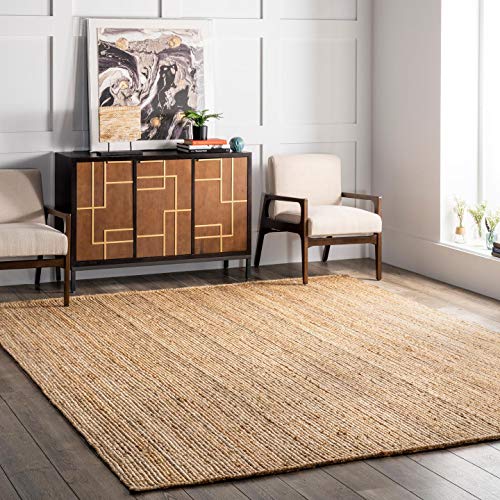
Density is usually a better durability signal than thickness. A tightly woven rug has less visible space between strands, resists flattening, and is less likely to snag when furniture moves across it. For a living room or hallway, look for a compact flat weave, closely packed braid, or substantial basket weave. A looser weave can look attractive but tends to release more short fibers and collect debris in the gaps.
Thickness is still relevant. A low-profile rug around 5–8 mm is easier to place beneath doors and dining chairs. A chunky braided rug may reach 10–15 mm or more, creating a softer visual effect but increasing the chance of door interference and uneven chair movement.
Softness and underfoot comfort
Jute is naturally firmer and more fibrous than wool. Some rugs are softened through finishing, blending, or a finer yarn, but “soft jute” should not be interpreted as plush. If the rug will sit beside a bed or in a reading area, choose a fine-weave or jute-blend construction and use a pad. A 5–8 mm felt or felt-and-rubber pad can improve comfort, stabilize the rug, and protect the floor.
For a sofa seating area, a firm surface is often acceptable because most contact occurs through furniture legs rather than bare feet. For a nursery, playroom, or meditation space, wool, cotton, or a washable synthetic may be more comfortable and practical.
Shedding and fiber variation
New jute rugs can shed small fibers, especially if the weave is loose or the yarn has many short ends. Moderate initial shedding is not automatically a defect, but persistent shedding, bald patches, or unraveling at the perimeter indicates weaker construction. Vacuum with suction only, avoid aggressive brush rollers, and empty the vacuum frequently during the first several weeks.
Natural jute also varies in color from pale straw to warm tan and muted brown. That variation helps disguise minor dust and wear, but it means a replacement or second rug may not match perfectly. If uniform color matters, choose a dyed or blended rug and retain its care label for future cleaning decisions.
Edge and corner quality
Edges receive more stress than the center because feet, vacuum heads, and chair legs repeatedly catch them. Examine whether the border is tightly braided, stitched, or bound rather than merely glued. Corners should lie flat without curling upward. A sturdy edge can add several years of usable life even when the central weave begins to show traffic variation.
For rugs larger than 8×10 ft, a reinforced perimeter is especially important because the rug is heavier and more difficult to reposition without pulling the edges. Avoid dragging heavy furniture across any jute rug; lift the piece or use furniture sliders.
Head-to-head: common jute rug constructions
| Construction | Texture | Shedding tendency | Durability and care | Best placement |
|---|---|---|---|---|
| Tightly woven flat weave | Firm, even, relatively smooth | Low to moderate | Good for frequent traffic; easier to vacuum | Dining room, entry-adjacent living room, home office |
| Braided jute | Textured with visible ridges | Moderate | Durable when tightly stitched; edges need inspection | Living room, bedroom, casual seating area |
| Chunky or looped weave | High texture, noticeably uneven | Moderate to high | More likely to snag and trap crumbs | Low-traffic bedroom or decorative sitting room |
| Jute and wool blend | Warmer and softer than pure jute | Usually lower fiber harshness, but may still shed | More comfortable, often more expensive; follow fiber-specific care | Bedroom, lounge, family room |
| Jute and synthetic blend | More consistent and sometimes smoother | Often lower than loosely woven pure jute | May offer better stain tolerance, depending on the synthetic fiber | Busy living room or rental home |
How large should a jute rug be?
Size affects both appearance and daily usability. In a living room, a 5×8 ft rug can fit beneath the front legs of a compact sofa and two chairs. A 6×9 ft rug usually gives a small seating group more cohesion, while an 8×10 ft rug can place all sofa and chair legs on the rug in a larger room.
For a 10×12 ft room, a 6×9 ft rug often leaves roughly 18 inches of floor around the seating arrangement, depending on furniture size. Measure the furniture first rather than choosing a size from the room alone. Keep approximately 12–18 inches of visible floor between the rug and walls when possible.
Under a dining table, measure the tabletop and add at least 48–60 inches to both the length and width. This provides about 24–30 inches on each side for a chair to slide out while remaining on the rug. A 60-inch round table generally needs a round rug at least 108–120 inches in diameter.
At a bed, a 6×9 ft rug can extend beyond the sides and foot of a full or queen bed, while an 8×10 ft rug offers better coverage around a king bed. Smaller runners placed along each side are easier to move and cost less, but they may shift unless secured with a pad.
Moisture tolerance and cleaning realities
Jute tolerates ordinary dry-room use, but it is not naturally moisture-resistant. Water, pet accidents, damp shoes, and repeated wet cleaning can cause staining, odor, discoloration, or fiber distortion. Keep pure jute away from bathrooms, laundry rooms, uncovered porches, and entrances exposed to rain or snow.
For a dining room, choose a low-pile construction and deal with spills immediately by blotting with a dry, absorbent cloth. Do not scrub, saturate, steam-clean, or place the rug back on the floor while damp unless the care instructions specifically allow it. A jute-blend rug may be more forgiving, but no natural-fiber rug should be treated as washable without explicit manufacturer guidance.
Use a washable runner near an exterior door and reserve jute for the drier portion of the room. This simple placement decision protects the rug more effectively than frequent deep cleaning.
Moving, setup, and long-term wear
Large jute rugs are awkward rather than exceptionally heavy. A tightly woven 8×10 ft rug may weigh approximately 25–45 pounds, while a thick braided version can be heavier. Check the rolled package length against stair turns, elevator dimensions, and door openings; a rug roll may be 8–10 feet long even when its packaged diameter is manageable.
Unroll the rug on a clean, dry floor and allow several days for natural curling to relax. Do not fold a thick jute rug sharply, since creases can remain visible or stress the backing. The first areas to show wear are usually the pathways in front of a sofa, the chair positions at a dining table, and the perimeter where vacuuming begins and ends. Rotating the rug 180 degrees every few months can distribute traffic, provided the furniture layout permits it.
Final buying checklist
- Choose a dense, low-profile weave for dining rooms and busy living areas.
- Prefer stitched, braided, or bound edges over a perimeter that relies only on adhesive.
- Use a rug pad, especially on smooth wood, tile, or laminate floors.
- Measure door clearance, furniture placement, and chair pull-out space before ordering.
- Expect some early fiber release, but reject rugs with bald spots or loose perimeter threads.
- Keep pure jute in dry rooms and blot spills instead of wet-cleaning the entire rug.
- Select a jute blend when softness, consistency, or improved stain tolerance matters more than an entirely natural fiber.
For most homes, the best jute area rugs are tightly woven, moderately low-profile designs with reinforced edges and a separate quality pad. Choose pure jute for dry rooms where texture and natural variation are priorities; choose a jute blend when children, pets, bare feet, or frequent spills make softness and easier maintenance more important.