Key takeaways
- Edges and corners: Repeated vacuuming, furniture movement, and foot traffic can loosen binding before the center looks worn.
- Chair zones: Dining chairs scrape the same narrow strips repeatedly, causing fuzzing or stretching.
- Entry paths: Grit acts like sandpaper. A door mat outside and frequent vacuuming can add years to an indoor rug’s life.
- Sun-facing areas: Strong daylight can fade dark dyes, especially on cotton and polyester.
- Under rolling chairs: Casters can pull a lightweight rug or wear a path. A firm chair mat may be more practical in a home office.
The best flatweave rugs for easy-care style are low-pile wool for warmth and longevity, washable synthetic for homes with children or pets, recycled polyester for affordable stain resistance, and reversible cotton or polypropylene for renters who need flexible, lightweight coverage.
Quick picks by situation
| Your situation | Best rug type | Why it fits | Main compromise |
|---|---|---|---|
| Small apartment | Reversible cotton or thin polypropylene | Easy to carry, simple to vacuum, and usually under 0.25 inch thick | Cotton stains more readily; thin rugs may need a pad |
| Kids and pets | Washable polyester or polypropylene | Strong stain resistance and low moisture absorption | Can feel less soft and less natural than wool |
| Renters | Reversible, lightweight cotton-polyester blend | Easy to move without professional delivery or installation | Often wears faster in entryways than wool or dense polypropylene |
| Back pain or standing desk | Dense wool flatweave with a supportive pad | More resilient underfoot and less compressible than thin cotton | Costs more and may shed during the first months |
| Low-clearance doors | Very thin cotton, PET, or polypropylene | Usually 0.10–0.20 inch thick before the pad | Offers little cushioning by itself |
Flatweave rug materials compared
Flatweave construction has no tall pile, so the fiber often matters more than the pattern. Two rugs can look similarly thin while behaving very differently when exposed to spills, claws, sunlight, and repeated foot traffic.
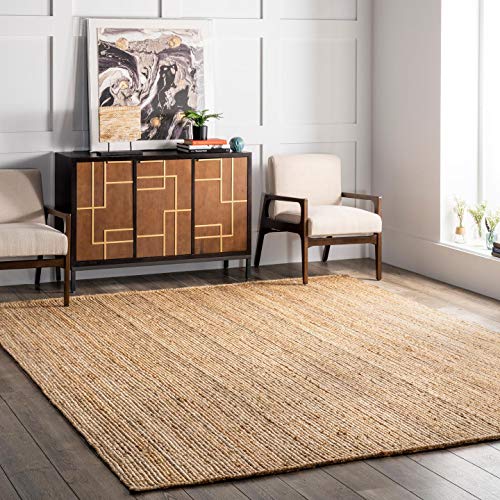
nuLOOM Rigo Natural Solid Flatweave Area Rug, 6' x 9'
Included for 'Best Flatweave Rugs for Easy-Care Style' because the listing specifies 6' x 9', details this guide uses to compare options.
View on Amazon
nuLOOM Elfriede Natural Solid Flatweave Area Rug, 7' 6" x 9' 6"
Included for 'Best Flatweave Rugs for Easy-Care Style' because the listing specifies 7' 6" x 9' 6", details this guide uses to compare options.
View on Amazon
Soalmost Washable Area Rug 8x10 Large Soft Beige Rugs for Living Room
Included for 'Best Flatweave Rugs for Easy-Care Style' as a relevant option in this category; details come from the product listing.
View on Amazon
Outdoor Rug Carpet 5x8 ft, Flatweave Textured Outdoor Patio Rug Non Slip Indoor Outdoor Rugs with Rubber Particles Backing Boho Outdoor Area Rug for Patio Deck Front Porch Backyard Balcony
Included for 'Best Flatweave Rugs for Easy-Care Style' as a relevant option in this category; details come from the product listing.
View on AmazonWool: the durable, comfortable choice
Wool flatweaves are the strongest all-around option when you want a rug that feels substantial without a thick pile. Wool fibers naturally resist some liquid penetration, recover from compression, and usually age more gracefully than cotton. A tightly woven wool rug can work well in a living room, dining room, hallway, or home office.
The drawbacks are price, weight, and initial shedding. Loose fibers are normal with many new wool rugs and generally decrease with regular vacuuming. Avoid aggressive beater-bar settings at first, and blot spills rather than soaking the rug. Wool is not stain-proof: oily spills and colored liquids can still leave marks if they sit.
Polypropylene: the practical high-traffic pick
Polypropylene is a strong choice for entryways, dining areas, playrooms, and busy family rooms. It absorbs very little water, resists many household stains, and is easier to clean than natural fibers. Many polypropylene flatweaves are also reversible, allowing you to turn the rug over when one side looks worn or dirty.
Its feel is usually firmer and more synthetic than wool. Heat is another consideration, so keep it away from fireplaces, radiators, and hot cookware. A dense polypropylene weave can be surprisingly durable, but low-cost versions may flatten, fuzz, or develop edge curling sooner.
Polyester and recycled PET: soft and washable
Polyester, including recycled PET made from plastic bottles, is popular for washable rugs and casual indoor-outdoor designs. It offers good color variety, low water absorption, and a softer hand than many polypropylene rugs. It is particularly useful when frequent washing matters more than heirloom longevity.
Polyester can hold oily residue and may show traffic paths sooner than wool or dense polypropylene. Check the care label carefully: a rug may be marketed as washable but still require a commercial-size machine, cold water, air drying, or a separate non-slip backing.
Cotton: light, reversible, and easiest to move
Cotton flatweaves are often the most affordable and easiest to fold. They suit bedrooms, nurseries, small apartments, and temporary decorating because one person can usually carry a modest-size rug without difficulty. Reversible cotton designs also hide everyday wear more effectively than a single-sided print.
Cotton absorbs spills quickly and may shrink, wrinkle, or lose shape if washed incorrectly. It is not the first choice for a wet entryway or a household where muddy paws are routine. A cotton-polyester blend improves durability, but it still should not be treated as stain-proof.
Thickness, door clearance, and furniture fit
Flatweave rugs typically range from about 0.10 to 0.30 inch thick, excluding the rug pad. That low profile is one of their biggest advantages, but the pad can create more clearance problems than the rug itself. Measure from the floor to the bottom of the door at its closest point, then subtract at least 0.10 inch for dependable movement. For a door with 0.35 inch of clearance, a rug and pad totaling no more than 0.25 inch is a safer target.
| Use | Useful rug size | Recommended total thickness | Practical fitting note |
|---|---|---|---|
| Entryway | 2.5 x 6 ft to 3 x 8 ft | 0.10–0.25 in | Leave 3–6 in of visible floor near the door swing |
| Small living room | 5 x 7 ft or 6 x 9 ft | 0.20–0.40 in with pad | At least the front legs of seating should sit on the rug |
| 10 x 12 ft living room | 8 x 10 ft | 0.20–0.45 in with pad | Place the rug under the sofa’s front legs and occasional chairs |
| Dining area | 8 x 10 ft for a 6-seat table | 0.15–0.35 in with pad | Allow about 30–36 in beyond the tabletop for pulled-out chairs |
| Desk zone | 5 x 7 ft or 6 x 9 ft | 0.15–0.30 in | Keep the chair’s rolling path fully on the rug where possible |
For a low-clearance door, choose a rug that is thin enough without sacrificing stability. A very thin rug placed directly on a smooth floor can slide or bunch, creating a trip hazard. Look for a low-profile felt-and-rubber pad, and confirm that the combined height still clears the door. Avoid thick memory-foam pads beneath doors, drawers, and wheeled office chairs.
Reversible versus single-sided flatweaves
Reversible rugs are practical when both faces are finished and the pattern works in either direction. They distribute wear, extend the useful life of the rug, and make small spills less visible after turning. They are especially convenient under dining tables and in rental homes where a rug may move between rooms.
Single-sided rugs can offer sharper pattern definition, a more cushioned backing, or a specialized stain-resistant surface. They may also lie flatter because the construction is optimized for one face. Check the edges before buying: a reversible rug with loose binding or a tendency to curl will need a pad and may require occasional reshaping.
What wears first in a flatweave rug?
- Edges and corners: Repeated vacuuming, furniture movement, and foot traffic can loosen binding before the center looks worn.
- Chair zones: Dining chairs scrape the same narrow strips repeatedly, causing fuzzing or stretching.
- Entry paths: Grit acts like sandpaper. A door mat outside and frequent vacuuming can add years to an indoor rug’s life.
- Sun-facing areas: Strong daylight can fade dark dyes, especially on cotton and polyester.
- Under rolling chairs: Casters can pull a lightweight rug or wear a path. A firm chair mat may be more practical in a home office.
Furniture weight is usually not a problem for a quality flatweave, but concentrated pressure can leave temporary impressions or stress the weave. Use wide furniture cups beneath narrow legs, and lift furniture rather than dragging it. For a sofa, leave at least 6–12 inches of rug beneath the front legs; placing the whole sofa on an undersized rug often creates curled edges and an awkward floating appearance.
How to choose the best flatweave rug
- Measure the room and door swing. Mark the intended rug footprint with painter’s tape, then open every nearby door, cabinet, and drawer.
- Match fiber to the mess. Choose wool for comfort and resilience, polypropylene for stains, washable polyester for frequent cleaning, or cotton for light-duty flexibility.
- Decide whether reversibility matters. Select a two-sided weave for rental moves, dining areas, and high-wear zones.
- Budget for the pad. A low-profile pad improves grip, protects flooring, and makes a thin rug feel more stable. It commonly adds about $20–$100 depending on size and material.
- Inspect construction details. Look for secure binding, even edges, a dense weave, and care instructions that match your cleaning equipment.
Care and cost expectations
Vacuum both sides occasionally, clean spills immediately, and rotate the rug 180 degrees every few months in a one-way traffic area. Shake or beat only according to the manufacturer’s instructions; vigorous beating can damage bindings. Most flatweaves cost roughly $50–$250 for cotton or basic synthetic sizes, $150–$600 for better-quality wool, and more for large, handwoven designs.
The right choice depends less on the word “flatweave” than on the demands of the room. Pick wool when comfort and long-term resilience matter most, polypropylene when stains and traffic dominate, washable polyester when maintenance is the priority, and cotton when light weight, reversibility, and a modest budget are the deciding factors.