Key takeaways
- Keep spare bulbs identifiable in their original packaging, with clear counts, confirmed fixture references and a separate place for unresolved items.
What's inside
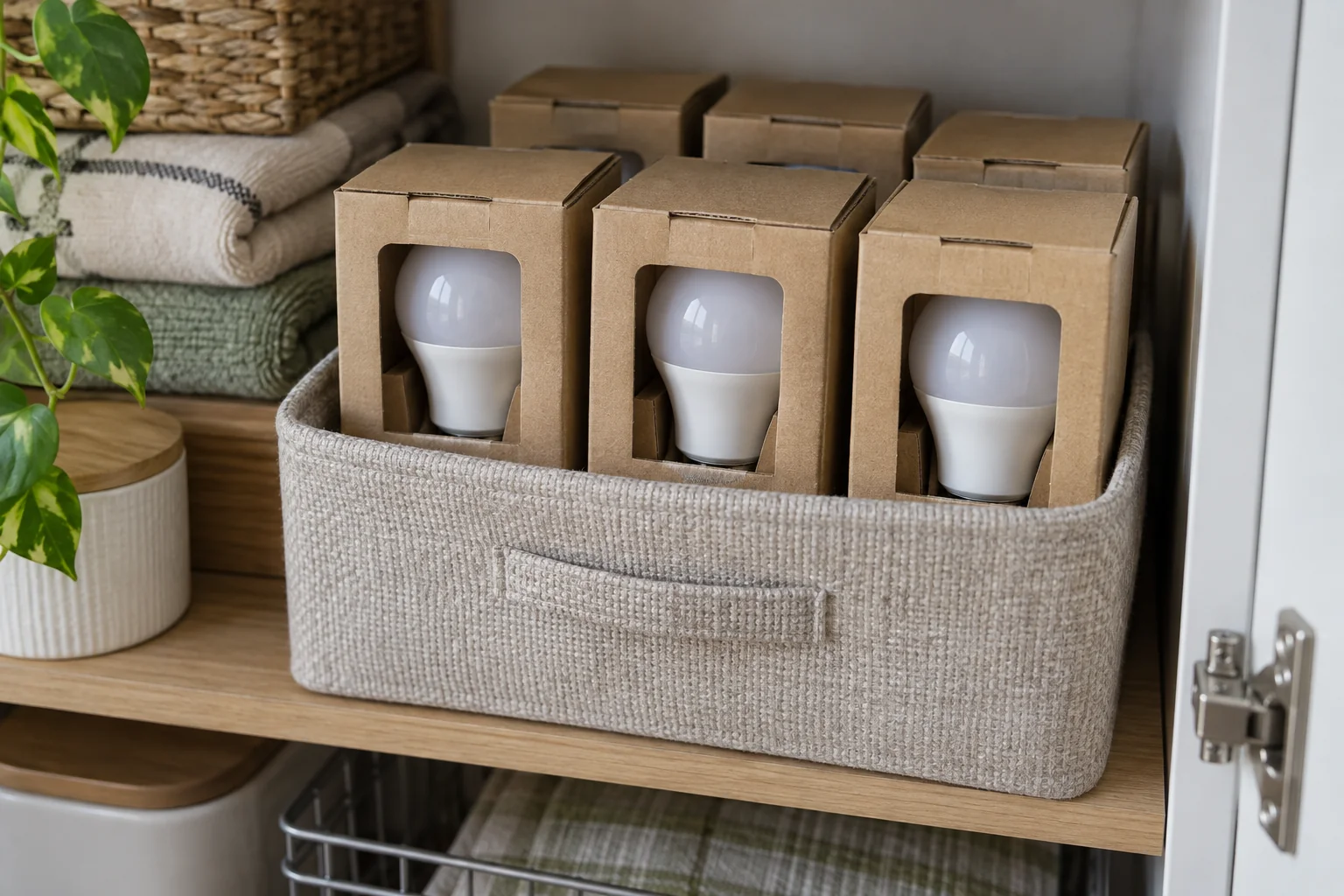
Organize spare light bulbs by keeping each bulb with its correct original packaging and grouping packages around identifiable household uses. A loose drawer of similar-looking bulbs loses the information that distinguishes their output, appearance and restrictions. The storage system should preserve those details without encouraging someone to install a bulb simply because it fits a socket.
Start with unused, intact bulbs you already own. Keep installed-fixture work outside this task. You can organize packaging, receipts and instructions without opening a light fitting or testing unknown bulbs.
Keep the package and bulb identity together
Leave the bulb in its protective insert where practical and keep the outer package that identifies it. If a multipack has partly been used, mark the actual remaining quantity on the box. Do not refill an empty branded box with a different bulb and rely on remembering the substitution.
If an unpackaged bulb cannot be confidently identified from its markings and reliable documentation, place it in a separate unresolved group. Avoid assigning specifications from another bulb that looks similar. A screw base and a frosted envelope do not identify every relevant characteristic.
The FTC’s consumer bulb guidance explains that the Lighting Facts label can include lumens, energy use, appearance, expected life and mercury information. It also distinguishes brightness from wattage. Keeping the correct packaging preserves useful comparison information that a handwritten “60-watt replacement” label may omit.
Build a short package index
Give each package a simple location in the cupboard, such as bulb bin A, rather than putting a sticker directly on the bulb. Record the manufacturer and product code, base or shape information stated by the maker, output, appearance and any relevant use restrictions. Copy the meaning accurately and retain the original label.
| Index field | Purpose | Common mistake to avoid |
|---|---|---|
| Exact product reference | Connect the spare to its documentation | Grouping solely by visual shape |
| Quantity remaining | Avoid unnecessary purchases | Assuming a four-pack still contains four |
| Intended fixture reference | Show where compatibility was checked | Treating that note as proof for every similar fixture |
| Restrictions or uncertainty | Keep unanswered questions visible | Inferring dimmer or enclosure suitability |
| Storage location | Retrieve the correct package | Mixing loose bulbs into an unrelated box |
Keep a fixture reference only when you have checked the relevant requirements. A note such as “desk lamp L2, confirmed with instructions” is more useful than “living room.” If the fixture changes, review the note rather than transferring it automatically to the replacement.
Separate inventory from compatibility
The index records what is on hand; it does not approve an installation. Before use, the bulb and fixture instructions still need to agree, including the applicable electrical and environmental requirements. A package’s equivalent-brightness number is not the same as its actual power consumption or a fixture’s permitted load.
Keep dimmer compatibility and suitability for enclosed or special-use fixtures as explicit questions where relevant. Do not fill blank fields by guessing from the word LED. If the information is missing, contact the maker or use an appropriate verified replacement instead of treating tidy storage as confirmation.
Choose a protected, retrievable location
Use a stable storage area suitable for the products and follow any package storage instructions. Keep the boxes away from routine moisture and places where heavier objects will crush them. Arrange labels so the required box can be removed without pulling out a pile of loose glass.
Do not store damaged bulbs among ready spares. Keep disposal or recycling items separate from the usable inventory and follow the relevant local and product guidance. If a bulb breaks, use the appropriate cleanup instructions for its type rather than handling the contents as an ordinary storage task.
A fictional cupboard audit
Imagine three boxes on one shelf. Box A is a four-pack with one bulb left. Box B contains two intact bulbs but belongs to a different model from the one written on the shelf label. Box C is empty. The household first corrects quantities and removes the empty package from active stock.
They then separate Box B until its actual bulbs can be identified reliably. They do not buy more of Box A merely because its front still says four-pack, and they do not use Box B’s cardboard as evidence about its substituted contents. The audit produces one confirmed spare group and one unresolved group.
Update the record when a bulb leaves
Reduce the package count when someone takes a spare. Keep any new compatibility confirmation with the fixture reference, and remove obsolete associations when a lamp leaves the home. Review stock before buying another multipack.
The finished system can stay small: intact original packages, honest quantities, verified references and a separate place for uncertainty. Its value is preserving information and protecting the stored bulbs, not turning a household shelf into a substitute for product instructions.