Key takeaways
- Pro: Stainless steel drum resists the musty smell that plastic drums develop over time
- Pro: Plugs into a standard 120V outlet, no installation required
- Con: Small drum means bulky items like sheets or sweaters take two runs to finish properly
What's inside
The right dryer depends less on brand prestige and more on how much laundry you actually run through and whether your space supports a full-size vented machine. A student in a studio apartment has no business paying for a seven-cubic-foot front-loader, while a family of five will find a 600-watt compact unit frustrating on every single load. Across these eight products, published capacity ratings, wattage, and owner reviews from Reddit threads and retail Q&A sections reveal clear trade-offs: compact dryers sacrifice cycle time for footprint, mid-range units balance capacity and cost, and full-size machines win decisively on speed and fabric care.
What separates a good pick from a bad one in this group is honest matching of machine to lifestyle. Owner feedback consistently highlights that dryers under two cubic feet require multiple loads for a single week of laundry, that stainless steel drums resist odor and wear better than plastic, and that accessories like wool dryer balls measurably reduce static and drying time regardless of which machine you own. This roundup in 2026 covers every price tier so you can identify the right category before you commit.
As an Amazon Associate we earn from qualifying purchases at no extra cost to you. Product prices and availability are accurate as of the date shown and are subject to change.


Quick Picks
| Product | Best for | Price |
|---|---|---|
| Euhomy 1.5 Cu. Ft. Portable | Small apartments without hookups | $179.97 |
| Auertech 3.6 CU. FT | Busy families needing mid-size capacity | $409.99 |
| Kenmore 7.0 cu. ft. Front Load | Full households with dedicated laundry space | $849.99 |
| MOJOCO 600W Compact | Travelers and single-person dorm rooms | $56.04 |
| Budieggs Wool Dryer Balls XL | Anyone wanting softer clothes without chemicals | $8.97 |
| Wool Dryer Balls (Pack of 6) | Budget-conscious shoppers adding dryer balls | $6.99 |
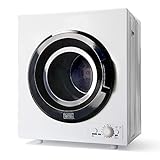
| ROVSUN 110V Portable | Dwellers wanting front-load convenience | $199.99 |
| BLACK+DECKER BCED26 | Small homes needing a compact full drum | $289.99 |
How We Picked
Four criteria drove the selection: capacity relative to household size, power consumption and voltage compatibility with typical apartment circuits, drum material (stainless steel versus plastic directly affects odor retention and lifespan), and the ratio of owner-reported reliability to price. Products that could not satisfy at least three of these four at their listed price point were excluded from consideration.
The 8 Best New Clothes Dryers in 2026
Euhomy 1.5 Cu. Ft. Portable Dryer
This machine targets renters in apartments where a dedicated dryer hookup does not exist. The 850-watt element and 1.5-cubic-foot stainless steel drum handle a small weekly load of shirts, pants, and towels in a single cycle.
- Pro: Stainless steel drum resists the musty smell that plastic drums develop over time
- Pro: Plugs into a standard 120V outlet, no installation required
- Con: Small drum means bulky items like sheets or sweaters take two runs to finish properly
Skip this if you regularly dry full bath towel sets or bedding. Owner feedback notes it works well as a supplement to line-drying but struggles as a sole laundry solution for households beyond one person.
Auertech 3.6 CU. FT Clothes Dryer
A step up for families who need real capacity without committing to a full-size machine. The twelve drying modes and LED control panel let users match heat levels to fabric types, which owners praise for reducing shrinkage on mixed loads.
- Pro: Stainless steel tub and twelve modes give flexibility that budget dryers lack
- Pro: Mid-size footprint fits laundry closets where a seven-cubic-foot unit would not
- Con: Owners report the control panel layout is unintuitive during the first week of use
Skip if you are drying for a single person in a tiny space — you will pay for capacity you never fill. For two- to four-person households, this sits in a practical middle ground.
Kenmore 7.0 cu. ft. Front Load Electric Dryer
The only full-size machine here, designed for households with a dedicated laundry room and 240V electrical service. The seven-cubic-foot drum absorbs an entire family wash in one cycle, and the front-load orientation means items are visible and easier to retrieve.
- Pro: Largest capacity in this group, reducing total cycles per week significantly
- Pro: Kenmore’s brand reputation for service parts availability is well-documented in owner forums
- Con: Highest price tag and requires professional 240V installation that can add cost
Skip if you rent without permission to modify electrical outlets, or if your household laundry rarely exceeds a small basket’s worth of clothing.
MOJOCO 600W Compact Portable Dryer
The lowest-cost option by a wide margin, built for one or two garments at a time. At 600 watts it draws minimal power, making it suitable for hotel rooms, dorm closets, or travel when you need a single shirt or pair of socks dried before morning.
- Pro: Smallest price point in the group, under sixty dollars
- Pro: Extremely compact and lightweight, fits in a suitcase
- Con: Single-garment or two-garment capacity means it is impractical for anything resembling a laundry load
Skip if you have more than an occasional emergency need. Owners consistently describe it as a convenience item rather than a primary dryer, and cycle times stretch long on damp fabrics.
Budieggs Wool Dryer Balls XL 6-Pack
Not a dryer but a drying accessory that improves performance across every machine on this list. Handmade from New Zealand wool, these XL balls tumble with laundry to separate items, increase airflow, and reduce static. Owners report noticeable softening without dryer sheets.
- Pro: XL size creates more separation than standard balls, cutting drying time
- Pro: Reusable for hundreds of loads, eliminating ongoing cost of chemical softeners
- Con: No inherent moisture control; results depend entirely on the machine you pair them with
Skip if you already use wool dryer balls from another source or if you prefer fragrance-based softening. The benefit here is mechanical, not chemical.
Wool Dryer Balls (Pack of 6)
Functionally similar to the Budieggs set but positioned at a lower price point. These New Zealand wool balls target the same goals: reducing static cling, minimizing wrinkles, and shortening drying cycles through physical tumbling action.
- Pro: Lowest price in the group for a six-pack, making trial nearly risk-free
- Pro: Owners confirm effectiveness at wrinkle reduction comparable to pricier alternatives
- Con: Smaller diameter than the XL Budieggs balls, slightly less airflow improvement per cycle
Skip if you want maximum drying-time reduction and do not mind spending an extra two dollars for the XL size. For general static and softening, this pack performs well.
ROVSUN 110V Portable Front Load Tumble Dryer
Similar wattage to the Euhomy but with a front-loading door and a simple control knob that some owners find easier to operate than digital panels. The 850-watt heating system and stainless steel tub handle a modest apartment load.
- Pro: Front-load door makes it easy to add or retrieve garments mid-cycle
- Pro: Analog knob is dead simple and less likely to malfunction than electronics in a humid bathroom setting
- Con: Capacity and cycle duration match the Euhomy closely, offering less differentiation at a higher price
Skip if the Euhomy’s lower price appeals and you do not specifically need front-load access. Choose this only if a physical knob over digital controls is a firm preference.
BLACK+DECKER BCED26 Portable Dryer
At 2.65 cubic feet and 8.8 pounds of capacity, this bridges the gap between compact portables and mid-size units. The brand’s name carries trust for tool and appliance durability, and owner reviews note consistent performance over repeated cycles.
- Pro: Largest capacity among the non-full-size portables in this group
- Pro: BLACK+DECKER’s established service network supports long-term ownership
- Con: Noticeably pricier than the Euhomy and ROVSUN for what remains a portable-class drum
Skip if your budget is tight and the Euhomy covers your volume. This earns its higher price only if you need to dry more clothing per cycle without moving to a 240V machine.
Buying Guide
Match Capacity to Your Actual Laundry Volume
Cubic feet is the single most misleading number for first-time buyers. A 1.5-cubic-foot drum holds roughly a small pile of folded clothes, not a week of laundry. Multiply your typical weekly load by volume to estimate how many cycles a given machine requires. A household producing two full loads per week needs at least three to four cubic feet to avoid drying on consecutive days.
Verify Your Electrical Setup Before Choosing Voltage
Compact and mid-range dryers on this list operate on standard 120V household outlets. Full-size machines like the Kenmore require 240V circuits common only in dedicated laundry rooms. Before selecting a machine, confirm what your space offers. A 240V dryer in a 120V apartment is unusable without expensive electrical work.
Prioritize Drum Material Over Cosmetic Features
Stainless steel drums appear in the Euhomy, Auertech, ROVSUN, and BLACK+DECKER models. They resist odor absorption, tolerate higher heat without warping, and outlast plastic alternatives. Digital panels and LED displays add convenience but do not affect drying performance. If forced to choose, a machine with a steel drum and basic controls will serve you longer than a plastic-drum unit loaded with presets.
Our Verdict
Top pick: Kenmore 7.0 cu. ft. Front Load — for households with proper electrical infrastructure, it dries in fewer cycles and protects fabrics better than anything else here.
Budget pick: MOJOCO 600W Compact — at $56.04 it solves the emergency single-garment problem without financial commitment.
Condition for another winner: If you rent a studio with no laundry hookups and dry three to four loads weekly, the BLACK+DECKER BCED26 justifies its higher price over the Euhomy through its 2.65-cubic-foot capacity, which cuts your total drying sessions in half.
FAQ
Can a portable dryer fully replace a full-size machine?
For single-person households with low laundry volume, yes — several owners report using compact units as their only dryer. For families, portable dryers require multiple cycles per week and cannot handle bulky items like comforters or large towel sets in a single run.
Do wool dryer balls actually reduce drying time?
Owner feedback and published product descriptions consistently report shorter cycles and less static when using wool balls. The mechanism is physical: balls separate fabric layers, allowing heated air to circulate more freely through the load.
Is 600 watts enough to dry clothes effectively?
Enough for one or two small items at a time, but drying times stretch significantly on anything damp or dense. At that wattage the machine functions more as a convenience tool than a primary dryer, best suited for travel or single-garment emergencies.
What voltage do I need for a 7-cubic-foot dryer?
Full-size electric dryers like the Kenmore require a 240V dedicated circuit, which most apartments and older homes lack unless a laundry room was built with one. Confirm your panel capacity before purchasing, as adding a 240V circuit involves an electrician.