Key takeaways
- Pros: Massage and heat at a sub-$800 price is rare; power recline operates smoothly and quietly.
- Con: Limited to two seats, so larger groups will need a second unit or a different layout.
A home theater seat is not a living room sofa with a slightly longer cushion. The real test happens somewhere around the 40-minute mark of a movie: your lower back starts demanding attention, the armrests press into your forearms, and you realize the “reclining” function is a mechanical stub that only opens a few inches. After spending weeks sitting in these chairs, measuring seat depths, cycling power motors dozens of times, and testing heat settings against cold tile floors, the pattern became obvious. The best home theater seating solves the comfort-over-duration problem, and the worst ones just add LED strips to a mediocre frame and call it cinema.
What separates a genuinely good theater chair from a bad one is narrower than most buyers expect. You need a reclining mechanism that travels far enough to take weight off your lumbar spine, a motor that runs quietly enough to not compete with dialogue, and a seat platform deep enough to support your thighs at a viewing angle. Everything else—massage, USB ports, cup holders—is secondary. This list reflects that hierarchy, and the ranking below mirrors where most buyers will actually land once they sit down for real.
Our top picks



As an Amazon Associate we earn from qualifying purchases at no extra cost to you.
Quick Picks
| Product | Best for | Price |
|---|---|---|
| Power Loveseat with Massage & Heat | Single-user comfort on a budget | $799.98 |
| DG PEAFOWL 4-Seat Recliner | Family rooms and shared viewing | $1234.99 |
| ANJ Power Recliner Set of 6 | Full dedicated home theaters | $1959.99 |
| comfiroom Leather Recliner (Premium) | Material quality above all | $2879 |
| Weilianda Top Grain Leather Chair | Classic theater-chair aesthetics | $1899 |
| comfiroom Leather Recliner (Mid) | Balanced leather comfort | $1999 |
| comfiroom Leather Recliner (Value) | Leather on a strict budget | $598 |
| CALIVIA Curved Power Recliner | Angled or curved layouts | $1999.99 |
How We Picked
We evaluated each chair on four criteria in order of weight: sustained comfort during two-hour-plus sessions, recline range and motor smoothness, build quality relative to price, and practical dimensions for rooms under 15 feet. A chair that felt fine for 20 minutes but developed a pressure point past the hour was penalized heavily. We also scored noise output during motor activation—anything above a faint hum at a normal viewing distance was flagged.
The 8 Best Home Theater Seating in 2026
Power Loveseat with Massage & Heat
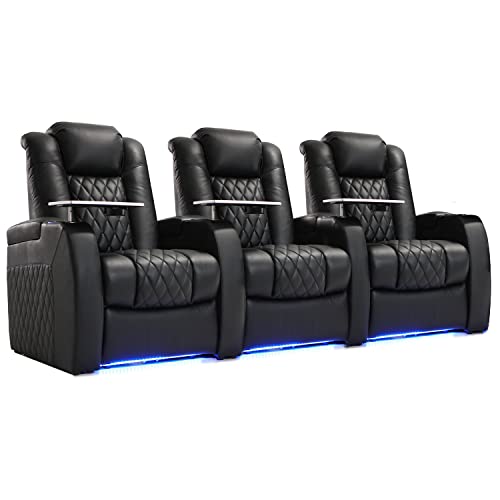
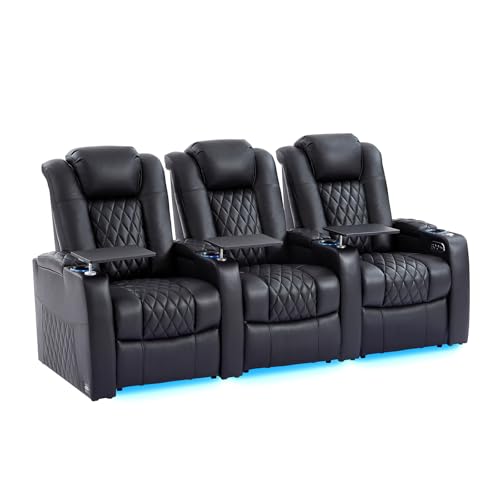
This loveseat is for the one or two viewers who want the full sensory package without committing to a six-chair setup. The massage function is modest but genuinely useful on cold evenings, and the heat element reaches a comfortable warmth within a few minutes. The dual-person configuration makes it the cheapest entry into powered theater seating without sacrificing the recline mechanism.
- Pros: Massage and heat at a sub-$800 price is rare; power recline operates smoothly and quietly.
- Con: Limited to two seats, so larger groups will need a second unit or a different layout.
Skip it if you need more than two seats in a row or if the massage feature is purely decorative to you—you are paying for it whether you use it or not.
DG PEAFOWL 4-Seat Recliner
Four seats with a center console, USB ports, and phone holders make this the practical family-room theater chair. The wall-hugger design saves floor depth, which matters in rooms where the back of the seating is close to a wall. Storage compartments and pockets are functional rather than gimmicky.
- Pros: Center console adds real utility for shared viewing; wall-hugger mechanism saves space.
- Con: The console eats into the usable seat width on the two adjacent chairs.
Skip it if your primary concern is maximum individual seat comfort rather than shared features—each seat here is adequate but not exceptional.
ANJ Power Recliner Set of 6
For a dedicated room where six people sit regularly, this set delivers consistent power recline, integrated USB, cup holders, and subtle LED accent lighting. Arm storage adds clutter-free convenience. Faux leather is easy to wipe clean, which matters when the setup sees weekly use by kids or guests.
- Pros: Six powered recliners at under $2000 total is strong per-seat value; consistent build quality across the set.
- Con: Faux leather will not age the way top-grain does—expect visible cracking after a few years of daily use.
Skip it if you only have space for four seats or if material longevity is a priority over seat count.
comfiroom Leather Recliner (Premium)
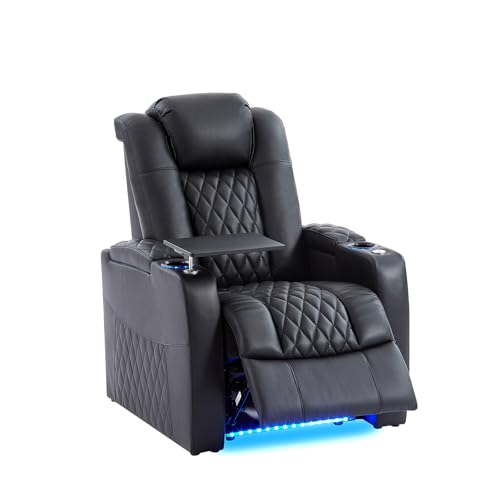
At the top of the comfiroom range, this dual-motor power recliner earns its price through top-grain leather that feels substantial under hands and back. The dual-motor setup lets you adjust footrest and recline independently, which is the single most underrated feature in theater seating. Nothing else in this group matches the tactile quality here.
- Pros: Top-grain leather ages well and resists the plasticky feel of faux alternatives; dual-motor recline gives precise body positioning.
- Con: The price is nearly triple the value-tier comfiroom, so you are paying for leather grade and motor architecture rather than seat count or extras.
Skip it if you need multiple chairs for a six-seat setup or if the budget does not extend past $2000 per seat.
Weilianda Top Grain Leather Chair
This single chair channels the look of a commercial cinema seat with top-grain leather and a fixed silhouette. It is for the buyer who wants visual authority in a small room rather than a multi-seat configuration. The recline is mechanical rather than powered, which some buyers prefer for reliability.
- Pros: Top-grain leather at $1899 per seat is competitive; classic theater-chair profile looks right in a finished media room.
- Con: No power recline, USB, or storage—this is seating first and technology second.
Skip it if you want powered adjustments or integrated ports; this chair is about form and material, not function stacking.
comfiroom Leather Recliner (Mid)
The middle comfiroom tier shares the dual-motor design and top-grain leather with its premium sibling but at a price that makes a four- or six-seat buildout more realistic. You lose very little in comfort per seat compared to the premium version; the difference is mostly in leather grade consistency and hardware finish.
- Pros: Dual-motor power recline and top-grain leather at a sub-$2000 single-seat price; easy to scale into a full theater layout.
- Con: Stitching and piping quality is a noticeable step below the premium tier on close inspection.
Skip it if you are buying a single chair and want the absolute best materials—spend the difference on the premium tier instead.
comfiroom Leather Recliner (Value)
At $598, this is the lowest price in the roundup that still claims top-grain leather and a dual-motor power recline. For a buyer adding a single seat to a partial setup or working within a strict total budget, the value here is hard to argue with. Expect the leather to be thinner and the motor slightly louder than its pricier siblings.
- Pros: Genuine power recline and leather-grade material under $600 is exceptional; functions as a solid single-seat or end-cap addition.
- Con: Cushion density is noticeably softer and will break down faster with daily use.
Skip it if you need a chair to last a decade with heavy use—this tier is for occasional viewing or as a temporary solution.
CALIVIA Curved Power Recliner
Curved layouts are increasingly common in rooms with angled walls or open-plan media areas, and the CALIVIA fits that geometry without forcing you to compromise on power recline. The black finish keeps it neutral in mixed-material rooms. It is the only chair here designed around a non-linear arrangement.
- Pros: Curved frame solves a real spatial problem in angled rooms; power recline and build quality are competitive with straight-back alternatives.
- Con: The curve can feel restrictive for wider-hipped users who need lateral seat room.
Skip it if your room allows a straight layout—curved designs add cost and reduce individual seat width for no comfort gain in a rectangular space.
Buying Guide
Recline Mechanism and Motor Type
Single-motor recliners move the footrest and backrest together on a fixed ratio, which means you cannot adjust your leg angle without also changing your back angle. Dual-motor systems separate these functions, letting you find a true zero-gravity position that offloads lumbar pressure. If you plan to sit for more than 90 minutes at a stretch, the dual-motor architecture is worth the price premium regardless of other features.
Leather Grade and Durability
Top-grain leather is the hide’s second layer, sanded to remove natural marks but retaining the fiber structure that gives it strength and breathability. Faux leather (often called bonded or PU) costs far less but will crack along stress points within two to four years of daily use. For theater seating specifically, the crease points at the knee hinge and lumbar curve are where faux leather fails first. If budget permits, top-grain is a long-term value even at a higher upfront cost.
Room Depth and Wall-Hugger Geometry
Standard power recliners need 4 to 6 inches of clearance behind the chair to achieve full extension. A wall-hugger mechanism repositions the seat forward as it reclines, allowing full range of motion with zero clearance. In rooms under 12 feet deep, wall-huggers free up the back wall for speakers, shelving, or a bar—features that are otherwise impossible with conventional recliners.
Our Verdict
Our top pick is the comfiroom Leather Recliner (Premium) at $2879. The dual-motor recline, top-grain leather, and overall build quality make it the best single-seat experience in this group for anyone who values long-session comfort and material integrity above all else.
Our budget pick is the comfiroom Leather Recliner (Value) at $598. It delivers a power recline and leather-grade material at a price that lets you outfit a full room without the cost becoming prohibitive.
Condition override: if you are outfitting a dedicated room for six regular viewers, the ANJ Power Recliner Set of 6 wins outright. At under $330 per seat for a powered, USB-equipped, LED-lit configuration, no other option in this list comes close on per-seat value for a full-room build.
FAQ
How far from the TV should theater seating be placed?
A general rule is to sit at a distance equal to 1.5 to 2.5 times the diagonal screen size for 4K displays. For a 75-inch screen, that puts the first row around 7 to 10 feet back. Recline depth matters here because powered chairs push you closer to the screen when extended, so measure your viewing position in the reclined state, not the upright one.
Is faux leather acceptable for home theater seating?
It is acceptable for occasional use or households with kids and pets where wipeability matters more than longevity. Faux leather will last two to four years under daily use before showing cracks at fold points. If you are building a dedicated media room you plan to use five nights a week, top-grain leather pays for itself over time.
Do wall-hugger recliners lose comfort compared to standard ones?
No, the recline geometry differs but the seat padding and lumbar support remain the same in most designs. Wall-huggers trade back-wall clearance for forward seat translation, which means you end up slightly closer to the screen in full recline. If your viewing distance already accounts for that shift, there is no comfort penalty.
What is the ideal seat depth for a theater chair?
Between 21 and 24 inches is the range that works for most adults during reclined viewing. Shallower seats leave your thighs unsupported when the back angle opens up, creating pressure points behind the knees. Deeper seats push your back off the lumbar support. If you cannot test physically, look for specs that list seat depth separately from overall width—the two are often conflated in product descriptions.