Key takeaways
- For a rectangular table: Add 48 to 60 inches to both the length and width of your table. A 42 x 72 inch table needs a rug that is at least 90 x 120 inches (7.5 x 10 feet) to meet the 24-inch minimum.
- For a round table: Add 48 to 60 inches to the diameter. A 60-inch round table requires a rug that is at least 108 inches (9 feet) in diameter or an 8×10 rug turned so the extra length is evenly distributed.
- For a square table: Use the same 48 to 60 inch addition. A 48 x 48 inch square table needs a minimum 8×8 foot rug, with an 8×10 often being the better fit for the room.
Getting the rug size wrong is the most common mistake in the dining room. A rug that is too small makes the table look crowded and causes chair legs to catch on the edge, while one that is too large can overwhelm the room and crowd the walls. The right rug anchors your table, protects your floors, and makes the entire space feel balanced and intentional.
In this 2026 guide, we break down exactly how to measure for a dining room area rug with simple, specific numbers you can use today. You will learn the clearance rules designers use, how to match rug size to your table shape, and how to avoid common measuring pitfalls before you buy.
Our top picks





As an Amazon Associate we earn from qualifying purchases at no extra cost to you. Ratings are shown as listed on Amazon.
⚡ Save on Your Next PC — Amazon Prime
Prime members get fast free shipping on the systems above, plus early access to Prime Day & Black Friday PC deals. New members get a 30-day free trial.
Watch: How to Measure for an Area Rug in Your Dining Room — Video Review
The Golden Rule: 24 to 30 Inches Beyond the Table
The core principle for any dining room rug is that all chair legs should stay on the rug, even when chairs are pushed back to sit down or stand up. To achieve this, your rug should extend 24 to 30 inches beyond the edge of the table on all four sides. This provides enough space for a standard dining chair to slide out fully without falling off the rug.
- For a rectangular table: Add 48 to 60 inches to both the length and width of your table. A 42 x 72 inch table needs a rug that is at least 90 x 120 inches (7.5 x 10 feet) to meet the 24-inch minimum.
- For a round table: Add 48 to 60 inches to the diameter. A 60-inch round table requires a rug that is at least 108 inches (9 feet) in diameter or an 8×10 rug turned so the extra length is evenly distributed.
- For a square table: Use the same 48 to 60 inch addition. A 48 x 48 inch square table needs a minimum 8×8 foot rug, with an 8×10 often being the better fit for the room.
How to Measure Your Dining Room Step by Step
You only need a tape measure, painter’s tape, and 10 minutes to get perfect measurements. Do not rely on estimating or your table’s listed dimensions alone.
- Measure your table length, width, and diameter at the widest points. Write these numbers down. Include any leaves you regularly use for holidays.
- Measure your room length and width from baseboard to baseboard. Your rug should leave 18 to 24 inches of bare floor exposed between the rug edge and the wall for a balanced border. In a small 10×12 foot dining room, this caps you at an 8×10 rug.
- Mark the rug outline with painter’s tape on the floor. Extend 24 inches out from each table edge and tape the rectangle. Place your chairs around the table and slide them in and out to test clearance.
- Measure chair push-back distance. Pull a chair out as if someone is sitting down and measure from the table edge to the back legs. Most dining chairs need 28 to 32 inches; add 2 inches for extra comfort.
- Record your ideal rug dimensions: Table size + (chair clearance x 2) = minimum rug size. This is the number to shop with.
Choosing the Right Standard Size: 6×9, 8×10, or 9×12
Area rugs come in standard sizes, so you will round up to the nearest option that satisfies your measurements. Here is how the most common dining room sizes work in practice.
- 6×9 feet: Only works for small bistro sets or a 36-inch round table with 2 to 4 chairs. In most dining rooms, this size will be too small and cause chairs to catch.
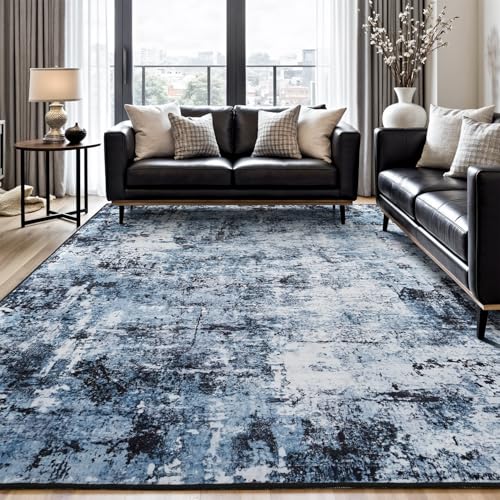
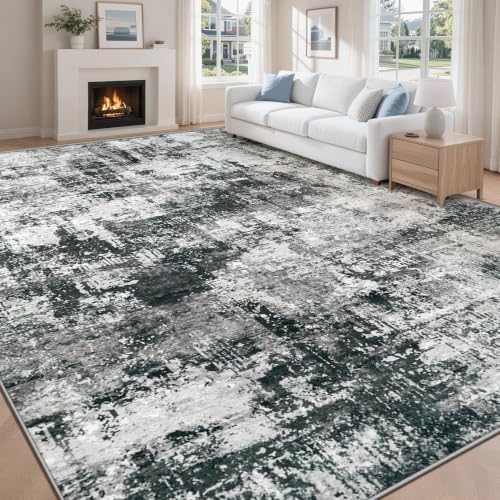
- 8×10 feet: The most versatile and popular size for dining rooms in 2026. It comfortably fits a standard 42 x 72 inch rectangular table for 6, or a 48-inch round table for 4 to 6. Options like the 8×10 Abstract Washable Rug in Gold, the VECARF 8×10 Abstract Rug in Blue Grey, and the MXSANYOO 8×10 Abstract Rug in Multi Blue are ideal here because they offer a low pile and stain-resistant finish that handles dining spills and frequent chair movement.
- 9×12 feet: Best for large tables seating 8 to 10, such as a 44 x 84 or 44 x 96 inch table, or for open-concept dining areas. If you have a spacious room, the 9×12 Green Washable Rug provides the extra 24-inch border you need without looking skimpy. The Rugflix 8×10 Modern Dark Rug in Navy Blue/Black and the 8×10 Green Washable Rug also work well in larger rooms when your table is slightly smaller but you want a more compact footprint.
Rule of thumb: Always size up if you are between sizes. A slightly larger rug is far more functional than one that is 6 inches too small.
Shape Matters: Matching Your Rug to Your Table
Rug shape should echo your table shape for visual harmony, but room shape also plays a role.
- Rectangular table: Choose a rectangular rug. This is the most common pairing and elongates the room. Align the rug so it runs in the same direction as the table.
- Round table: A round rug creates a boutique, intentional look, but a square or rectangular rug also works. If you use an 8×10 rectangular rug under a 48 to 60 inch round table, center the table so the overhang is even on all sides — about 18 to 24 inches from the table edge to the rug edge on the sides.
- Oval table: Treat it like a rectangular table and use a rectangular rug. Measure at the longest and widest points of the oval for clearance.
- Square table: A square rug is ideal, but an 8×10 rectangular rug is often easier to find and works well if your dining room is rectangular. Center the square table in the middle of the rug.
How to Account for Buffets, Hutches, and Traffic Flow
Your table is not the only factor. Built-in furniture and how people move through the room determine whether a rug will lie flat and stay safe.
- Keep all furniture legs either fully on or fully off the rug. Avoid placing a buffet or hutch with front legs on and back legs off, which creates a slope and wobble. If your buffet is 20 inches deep against the wall, keep the rug at least 4 to 6 inches away from its front legs.
- Maintain 36 inches of clear walkway between the rug edge and any wall or doorway where traffic flows. If your tape outline blocks a doorway or forces people to step on the rug edge, go one size smaller or shift the layout.
- Check for floor vents and door swings. The rug plus pad should not block heat registers or prevent a door from opening. Low-pile, non-slip rugs reduce bulk at doorways.
- Use a non-slip rug pad even if the rug has a non-slip backing. Chair movement creates shear force that can cause creeping over time, especially on hardwood.
Tips
- Washability matters in the dining room. Food and wine spills are inevitable, so choose a washable, stain-resistant low-pile rug that can be spot-cleaned or machine-washed.
- Test with painter’s tape and live chairs for 24 hours. Walk around the taped outline and sit at the table to catch traffic issues before you order.
- Leave that 18 to 24 inch floor border. Wall-to-wall rug coverage makes a dining room feel smaller and hides your flooring.
- Measure with leaves in. If you host with an extra leaf twice a year, measure and buy for the extended table, not the everyday size.
Frequently Asked Questions
What size rug do I need for a table that seats 6?
Most 6-person tables are 42 x 72 inches. Add 48 to 60 inches to each dimension for chair clearance, so you need at least a 90 x 120 inch rug. An 8×10 rug is the standard solution and will give you 24 inches of clearance on each side, which is the minimum for chairs to slide without catching.
What size rug do I need for a table that seats 8?
An 8-person table is typically 44 x 84 to 44 x 96 inches. You will need a 9×12 rug to maintain 24 to 30 inches of space all around. An 8×10 will be too tight — chairs at the ends will hang off the edge when pushed back.
Can I put a rectangular rug under a round table?
Yes. It is very common and often easier to find than a large round rug. Center the round table on the rectangular rug and ensure the distance from the table edge to the rug edge is at least 24 inches on all sides. For a 60-inch round table, an 8×10 rug will have about 18 inches on the narrow sides, so a larger or round option may be better.
Should the rug go under the buffet or sideboard?
No, in most cases. Keep the rug under the table and chairs only, with a 4 to 6 inch gap between the rug and the buffet. This prevents uneven furniture, protects the rug from extra wear, and keeps the visual focus on the dining set.
Conclusion
The right dining room rug size comes down to one simple calculation: your table dimensions plus 48 to 60 inches. Tape it out, test your chairs, and round up to the nearest standard size — most often an 8×10 for 4 to 6 people or a 9×12 for 8 or more. With accurate measurements and a low-pile, washable style, your rug will stay beautiful, safe, and functional for years of meals to come.