Key takeaways
- Tooth count: Choose roughly 60 to 80 teeth for cleaner plywood edges; lower-tooth blades cut faster but are usually better suited to ripping and rough sizing.
- Tooth geometry: An alternate-top-bevel (ATB) profile is a strong all-round choice for plywood because its angled teeth shear through face veneers rather than simply tearing them.
- Blade diameter: Match the blade diameter to your table saw’s specification. A 10-inch blade is common, while compact saws may require an 8-1/4- or 8-1/2-inch option.
- Arbor fit: Confirm the arbor size before ordering. The blades here commonly use a 5/8-inch arbor, but compatibility should always be checked against your saw.
- Project finish: For painted or edge-banded furniture, prioritize a high-tooth-count finish blade. For rough breakdown cuts, a versatile set with both ripping and finishing blades can be more practical.
What's inside
Cutting plywood cleanly is less about brute force and more about choosing a blade that matches the panel. The wrong tooth count can leave ragged veneers, chipped edges, or a cut line that needs hours of sanding—an especially frustrating result when you are building furniture with visible faces and crisp joinery.
This guide focuses on table-saw-friendly blades for plywood, with attention to tooth count, finish quality, arbor compatibility, and versatility. Whether you are breaking down cabinet panels or refining a small furniture project, these picks cover fine crosscuts, general-purpose work, and budget-conscious blade changes.
As an Amazon Associate we earn from qualifying purchases.


🛒 Best Price Today on Amazon
Prime members get fast, free shipping on everything above, plus member-only deals. New members get a 30-day free trial — cancel anytime.
How to Choose a Table Saw Blade for Plywood (2026)
- Tooth count: Choose roughly 60 to 80 teeth for cleaner plywood edges; lower-tooth blades cut faster but are usually better suited to ripping and rough sizing.
- Tooth geometry: An alternate-top-bevel (ATB) profile is a strong all-round choice for plywood because its angled teeth shear through face veneers rather than simply tearing them.
- Blade diameter: Match the blade diameter to your table saw’s specification. A 10-inch blade is common, while compact saws may require an 8-1/4- or 8-1/2-inch option.
- Arbor fit: Confirm the arbor size before ordering. The blades here commonly use a 5/8-inch arbor, but compatibility should always be checked against your saw.
- Project finish: For painted or edge-banded furniture, prioritize a high-tooth-count finish blade. For rough breakdown cuts, a versatile set with both ripping and finishing blades can be more practical.
The Best Table Saw Blades for Plywood (2026) Reviewed
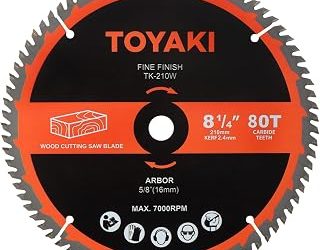
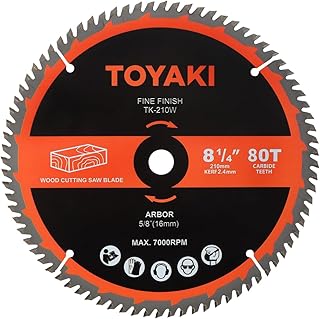
8-1/4-Inch 80-Tooth Ultra-Fine Finish Blade
This compact, high-tooth-count blade is appealing for smaller table saws and detail-focused furniture work. Its ultra-fine configuration is designed with smooth crosscuts and clean plywood edges in mind, while the 5/8-inch arbor suits many compact saws; verify your machine’s diameter and speed limits first.
KENDO 10-Inch Circular Saw Blade Set
KENDO’s two-blade set offers useful flexibility: the 40-tooth blade handles faster ripping, while the 60-tooth option is better suited to plywood, MDF, and laminate finish cuts. It is a sensible workshop pairing for makers who would rather switch blades by task than force one blade to do everything.
Benchmark Abrasives 8-1/2-Inch 60-Tooth TCT Blade
The 60-tooth tungsten-carbide-tipped Benchmark blade is a practical middle ground for compact saws, combining a relatively smooth finish with more efficient cutting than an ultra-fine 80-tooth blade. Its stated range includes plywood, hardwood, MDF, and wood carving applications, making it a versatile choice for a small furniture studio.
10-Inch 80-Tooth Woodworking Saw Blade
With 80 teeth and a 5/8-inch arbor, this blade is aimed squarely at fine crosscutting and polished-looking results. It is particularly attractive for visible plywood parts, trim, shelving, and furniture components where reducing breakout matters more than maximizing feed speed.
FOXBC 10-Inch 80-Tooth Table Saw Blade
The FOXBC is a straightforward high-tooth-count option for woodworkers who want an ultra-finish blade without a complicated setup. Its 10-inch format and 5/8-inch arbor fit many full-size table saws, but check the saw’s maximum RPM and manufacturer guidance before installation.
Frequently Asked Questions
Is an 80-tooth blade best for plywood?
An 80-tooth blade is often excellent for clean, presentation-ready cuts, especially across plywood or through veneered faces. It generally cuts more slowly than a lower-tooth blade, so it is not always the most efficient choice for long rip cuts or rough sizing.
Can I use a miter-saw blade on a table saw?
Some blades are explicitly rated for both miter and table saws, but the label and specifications matter. Confirm the diameter, arbor, kerf, tooth design, and maximum RPM, and never install a blade that is not approved for your saw.
How can I reduce plywood tear-out?
Use a sharp, high-tooth-count ATB blade, support the panel properly, and keep the fence or guide aligned. A zero-clearance insert, painter’s tape along the cut line, and cutting with the best face oriented appropriately can also help, depending on the cut and saw setup.
Should I choose a 60-tooth or 80-tooth blade?
Choose 60 teeth for a useful balance of speed and finish quality, particularly on a compact saw or for mixed projects. Choose 80 teeth when edge appearance is the priority and you are willing to trade some cutting speed for a finer result.
Final Thoughts
For the cleanest furniture-grade plywood work, the 8-1/4-inch 80-tooth blade and the 10-inch 80-tooth woodworking blade are strong finish-focused picks, while the KENDO set is the most flexible choice for a workshop that handles both ripping and detail cuts. Whichever you choose, a correctly matched arbor, a stable setup, and a sharp blade will have as much impact on the final edge as the tooth count itself.