Key takeaways
- Best for long, thick hair: a large oval brush with strong airflow, two or more heat settings, and widely spaced bristles. The Revlon One-Step Volumizer Plus and Drybar Double Shot Blow-Dryer Brush are useful examples of this format.
- Best for short hair and layers: a smaller round or compact oval barrel, typically about 1 to 1.5 inches across. It can reach roots and turn ends without making a chin-length bob look overly rounded.
- Best for fine or heat-sensitive hair: a tool with low heat, low airflow, and separate temperature controls. The Shark FlexStyle and Dyson Airwrap offer more adjustment than basic one-speed brushes, although both usually cost much more.
- Best for maximum volume: a large oval brush with firm nylon pins and shorter, denser bristles near the edges. This combination grips the root while smoothing the mid-lengths.
- Best for frequent travel: a lighter brush with a shorter handle, dual-voltage capability if available in your region, and a swivel cord. Check voltage before using any U.S.-only model overseas.
- Best budget choice: a conventional one-piece hot air brush, often priced around $40–$80. These are quick and simple but generally offer less control over heat, airflow, and direction.
The best hot air brushes for fast, smooth styling depend on your hair length, desired volume, and tolerance for heat: choose a large oval brush for long hair and a polished blowout, a smaller round barrel for shorter layers and curls, or a multi-styler when adjustable airflow and interchangeable attachments matter most.
Best hot air brushes by styling situation
- Best for long, thick hair: a large oval brush with strong airflow, two or more heat settings, and widely spaced bristles. The Revlon One-Step Volumizer Plus and Drybar Double Shot Blow-Dryer Brush are useful examples of this format.
- Best for short hair and layers: a smaller round or compact oval barrel, typically about 1 to 1.5 inches across. It can reach roots and turn ends without making a chin-length bob look overly rounded.
- Best for fine or heat-sensitive hair: a tool with low heat, low airflow, and separate temperature controls. The Shark FlexStyle and Dyson Airwrap offer more adjustment than basic one-speed brushes, although both usually cost much more.
- Best for maximum volume: a large oval brush with firm nylon pins and shorter, denser bristles near the edges. This combination grips the root while smoothing the mid-lengths.
- Best for frequent travel: a lighter brush with a shorter handle, dual-voltage capability if available in your region, and a swivel cord. Check voltage before using any U.S.-only model overseas.
- Best budget choice: a conventional one-piece hot air brush, often priced around $40–$80. These are quick and simple but generally offer less control over heat, airflow, and direction.
Head-to-head comparison of popular designs
| Type or example | Typical price | Barrel and bristles | Best hair length | Main advantage | Main limitation |
|---|---|---|---|---|---|
| Large oval one-piece brush, such as Revlon One-Step | $40–$80 | About 2.5–3 inches wide; mixed nylon and tufted bristles | Shoulder length and longer | Fast root lift and smooth volume | Can feel bulky on short layers and may run hot |
| Oval brush with stronger airflow, such as Drybar Double Shot | $120–$160 | Large oval surface; nylon and bristle combination | Medium to long, including thick hair | More controlled blowout shape and efficient drying | Higher cost and relatively large handle |
| Interchangeable multi-styler, such as Shark FlexStyle | $250–$350 | Separate oval brush, round brush, dryer, and curling attachments | Most lengths, depending on attachment | Adjustable heat and multiple styling options | More parts to store and a steeper learning curve |
| Air-styling system, such as Dyson Airwrap | $500–$650 | Several brush and barrel sizes; mostly flexible or smoothing bristles | Most lengths, with the correct barrel | Fine control and lower-temperature styling approach | Premium price and less effective on soaking-wet hair |
| Compact round hot air brush | $35–$100 | About 1–1.5 inches; nylon, pin, or bristle surface | Short hair, bangs, and layers | Root detail and curled ends | Slow on long, dense hair |
These prices are broad market ranges rather than fixed quotes. Included accessories, sales, regional voltage, and model revisions can change the final cost.
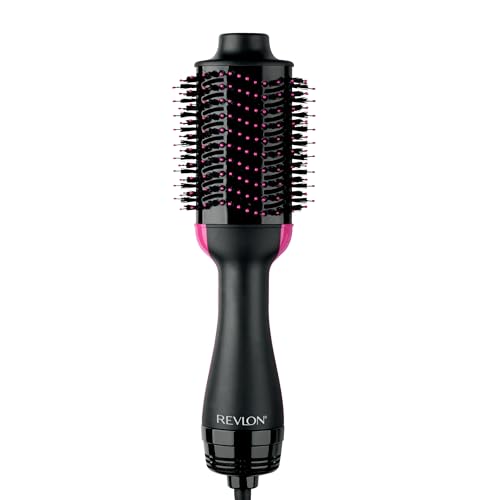
REVLON One-Step Volumizer Hair Dryer and Styler, 2.8 in Barrel, Black
Included for 'Best Hot Air Brushes for Fast, Smooth Styling' because the listing specifies 2.8 in Barrel and Black, details this guide uses to compare options.
View on Amazon
REVLON One-Step Volumizer Plus Hair Dryer and Styler, 2.4 in Barrel, Black
Included for 'Best Hot Air Brushes for Fast, Smooth Styling' because the listing specifies 2.4 in Barrel and Black, details this guide uses to compare options.
View on Amazon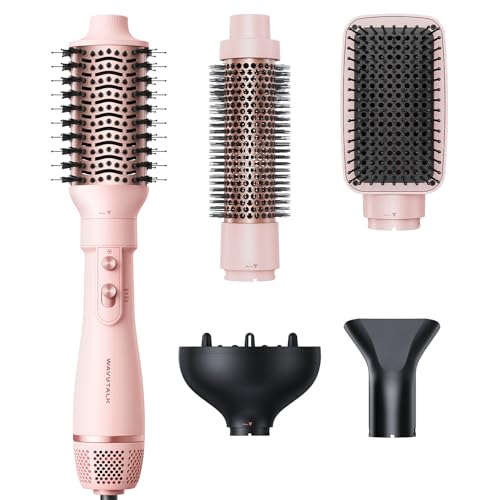
Blow Dryer Brush Set, Wavytalk Air Sculpt 5-in-1 Hot Air Brush Set
Included for 'Best Hot Air Brushes for Fast, Smooth Styling' because the listing specifies Wavytalk Air Sculpt 5-in-1 Hot Air Brush Set, details this guide uses to compare options.
View on Amazon
L'ANGE HAIR Le Volume 2-in-1 Titanium Blow Dryer Brush | Frizz Control Blowout Hair Dryer Brush for Drying and Styling | Volumizing Hot Air Styler for All Hairstyles | Oval Barrel | Black - 60mm
Included for 'Best Hot Air Brushes for Fast, Smooth Styling' because the listing specifies Volumizing Hot Air Styler for All Hairstyles and Oval Barrel, details this guide uses to compare options.
View on AmazonBarrel size determines the finish
A larger barrel does not automatically mean a better brush. It creates a looser bend and covers more hair per pass, which makes it efficient for hair below the shoulders. The trade-off is reduced control: a very large oval brush may not get close enough to short roots or wrap neatly around a short bob.
- 1–1.5 inches: best for pixie cuts, bangs, short bobs, curtain fringe, and defined flips.
- 1.5–2.5 inches: the most versatile range for medium-length hair and soft waves.
- 2.5–3 inches: best for long hair, broad volume, and a smooth salon-style bend.
Oval barrels are usually better for straightening and root lift because their flatter sides press hair against the surface. Round barrels create more curvature but require more wrist control. If you want one tool for a shoulder-length cut, a medium oval brush is generally a safer choice than an extra-large model.
Heat, speed, and bristle choices matter more than wattage
Look for at least two heat settings and two airflow settings, plus a cool-shot or cool-air option. Fine, bleached, or dry hair usually needs lower heat and smaller sections; thick hair may benefit from stronger airflow, but not from holding the brush motionless against the same area. A cool setting helps the finished shape and can reduce the need for repeated passes.
Nylon pins grip and detangle effectively, making them useful for thick or resistant hair. Boar or boar-style bristles distribute natural oils and create a polished surface, but they can struggle with very dense hair and may snag if the section is too large. Mixed bristles provide the most balanced performance: pins provide tension while softer bristles smooth flyaways. Flexible bristles are gentler on fragile hair, though they may produce less dramatic root lift.
Frizz control: what actually makes a difference
Frizz reduction depends on technique as much as the tool. Ionic airflow can help neutralize static and make the surface look smoother, especially in dry climates, but it does not repair damaged hair. Bristle tension, airflow direction, and drying hair completely are often more important.
For a smoother result, rough-dry hair until it is about 70–80 percent dry, then work in sections no wider than the brush. Move from roots toward ends while directing airflow downward. Use the cool setting for the final pass. If your hair is very porous or humid-weather frizz is your main problem, choose a brush with mixed bristles and adjustable speed rather than relying only on an “ionic” label.
Decision matrix: match the brush to your routine
| Your situation | Recommended specification | Why | What to avoid |
|---|---|---|---|
| Small apartment or shared bathroom | Compact brush under about 1.5 lb, with a hanging loop and swivel cord | Easier to store and less tiring during quick styling | Large multi-styler kits with many loose attachments |
| Kids, pets, or a crowded counter | Auto-shutoff, insulated tip, stable storage case, and a cord of about 8–10 ft | Reduces accidental contact and keeps the cord away from the sink | Exposed hot surfaces and short cords that require an extension cable |
| Rental home or limited outlets | Swivel cord, 8–10 ft cable, and a cool-touch housing | Prevents twisting and makes it easier to work without moving furniture | Models that require an adapter or permanent wall-mounted storage |
| Back, wrist, or shoulder discomfort | Tool around 1–1.5 lb, balanced near the handle, with a medium barrel | Less leverage and fewer repeated passes | Top-heavy brushes over 2 lb |
| Long, thick hair | Strong airflow, large oval barrel, wide vents, and mixed nylon bristles | Shortens drying time while maintaining tension | Small barrels and soft bristles that cannot control dense sections |
Weight, cord design, and durability are easy to overlook
A brush that weighs 1.3 lb can feel substantially easier than one weighing 1.9 lb after 15 minutes of overhead styling. Balance matters as much as the listed weight: a heavy motor at the top creates more strain than the same weight centered in the handle. If you have shoulder or wrist pain, choose a medium barrel and divide hair into smaller, pre-dried sections rather than buying the most powerful model.
A swivel cord helps prevent twisting, while an 8–10-foot cord gives practical reach around a bedroom vanity without placing the tool beside a sink. Do not use an extension cord unless the manufacturer permits it. Store the brush only after it has cooled, and clear lint and hair from the air intake regularly. The parts most likely to wear first are bristle tips, the cord strain relief, and the removable filter or rear intake cover.
How to choose in five steps
- Measure your shortest important section, such as bangs or a bob layer, not only your overall length.
- Select a barrel size: small for detail, medium for versatility, or large for long hair and speed.
- Prioritize separate heat and speed controls if your hair is fine, colored, curly, or easily frizzed.
- Choose mixed or nylon bristles for tension; choose flexible or softer bristles when breakage is the larger concern.
- Check weight, cord length, auto-shutoff, voltage, warranty, and replacement-filter availability before comparing cosmetic features.
For most people, the best hot air brushes are not the hottest or most expensive models. A medium-to-large oval brush with mixed bristles, two heat settings, adjustable airflow, cool air, a swivel cord, and a manageable weight offers the strongest balance of speed, smoothness, and everyday control.