Key takeaways
- Cold and mostly dry: Choose the Mackinaw Wool Cruiser. It provides the most dependable warmth without relying on a separate insulated liner.
- Windy, wet, and abrasive: Choose the Tin Cloth Short Lined Cruiser with a removable or worn-under insulating layer.
- Cold work with frequent stops: Choose a lined Tin Cloth Cruiser, especially if you spend more time standing than moving.
- Cool but changeable weather: Choose the lightweight Alaskan Guide Shirt Jacket and carry a waterproof shell when rain is likely.
- Driving and equipment work: A short Cruiser length is less restrictive than a long coat and is less likely to bunch at the waist.
- Backpack or tool-belt use: Wool is comfortable under moderate loads, while stiff oil-finish canvas may rub at shoulder straps until broken in.
The best Filson jackets for most buyers are the Mackinaw Wool Cruiser for cold, dry work, the Tin Cloth Short Lined Cruiser for abrasion and wet-weather protection, and the Lightweight Alaskan Guide Shirt Jacket for milder everyday wear.
Filson jackets are built around a small number of durable materials rather than one universal “best” design. Your choice should depend on whether you need insulation, rain resistance, brush protection, easy layering, or a shorter cut for driving and daily wear. The comparison below focuses on the jackets’ materials, warmth, weather performance, fit, and pocket layouts.

FILSON TIN CLOTH SHORT LINED CRUISER JACKET
Included for 'Best Filson Jackets for Work and Everyday Wear' as a relevant option in this category; details come from the product listing.
View on Amazon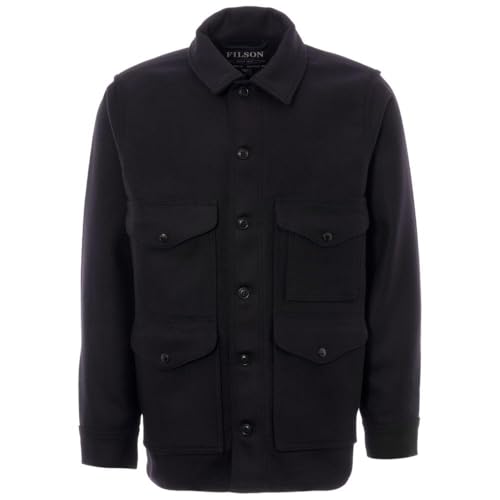
Filson Mens Mackinaw Wool Jacket Dark Navy (US, Alpha, Medium, Regular, Regular)
Included for 'Best Filson Jackets for Work and Everyday Wear' because the listing specifies Alpha and Medium, details this guide uses to compare options.
View on AmazonQuick comparison: which Filson jacket fits your use?
| Jacket type | Primary material | Warmth | Weather resistance | Best for | Main compromise |
|---|---|---|---|---|---|
| Mackinaw Wool Cruiser | 24-oz 100% wool | High | Good in cold drizzle and snow; not waterproof | Cold outdoor work and layering | Heavy, bulky, and slower to dry |
| Tin Cloth Short Lined Cruiser | 14-oz oil-finish cotton canvas | Low to moderate | Very good against wind, brush, and light rain | Work, hunting, farm use, and hard wear | Needs a warm mid-layer in winter |
| Tin Cloth Cruiser with lining | Oil-finish cotton canvas with blanket or quilted lining, depending on version | Moderate to high | Very good against wind and light precipitation | Cold-weather work without a separate shell | Can feel stiff and warm indoors |
| Lightweight Alaskan Guide Shirt Jacket | Brushed cotton or cotton-blend guide fabric, depending on version | Low to moderate | Light wind and brief showers | Everyday wear and cool shoulder seasons | Not a substitute for a rain shell |
Best overall for cold work: Mackinaw Wool Cruiser
The Mackinaw Wool Cruiser is the strongest choice when warmth matters more than low weight. Its dense 24-ounce Mackinaw wool traps heat while continuing to insulate when slightly damp. Wool also resists odor better than many synthetics, which is useful when the jacket is worn repeatedly during outdoor work or travel.
The jacket’s classic four-pocket front layout is practical rather than minimal. Large lower pockets can hold gloves, a hat, or a compact tool, while the upper pockets keep smaller items accessible without reaching into trouser pockets. The internal pocket is useful for a phone or wallet, although bulky objects can become uncomfortable under a shoulder strap.
Choose this jacket for temperatures around freezing and below when your work level is moderate. It is especially effective over a flannel shirt or light sweater. For strenuous labor, wool may become too warm because it does not vent as quickly as an unlined canvas jacket.
Fit and layering
The Cruiser cut is intentionally roomy, allowing a shirt, sweater, or light insulated vest underneath. If you normally wear a thin base layer only, the jacket may feel generous through the chest and sleeves. Avoid sizing down merely to obtain a closer appearance if you plan to work in it; restricted arm movement is more troublesome than extra room.
Best for abrasion and wet brush: Tin Cloth Short Lined Cruiser
The Tin Cloth Short Lined Cruiser is the better work jacket when durability and weather protection outrank built-in insulation. Its tightly woven, 14-ounce oil-finish cotton canvas sheds light rain and resists abrasion from branches, fencing, rough lumber, and equipment. The waxy finish also blocks wind more effectively than ordinary cotton shirts or uncoated canvas.
“Short lined” does not mean highly insulated. The lining improves comfort and helps the jacket slide over layers, but it is not equivalent to a winter coat. In cold weather, wear a wool sweater, fleece, or insulated vest underneath. This modular approach is useful if the same jacket must work across several seasons.
The short length is convenient for climbing, driving, and working around machinery because there is less fabric below the waist. It also places less pressure on a tool belt than a longer coat. The trade-off is reduced coverage when sitting, kneeling, or working in wind-driven rain.
What to know about oil-finish fabric
Tin Cloth becomes more flexible with use, but it can feel stiff when new and may transfer some oil to light-colored upholstery or clothing, particularly in warm conditions. It should not be treated like a machine-washable cotton jacket. Follow the care label, avoid conventional detergent, and expect the finish to change over time.
Best for maximum protection: a lined Tin Cloth Cruiser
A lined Tin Cloth Cruiser is the choice for people who want the abrasion resistance of oil-finish canvas with more warmth than the short-lined version. Depending on the specific model, the interior may use a blanket-style lining or quilted insulation. Blanket lining gives a substantial, natural feel; quilted insulation usually provides more warmth for its weight and layers more easily over sweaters.
This style works well for cold construction sites, property maintenance, hunting, and winter commuting when rain is intermittent rather than constant. Oil-finish canvas is highly weather resistant, but it is not a waterproof membrane. In prolonged heavy rain, a dedicated waterproof shell will outperform it.
The front pockets are generally large enough for gloves and everyday tools, while chest pockets keep small items above a belt or harness. Before buying, check the exact model’s pocket design: Filson has produced multiple Cruiser variations, and lining, collar, and pocket details can differ.
Best for mild weather and everyday wear: Lightweight Alaskan Guide Shirt Jacket
For spring, fall, cool offices, travel, and casual daily wear, a lightweight Alaskan Guide Shirt Jacket is easier to live with than a heavy wool or oil-finish coat. It has a shirt-like profile, lower bulk, and enough structure to function as a light jacket over a T-shirt or base layer.
Its fabric is more breathable and less cumbersome indoors, but it gives up the hard-shell qualities of Tin Cloth. It is suitable for wind, cool temperatures, and brief light showers—not sustained rain, thorny brush, or very cold stationary work.
The pocket arrangement favors everyday convenience: chest pockets are useful for a phone, sunglasses, or small notebook, while the shirt-jacket format avoids the large, heavy front pockets found on work cruisers. If you regularly carry gloves, tools, or a beanie, the smaller storage capacity may be limiting.
Choose by climate and activity
- Cold and mostly dry: Choose the Mackinaw Wool Cruiser. It provides the most dependable warmth without relying on a separate insulated liner.
- Windy, wet, and abrasive: Choose the Tin Cloth Short Lined Cruiser with a removable or worn-under insulating layer.
- Cold work with frequent stops: Choose a lined Tin Cloth Cruiser, especially if you spend more time standing than moving.
- Cool but changeable weather: Choose the lightweight Alaskan Guide Shirt Jacket and carry a waterproof shell when rain is likely.
- Driving and equipment work: A short Cruiser length is less restrictive than a long coat and is less likely to bunch at the waist.
- Backpack or tool-belt use: Wool is comfortable under moderate loads, while stiff oil-finish canvas may rub at shoulder straps until broken in.
Fit, movement, and pocket details to check before buying
Measure your chest over the layers you expect to wear, then compare that measurement with the garment’s current size chart. Do not assume every Filson jacket has the same fit. Shirt jackets tend to fit closer and shorter, while Cruiser styles leave room for layering and work movement.
For practical mobility, check three areas:
- Shoulders: You should be able to reach forward without the back pulling tightly across the shoulder blades.
- Sleeves: Cuffs should cover the wrist when your arms are extended, but not catch on tools or machinery.
- Hem: A short hem is better for driving and climbing; a longer hem gives more coverage while sitting or kneeling.
Count the storage you actually need. A large lower pocket can hold gloves but may make a jacket look bulky when filled. Chest pockets are safer for small valuables because they are easier to reach while seated. Internal pockets protect a phone from rain and abrasion, but a thick case, power bank, or multitool can make the inside of the jacket feel lopsided.
Material trade-offs at a glance
| Material | Typical weight or specification | Strength | Weakness | Care reality |
|---|---|---|---|---|
| 24-oz Mackinaw wool | Heavy woven wool | Warm, odor resistant, insulating when damp | Heavy and slower to dry | Air out; follow wool-specific care instructions |
| 14-oz oil-finish Tin Cloth | Heavy waxed cotton canvas | Abrasion resistance, wind blocking, light-rain protection | Stiff at first; not fully waterproof | Spot clean or follow the label; do not treat like ordinary cotton |
| Lightweight guide fabric | Shirt-weight cotton or blend | Breathability and low bulk | Less warmth and weather protection | Generally easier to maintain, subject to the model’s label |
Final recommendation
Buy the Mackinaw Wool Cruiser if cold-weather warmth is your priority. Choose the Tin Cloth Short Lined Cruiser for the widest work-use range, provided you are willing to add layers. Select a lined Tin Cloth Cruiser for colder, more stationary work, and choose the Lightweight Alaskan Guide Shirt Jacket when everyday comfort and lower bulk matter more than maximum protection.
Expect premium Filson jackets to sit in the upper portion of the workwear market, commonly from about $250 to $600 depending on material, lining, and seasonal availability. The most expensive option is not automatically the best one: matching the fabric and insulation to your climate will matter more than buying the heaviest jacket.