Key takeaways
- Short indoor sessions: eight to ten hours of rated life is normally ample, provided the gimbal is charged before use.
- Events and weddings: choose a model with at least 10 hours of claimed runtime and bring a charging plan rather than relying on one battery.
- Travel: prioritize USB-C charging and a removable or rechargeable grip that can be topped up from a power bank.
- Heavy rigs: expect shorter practical runtime because stronger motors work harder, particularly during fast walking or low-angle operation.
The best camera stabilizer depends on three numbers: your fully assembled camera weight, the stabilizer’s payload rating, and the battery life needed for a typical shooting day. For most mirrorless setups, the DJI RS 4 is the most versatile choice; lightweight travel kits suit the DJI RS 3 Mini, heavier cinema-style rigs need the DJI RS 4 Pro or Zhiyun Crane 4, and phones are better served by a dedicated smartphone gimbal.
Quick picks by shooting situation
| Situation | Best fit | Why it makes sense | Typical market range |
|---|---|---|---|
| Phone video, travel, family clips | Insta360 Flow 2 Pro | Compact, phone-focused controls, tracking and easy setup | Usually $150–$250 |
| Small mirrorless camera with a light lens | DJI RS 3 Mini | Low carrying weight with a 2 kg payload | Usually $250–$400 |
| Most mirrorless and DSLR creator kits | DJI RS 4 | 3 kg payload, strong balance of size, controls and runtime | Usually $450–$650 |
| Large mirrorless, DSLR or cinema setup | DJI RS 4 Pro | 4.5 kg payload and greater motor headroom | Usually $800–$1,100 |
| Heavy rig or cinema accessories | Zhiyun Crane 4 | Up to 6 kg rated payload and substantial construction | Usually $700–$1,000 |
What type of stabilizer do you need?
Three-axis motorized gimbals
A three-axis gimbal uses motors to compensate for roll, tilt and pan movement. It is the right category for walking shots, real-estate tours, events, interviews and product videos where you want a level horizon without carrying a shoulder rig. The motors work best when the camera is mechanically balanced before you switch them on.
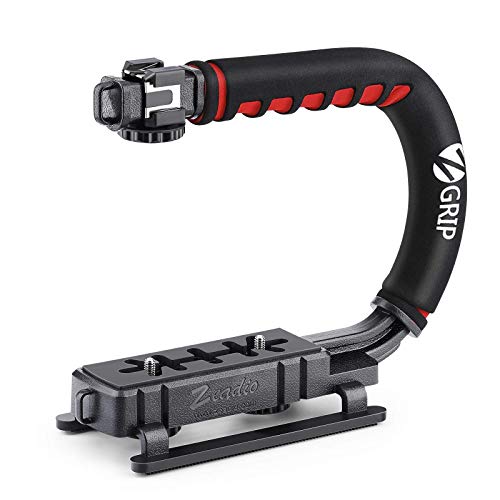
Zeadio Video Action Stabilizing Handle Grip Handheld Stabilizer with Cold-Shoe Mount for All DSLR Camera Camcorder
Included for 'Best Camera Stabilizers for Smooth Video on Any Budget' as a relevant option in this category; details come from the product listing.
View on Amazon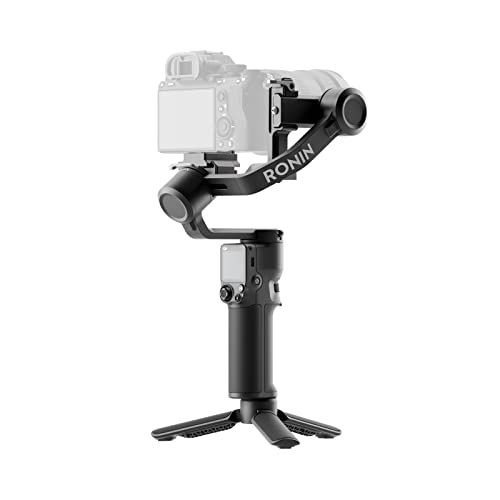
DJI RS 3 Mini, Camera Gimbal Stabilizer, Canon/Sony/Nikon/Fujifilm
Included for 'Best Camera Stabilizers for Smooth Video on Any Budget' because the listing specifies Camera Gimbal Stabilizer and Canon/Sony/Nikon/Fujifilm, details this guide uses to compare options.
View on Amazon
DJI RS 4 Mini Combo, Gimbal Stabilizer, Canon/Sony/Nikon/Fujifilm
Included for 'Best Camera Stabilizers for Smooth Video on Any Budget' because the listing specifies Gimbal Stabilizer and Canon/Sony/Nikon/Fujifilm, details this guide uses to compare options.
View on Amazon
DJI RS 4 Mini, Gimbal Stabilizer for Camera, Canon/Sony/Nikon/Fujifilm
Included for 'Best Camera Stabilizers for Smooth Video on Any Budget' because the listing specifies Gimbal Stabilizer for Camera and Canon/Sony/Nikon/Fujifilm, details this guide uses to compare options.
View on AmazonMost camera gimbals include follow modes that change how quickly the head responds to your movements. A slower mode looks controlled for dialogue or furniture walkthroughs, while a faster mode is more suitable for following a person or turning quickly through a doorway.
Smartphone gimbals
Phone gimbals are lighter and simpler than interchangeable-lens-camera models. They usually combine a three-axis stabilizer with a telescoping handle, tripod base, subject tracking and a companion app. The important limitation is not only phone weight; it is also the phone’s width, case thickness and the clearance needed for the clamp to rotate.
A dedicated phone gimbal is usually more convenient than attaching a phone to a full-size camera stabilizer. It starts faster, fits in a small bag and does not require balancing a lens. However, its app features may be less useful if you record exclusively with a third-party camera app.
Mechanical stabilizers
A counterweighted mechanical stabilizer has no motors or battery. It can produce smooth movement and is quiet, but it takes longer to balance and requires more arm strength. It is best for users who want long operating time, do not need electronic camera control and are comfortable carrying the rig correctly. For most modern solo creators, a motorized gimbal is easier to repeat and adjust.
Payload: calculate the real load, not the camera-box weight
Payload means the maximum supported working weight, but the useful number is your complete balanced setup: camera body, lens, battery, memory card, cage, microphone, filter, monitor, focus motor and cable. A camera body listed at 800 g can become a 1.8 kg rig once accessories are installed.
| Gimbal | Rated payload | Approximate gimbal weight | Advertised runtime | Best practical use |
|---|---|---|---|---|
| DJI RS 3 Mini | 2 kg | About 0.8 kg | Up to about 10 hours | Compact mirrorless body and small zoom or prime |
| DJI RS 4 | 3 kg | About 1.4 kg | Up to about 12 hours | Most hybrid-camera creator kits |
| DJI RS 4 Pro | 4.5 kg | About 1.6 kg before some accessories | Up to about 13 hours | Heavy lenses, cages and professional accessories |
| Zhiyun Crane 4 | Up to 6 kg | About 1.7 kg | Up to about 12 hours | Large cinema-style configurations |
| Insta360 Flow 2 Pro | Smartphone-specific | About 0.4 kg | Up to about 10 hours | Phones without large external accessories |
These are manufacturer-style maximum figures, not a promise that every setup will behave equally well at the limit. For quieter motors, better battery life and smoother starts, leave roughly 20–30% headroom. A 2.4 kg rig is a more comfortable target on a 3 kg gimbal than a 2.95 kg rig.
How the main camera gimbals compare
DJI RS 3 Mini: the lightweight travel choice
The RS 3 Mini is appealing when the stabilizer itself must remain easy to carry. Its 2 kg payload suits many APS-C and full-frame mirrorless cameras with compact lenses. It is a poor match for a heavy 24–70mm zoom plus cage, monitor and wireless transmitter, even if that combination technically fits near the limit.
Choose it for travel, documentary walking shots and small home-studio productions. Its main trade-off is expansion room: adding a large monitor, focus motor or cinema lens can quickly remove the weight advantage.
DJI RS 4: the balanced all-rounder
The RS 4 is the safest starting point for many creators using mirrorless or DSLR cameras. A 3 kg payload gives more flexibility for a substantial zoom, small cage or microphone, while the gimbal remains manageable for handheld work. Its automated axis locks and improved balancing adjustments are useful when changing lenses between shots.
It is particularly suitable for real-estate video, weddings, interviews and furniture or room tours. For long takes, remember that a 1.4 kg gimbal carrying a 2 kg camera package creates a roughly 3.4 kg handheld system before you add a monitor or dual handle.
DJI RS 4 Pro: for demanding configurations
The RS 4 Pro is designed for heavier cameras and accessories. Its extra capacity is valuable when you need a cage, follow-focus motor, external monitor, matte box or a larger cinema lens. More payload does not automatically mean better footage: the larger body adds carrying fatigue, and the rig still needs careful balance on every axis.
Buy it when your current setup is already close to the RS 4’s limit or when you know you will expand. Do not buy it merely because the rating is higher if your priority is a compact travel kit.
Zhiyun Crane 4: high payload with a substantial feel
The Crane 4 targets operators who need considerable payload capacity but still want a handheld three-axis design. It can make sense for a heavier cinema configuration, especially when you use dual handles or a support accessory. Its larger form is less convenient for a quick family clip or a narrow staircase, and the operator must plan how the weight will be supported during a long session.
Battery life is a shooting-style decision
Advertised runtime is measured under controlled conditions. Payload, motor strength, temperature, camera power, Bluetooth, tracking and frequent repositioning can all reduce it. A gimbal that claims 10–13 hours may still need a recharge during a full production day if it is powering accessories or repeatedly fighting an unbalanced setup.
- Short indoor sessions: eight to ten hours of rated life is normally ample, provided the gimbal is charged before use.
- Events and weddings: choose a model with at least 10 hours of claimed runtime and bring a charging plan rather than relying on one battery.
- Travel: prioritize USB-C charging and a removable or rechargeable grip that can be topped up from a power bank.
- Heavy rigs: expect shorter practical runtime because stronger motors work harder, particularly during fast walking or low-angle operation.
A simple buying process
- Weigh the complete rig. Attach the lens, cage, microphone, filter, monitor and every accessory you will use.
- Add headroom. Compare that total with 70–80% of the stated payload rather than treating the maximum as a target.
- Check physical clearance. Long lenses and rear screens can hit the roll arm even when the weight is acceptable. A camera may need to sit farther forward than expected.
- Measure your carrying setup. Include the gimbal, camera and support handle when judging stairs, narrow rooms and long walking shots.
- Confirm control compatibility. Start/stop, focus and zoom functions vary by camera brand, cable and app. Stabilization works even when every camera control does not.
- Practice balancing. A well-balanced camera uses less motor power, produces fewer vibrations and is less tiring to operate.
Bottom line
Choose the DJI RS 3 Mini for a genuinely lightweight mirrorless kit, the DJI RS 4 for the broadest range of everyday camera work, and the DJI RS 4 Pro or Zhiyun Crane 4 when accessories and lens weight demand more capacity. For phones, use a smartphone gimbal rather than carrying unnecessary camera-grade hardware. The best camera stabilizer is the smallest model that supports your fully assembled rig with meaningful payload headroom and enough battery for the way you actually shoot.