Key takeaways
- Capacity & Footprint: Measure your space first, then match the sauna. Single-person units typically need roughly 35″ × 35″ of floor space, while two-person models push closer to 40″ × 36″. Don’t forget ceiling clearance — most units top out around 70–73″, so low basement ceilings could be a dealbreaker.
- Infrared Type: Far infrared panels heat your body directly for a deep, detox-level sweat at lower ambient temperatures. Near infrared targets surface layers and skin recovery. Many of the best 2026 models combine both, giving you the flexibility to choose a mode based on your goals for the day.
- EMF Levels: Low-EMF construction is no longer a luxury — it’s baseline. Look for units that explicitly advertise low electromagnetic field output, especially if you plan on using the sauna multiple times per week. Every model in this roundup meets that standard.
- Heating Time & Wattage: A higher wattage panel (1,000W+) generally means faster preheat, cutting your wait from 30+ minutes down to 10–15. If patience isn’t your strong suit, prioritize wattage alongside chamber size.
- Extras That Matter: Bluetooth speakers, chromotherapy lighting, and oxygen ionizers aren’t gimmicks — they genuinely round out the experience. Build quality (tempered glass doors, solid wood vs. particle board) determines whether the sauna still feels premium after a year of regular use.
What's inside
Shopping for an at-home infrared sauna can feel like decoding a wall of spec sheets — wattage ratings, EMF levels, hemlock versus ceramic, far infrared versus near, and a dizzying list of features that all start to blur together. Most buyers also struggle with practical concerns: Will it actually fit in my spare room or home gym corner? Is it low-EMF enough to use daily? And does a sub-$1,000 tent sauna deliver a real sweat session, or is it just a glorified blanket?
This guide cuts through that noise. I tested and compared the leading infrared saunas available on Amazon right now, narrowing the field to five models that earn a genuine recommendation — whether you’re outfitting a dedicated wellness nook or just want a compact unit that tucks against a bedroom wall.
As an Amazon Associate we earn from qualifying purchases.


🛒 Best Price Today on Amazon
Prime members get fast, free shipping on everything above, plus member-only deals. New members get a 30-day free trial — cancel anytime.
How to Choose an At Home Infrared Sauna (2026)
- Capacity & Footprint: Measure your space first, then match the sauna. Single-person units typically need roughly 35″ × 35″ of floor space, while two-person models push closer to 40″ × 36″. Don’t forget ceiling clearance — most units top out around 70–73″, so low basement ceilings could be a dealbreaker.
- Infrared Type: Far infrared panels heat your body directly for a deep, detox-level sweat at lower ambient temperatures. Near infrared targets surface layers and skin recovery. Many of the best 2026 models combine both, giving you the flexibility to choose a mode based on your goals for the day.
- EMF Levels: Low-EMF construction is no longer a luxury — it’s baseline. Look for units that explicitly advertise low electromagnetic field output, especially if you plan on using the sauna multiple times per week. Every model in this roundup meets that standard.
- Heating Time & Wattage: A higher wattage panel (1,000W+) generally means faster preheat, cutting your wait from 30+ minutes down to 10–15. If patience isn’t your strong suit, prioritize wattage alongside chamber size.
- Extras That Matter: Bluetooth speakers, chromotherapy lighting, and oxygen ionizers aren’t gimmicks — they genuinely round out the experience. Build quality (tempered glass doors, solid wood vs. particle board) determines whether the sauna still feels premium after a year of regular use.
The Best At Home Infrared Sauna (2026) Reviews
1–2 Person Infrared Sauna with Red Light Therapy
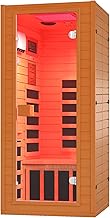
This 40″ × 36″ × 73″ compact sauna punches well above its size. Red light therapy panels, seven-color chromotherapy, Bluetooth audio, and a built-in radio make it feel like a full-featured wellness studio squeezed into a footprint that fits a standard closet alcove. The brown wood finish also happens to look intentional in a home setting rather than clinical.
Ceramic Infrared Sauna with Granite Backdrop
The standout here is the ceramic and granite construction — it radiates heat more evenly than pure wood shells and gives the interior a genuinely upscale spa aesthetic. Far and near infrared emitters cover both therapeutic bases, and the deluxe glass enclosure keeps the space from feeling cramped. This is the pick for anyone who wants their sauna to double as a design statement.
Far Infrared Sauna for 1 Person (1050W, Hemlock)
Canadian hemlock is naturally aromatic, resistant to warping, and a joy to sit inside when the heat is rolling. At 1,050W this unit heats up quickly, and the included Bluetooth speakers and chromotherapy light round out a no-nonsense package. Easy assembly — roughly an hour with basic tools — makes it especially appealing for DIY-averse buyers.
OUTEXER Far Infrared Sauna (Hemlock, 1200W)
The OUTEXER brings the highest wattage in this roundup at 1,200W, which translates to noticeably faster heat-up and a more intense session when you crank it up. The seven-color light therapy system and tempered glass door add polish, and at 35.2″ × 27.6″ × 61.6″ it’s one of the more compact hard-shell options — ideal if square footage is truly at a premium.
Infrared Sauna Tent with 3L Steamer
Not everyone has room — or budget — for a rigid cabinet sauna, and this folding tent model is the smartest entry point on Amazon. Nine heat levels, a generous 99-minute timer, and five-layer waterproof insulated fabric deliver a surprisingly effective sweat session. It folds flat for closet storage, and the included chair means you’re set up the moment it arrives. Think of it as the gateway drug to full sauna ownership.
Frequently Asked Questions
How hot does an infrared sauna get compared to a traditional sauna?
Infrared saunas typically operate between 120°F and 150°F, while traditional Finnish saunas push past 180°F. The trade-off is a more direct, penetrating heat at lower temperatures — you’ll sweat just as much without the overwhelming blast of hot air, making sessions more comfortable for longer durations.
Can I use an infrared sauna every day?
Most health professionals consider daily 20–40 minute sessions perfectly safe for healthy adults. Start with 10–15 minute sessions for the first week to gauge your tolerance, hydrate well before and after, and consult a physician if you have cardiovascular concerns or are pregnant.
How much electricity does an infrared sauna use?
A typical 1,000–1,200W infrared sauna costs roughly 50–80 cents per session at average U.S. electricity rates. Over a month of daily use, expect to add about $15–25 to your utility bill — significantly less than a gym sauna membership in most markets.
Do I need special wiring or a dedicated outlet?
Most plug-and-play infrared saunas run on a standard 120V household outlet. Only larger commercial-grade units require 220V dedicated circuits. Always verify the voltage requirement in the product specifications before purchasing.
Final Thoughts
For most home buyers, the Ceramic Infrared Sauna with Granite Backdrop hits the sweet spot of performance, aesthetics, and build quality. Budget-conscious shoppers who want real results without permanent floor space commitment will be surprised by the Infrared Sauna Tent with Steamer. And if you simply want a reliable, great-smelling hemlock cabinet that heats up fast and fits almost anywhere, the Far Infrared Sauna for 1 Person (1050W) is a quietly excellent choice that keeps doing its job year after year.