Key takeaways
- Tooth count: Lower counts generally cut faster for framing and rough stock, while 60-tooth and 80-tooth blades are better suited to clean furniture cuts. Extremely high counts favor fine finishing but may cut more slowly.
- Blade diameter: Match the blade to your miter saw’s specifications. A 10-inch saw requires a 10-inch blade, while a 12-inch model needs a 12-inch blade; diameter affects both capacity and safe operation.
- Arbor size: Check the arbor measurement before buying. Many 10-inch miter saws use a 5/8-inch arbor, but confirming your manual or existing blade prevents an incompatible purchase.
- Material and finish: Carbide-tipped teeth are a sensible choice for repeated woodworking. For painted trim, hardwood, plywood, or veneered panels, prioritize a blade designed for controlled, clean finishing cuts.
- Project range: A multi-pack or mixed-tooth set offers flexibility for homeowners who move between framing and furniture work. Dedicated fine-finish blades make more sense when appearance matters on nearly every cut.
What's inside
Choosing a miter-saw blade can feel surprisingly complicated: tooth counts vary widely, labels blur the line between framing and finish work, and a blade that looks ideal on paper may not suit your saw, timber, or preferred level of refinement. For furniture projects, the wrong choice can mean fuzzy crosscuts, chipped veneer, or extra sanding before a finish can be applied.
This guide focuses on practical woodworking performance, from fast rough cuts to polished trim and joinery. We compare tooth configuration, intended cut quality, versatility, and blade size so you can choose a dependable option for building furniture, shelving, cabinetry, and other home projects with confidence.
As an Amazon Associate we earn from qualifying purchases.


How to Choose a Saw Blade for Miter Saws (2026)
- Tooth count: Lower counts generally cut faster for framing and rough stock, while 60-tooth and 80-tooth blades are better suited to clean furniture cuts. Extremely high counts favor fine finishing but may cut more slowly.
- Blade diameter: Match the blade to your miter saw’s specifications. A 10-inch saw requires a 10-inch blade, while a 12-inch model needs a 12-inch blade; diameter affects both capacity and safe operation.
- Arbor size: Check the arbor measurement before buying. Many 10-inch miter saws use a 5/8-inch arbor, but confirming your manual or existing blade prevents an incompatible purchase.
- Material and finish: Carbide-tipped teeth are a sensible choice for repeated woodworking. For painted trim, hardwood, plywood, or veneered panels, prioritize a blade designed for controlled, clean finishing cuts.
- Project range: A multi-pack or mixed-tooth set offers flexibility for homeowners who move between framing and furniture work. Dedicated fine-finish blades make more sense when appearance matters on nearly every cut.
The Best Saw Blades for Miter Saws (2026) Reviewed
Best Versatile Set: 10-Inch 3-Pack
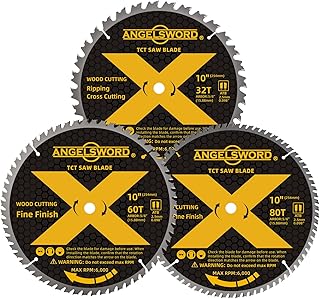
This 10 Inch Table Saw Blade/Miter Saw Blade set combines 32T, 60T, and 80T options, giving a home workshop a useful blade for rough framing, general cutting, and ultra-fine finishing. It is particularly appealing for furniture enthusiasts who do not want one blade handling every task, although you will need to change blades as your project moves from breakdown cuts to visible joinery.
Best Ultra-Fine Finish: WEN BL1080
The WEN BL1080 is an 80-tooth, 10-inch carbide-tipped blade aimed at smooth, polished cuts in wood. Its high tooth count makes it a strong choice for picture frames, trim, cabinet components, and other pieces where reducing tear-out is more important than cutting speed.
Best for 12-Inch Saws: WEN BL1280
Designed for 12-inch miter and table saws, the WEN BL1280 brings an 80-tooth configuration to larger cutting platforms. It suits detailed furniture work and wide stock when you want a refined edge, but confirm your saw’s maximum blade capacity and remember that an ultra-fine blade is not intended to replace a fast rough-cut option.
Best Everyday Fine-Finish Blade: WEN BL1060
The WEN BL1060 uses 60 teeth on a 10-inch blade, placing it in a practical middle ground between speed and surface quality. For many home furniture projects, that balance is more useful than an extreme tooth count: it can handle repeated crosscuts while producing an edge that usually needs minimal cleanup.
Best for Extra-Smooth Crosscuts: 120-Tooth 10-Inch Blade
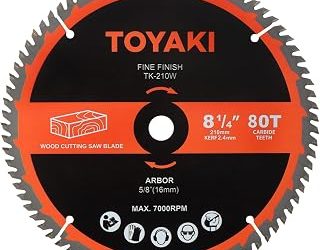
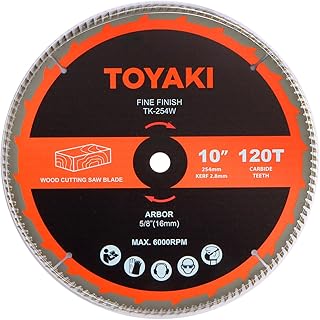
This 120-tooth 10-Inch Miter Saw Blade is built around exceptionally fine finishing, with a 5/8-inch arbor and compatibility aimed at miter, table, and circular saw applications. It is worth considering for delicate trim, thin boards, and highly visible cuts, though its dense tooth pattern is better treated as a specialist finishing tool than an all-purpose workshop blade.
Frequently Asked Questions
What tooth count is best for furniture making?
A 60-tooth blade is a dependable starting point for general furniture work, while an 80-tooth blade is preferable for especially clean crosscuts, veneered panels, and visible trim. A 32-tooth blade is more appropriate for fast rough cutting than final joinery.
Can I use a table-saw blade on a miter saw?
Sometimes, but only when the blade matches the miter saw’s diameter, arbor, and operating requirements. Always verify the manufacturer’s specifications; compatibility should never be assumed simply because the blade is marketed for both tools.
How can I reduce tear-out on a miter-saw cut?
Use a sharp, fine-tooth blade, support the workpiece firmly, and cut with the finished face oriented appropriately for your saw. A zero-clearance insert or sacrificial backing board can also help support fibers at the exit point.
How often should a miter-saw blade be replaced?
Replace or sharpen a blade when cuts become noticeably rough, burning appears, the saw requires unusual force, or the blade no longer tracks cleanly. Cleaning pitch and resin from the teeth can restore performance, but damaged or missing carbide teeth warrant replacement.
Final Thoughts
For the broadest workshop flexibility, the 10-inch 3-pack is a smart starting point. The WEN BL1060 is the strongest everyday choice for balanced furniture cuts, while the WEN BL1080 and 120-tooth blade are better picks when an exceptionally smooth finish takes priority.