Key takeaways
- Desktop depth: Look for roughly 28 inches or more from front to back if you want comfortable viewing distance, monitor stands, and room for a keyboard.
- Monitor support: Built-in risers are convenient, but check their width and height before pairing them with large or ultrawide displays.
- Frame stability: A substantial metal frame or reinforced corner construction helps prevent wobble, especially with heavy monitors and adjustable standing mechanisms.
- Layout: L-shaped desks make excellent use of corners, while long rectangular desks suit symmetrical dual-screen layouts and shared workspaces.
- Storage and power: Drawers, shelves, outlets, and cable openings reduce visual clutter and help the desk blend more naturally into a finished room.
What's inside
A multi-monitor setup can transform a home office, but only when the desk has enough depth, stability, and thoughtful cable management to support it. Many attractive desks feel cramped once two displays, a laptop, speakers, and everyday paperwork occupy the surface. Others sacrifice legroom or storage in favor of a sleek silhouette.
This guide focuses on desks that make multiple screens feel intentional rather than crowded. We’ve compared corner, executive, standing, and extra-long designs for workspace, monitor support, storage, adjustability, and overall interior appeal—so you can choose a desk that works hard without making the room feel like a control center.
As an Amazon Associate we earn from qualifying purchases.


How to Choose a Home Office Desk For Multiple Monitors (2026)
- Desktop depth: Look for roughly 28 inches or more from front to back if you want comfortable viewing distance, monitor stands, and room for a keyboard.
- Monitor support: Built-in risers are convenient, but check their width and height before pairing them with large or ultrawide displays.
- Frame stability: A substantial metal frame or reinforced corner construction helps prevent wobble, especially with heavy monitors and adjustable standing mechanisms.
- Layout: L-shaped desks make excellent use of corners, while long rectangular desks suit symmetrical dual-screen layouts and shared workspaces.
- Storage and power: Drawers, shelves, outlets, and cable openings reduce visual clutter and help the desk blend more naturally into a finished room.
The Best Home Office Desk For Multiple Monitors (2026)s Reviewed
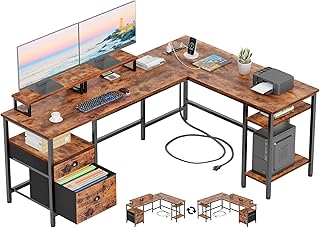
Furologee 66-Inch L-Shaped Desk
The Furologee 66” L Shaped Desk is a strong choice for a corner office that needs both monitor room and practical storage. Its reversible configuration, dual monitor stands, file drawer, shelves, and built-in power outlet create a highly functional workstation, while the rustic brown finish adds warmth that works especially well with woven baskets, matte-black lighting, and natural wood accents.
55-Inch U-Shaped Electric Standing Desk
This U-shaped electric standing desk is designed for users who want abundant surface area and a more active workday. The integrated keyboard tray, dual-monitor stand, three outlets, USB ports, memory presets, and LED options make it feature-rich; visually, the white finish is best suited to bright, contemporary offices where its technology-forward details can feel intentional rather than busy.
Grandder 55 x 32 Extra-Deep Standing Desk
For a large ultrawide monitor paired with two additional screens, the Grandder offers the kind of generous depth that prevents a workstation from feeling compressed. Its electric height adjustment, anti-collision feature, oak finish, and 176-pound capacity make it a particularly compelling option for serious work-and-gaming setups. Style it with a low-profile monitor arm and restrained accessories to keep the broad surface calm.
LVB 70.8-Inch Industrial Computer Desk
The LVB 70.8” Computer Desk is the standout for maximum horizontal workspace, whether you use several monitors or share the desk with another person. Its long wood-look surface and metal frame deliver an industrial-modern character, while the executive proportions leave room for a substantial monitor arrangement, notebooks, and desktop storage without forcing everything into a corner.
Korfile 59-Inch L-Shaped Computer Desk
The Korfile 59-inch L-shaped desk balances compact planning with useful extras. Four adjustable drawers, two monitor stands, power outlets, and a reversible layout make it adaptable for a bedroom office or shared gaming space. The black finish gives it a crisp, architectural look; soften it with an upholstered chair, warm task lamp, or light-colored wall art.
Frequently Asked Questions
How much desk space is needed for two monitors?
For two standard monitors, aim for at least 48 to 55 inches of usable width, depending on the screen sizes and whether you use stands or arms. Extra depth is equally important because it preserves comfortable viewing distance and leaves space for a keyboard and accessories.
Is an L-shaped desk better for multiple monitors?
An L-shaped desk is often better for corner rooms or users who want separate zones for screens, writing, and storage. A straight desk may be preferable if you want a centered monitor layout, a cleaner visual line, or space for two people to sit side by side.
Are built-in monitor stands worth having?
They can be useful for raising screens and adding storage underneath, particularly in compact offices. Before buying, confirm the stand’s width, weight capacity, and height; some large or unusually shaped monitors may work better with a separate monitor arm.
Should a multi-monitor desk be height adjustable?
Standing adjustment is worthwhile if you alternate positions throughout the day and the frame is sturdy enough to support your equipment. Memory presets make changes easier, while anti-collision protection is a valuable feature in tighter rooms.
Final Thoughts
Choose the Furologee 66” L-Shaped Desk for flexible corner organization and built-in storage, the Grandder Extra-Deep Standing Desk for an expansive monitor arrangement, or the LVB 70.8” Desk for a generous shared or executive-style workstation. Each gives multiple screens a more considered place in the room while keeping the broader interior scheme in view.