Key takeaways
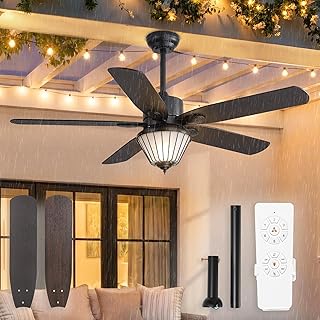
- Weather Resistance Rating: Look for IP65 or wet-rated certification, not just “damp rated.” An IP65 enclosure means the fan can handle direct rain and heavy humidity, while a damp rating only covers moisture in the air. For any fan mounted under a roof with even occasional wind-driven rain, wet rating or IP65 is the safer bet.
- Motor Type and Efficiency: DC motors consume roughly 70 percent less energy than conventional AC motors and run noticeably quieter. They also allow more speed options — typically six or more — and most support a reversible function for year-round airflow. The trade-off is a slightly higher upfront cost, which pays for itself over a couple of summers.
- Blade Span and Coverage: Match blade diameter to room size. Fans under 36 inches work for tight nooks and balconies. The 44- to 52-inch sweet spot covers most standard patios and porches. Anything above 60 inches is designed for large open-air entertaining areas where you need serious air movement across a wide footprint.
- Mounting and Installation: Consider ceiling height and structural support. Hook-mount or plug-in models are ideal for gazebos and pergolas where hardwiring isn’t practical. Standard flush or downrod mounts suit permanent porch ceilings. Always verify the mounting hardware supports the fan’s total weight, especially on vaulted or timber-beamed structures.
- Light Integration and Controls: Integrated LED kits with adjustable color temperature — often marketed as 3CCT — give you warm evening ambiance and bright task lighting from the same fixture. Remote and app control add convenience, particularly for fans mounted overhead where pull chains feel like a throwback nobody asked for.
What's inside
Buying a ceiling fan for a covered patio, gazebo, or open porch can feel like navigating a maze of conflicting specs — IP ratings that sound reassuring until you read the fine print, motor types that promise silence but vibrate like a phone on a table, and sizing guidelines that assume every outdoor space is identical. Most shoppers end up overpaying for features they’ll never use or, worse, bringing home a fan that corrodes after one rainy season.
This guide cuts through the noise. I’ve narrowed the field to five standout outdoor ceiling fans worth your attention in 2026, then laid out a straightforward buyer’s checklist so you can match the right pick to your exact space — whether that’s a compact balcony or a sprawling wraparound porch.
As an Amazon Associate we earn from qualifying purchases.


How to Choose a Ceiling Fan Outdoor (2026)
- Weather Resistance Rating: Look for IP65 or wet-rated certification, not just “damp rated.” An IP65 enclosure means the fan can handle direct rain and heavy humidity, while a damp rating only covers moisture in the air. For any fan mounted under a roof with even occasional wind-driven rain, wet rating or IP65 is the safer bet.
- Motor Type and Efficiency: DC motors consume roughly 70 percent less energy than conventional AC motors and run noticeably quieter. They also allow more speed options — typically six or more — and most support a reversible function for year-round airflow. The trade-off is a slightly higher upfront cost, which pays for itself over a couple of summers.
- Blade Span and Coverage: Match blade diameter to room size. Fans under 36 inches work for tight nooks and balconies. The 44- to 52-inch sweet spot covers most standard patios and porches. Anything above 60 inches is designed for large open-air entertaining areas where you need serious air movement across a wide footprint.
- Mounting and Installation: Consider ceiling height and structural support. Hook-mount or plug-in models are ideal for gazebos and pergolas where hardwiring isn’t practical. Standard flush or downrod mounts suit permanent porch ceilings. Always verify the mounting hardware supports the fan’s total weight, especially on vaulted or timber-beamed structures.
- Light Integration and Controls: Integrated LED kits with adjustable color temperature — often marketed as 3CCT — give you warm evening ambiance and bright task lighting from the same fixture. Remote and app control add convenience, particularly for fans mounted overhead where pull chains feel like a throwback nobody asked for.
The Best Ceiling Fan Outdoor (2026) Reviewed
Addlon 20″ Caged Plug-In Fan
This compact cage-style fan solves the hardest outdoor problem: no hardwire, no permanent mount. The IP65-rated housing and hanging hook make it a natural fit for gazebos and rental patios where you can’t drill into the ceiling. The reversible DC motor and six-speed remote control punch well above what the small footprint suggests, and the built-in timer is a genuinely useful touch for evening gatherings.
Hunter Cassius 44″
Hunter’s Cassius leans into simplicity and durability. The matte-black finish and three-blade profile have a no-nonsense industrial look that blends into most outdoor settings without drawing attention. It skips the integrated light — a deliberate choice that keeps the unit lighter and easier to mount on structures where weight matters. Pull-chain operation keeps maintenance minimal, and the 44-inch span covers patios and porches up to roughly 200 square feet comfortably.
Minka-Aire Xtreme H2O 65″ (Coal)
At 65 inches, this Minka-Aire is built for serious square footage. The coal finish reads modern without tipping into trendy, and the DC motor delivers strong airflow with impressively low wattage draw. It’s wet-rated, which means no anxiety when a summer storm rolls in sideways. This is the fan you choose when your outdoor space doubles as a primary entertaining area and you need broad, even circulation.
Minka-Aire Xtreme H2O 65″ (Oil Rubbed Bronze)
Functionally identical to the coal model but dressed in oil rubbed bronze, this version leans warmer and more traditional — ideal alongside brick, stone, or timber-heavy outdoor décor. The same wet-rated DC motor and 65-inch blade span apply, so the choice between the two finishes comes down entirely to aesthetic alignment with your space.
Orison 24″ Caged Plug-In Fan with Light
Where the Addlon keeps things minimal, the Orison adds a dimmable three-color-temperature LED ring inside its weatherproof cage. App and remote control give you flexibility the pull-chain crowd can only dream about. It’s a strong pick for pergolas and canopies where both lighting and airflow need to be handled by a single, compact unit that doesn’t require an electrician’s visit.
Frequently Asked Questions
Can I leave an outdoor ceiling fan out in the rain?
Only if it carries a wet rating or an IP65 certification. Damp-rated fans are designed for covered porches where moisture is in the air but water doesn’t directly hit the housing. Running a damp-rated fan in direct rain can damage the motor and void the warranty.
What size outdoor ceiling fan do I need?
Measure the area you want to cool. For spaces up to 75 square feet, a 36-inch fan works well. Patios between 75 and 200 square feet typically need a 44- to 52-inch fan. Anything larger than 200 square feet benefits from a 60-inch-plus model to ensure adequate airflow across the entire area.
Do outdoor ceiling fans use a lot of electricity?
Models with DC motors — like most of the fans reviewed here — are remarkably efficient, often drawing under 30 watts even at higher speeds. Over an entire summer season of regular use, that translates to only a few dollars in electricity cost, making them one of the most affordable cooling options for outdoor spaces.
Is it hard to install an outdoor ceiling fan without hardwiring?
Plug-in models with hook mounts, such as the Addlon and Orison, are genuinely simple to install — you hang the hook, attach the fan, and plug it into a weatherproof outlet. Hardwired fans with standard mounts require basic electrical knowledge or a licensed electrician, especially if you’re running new wiring to a porch or gazebo.
Final Thoughts
For most homeowners, the Orison 24″ caged fan offers the best balance of convenience, lighting, and weatherproofing without permanent installation. Buyers with larger outdoor rooms should look hard at the Minka-Aire Xtreme H2O 65″ for its combination of raw power and energy efficiency. And if you want a reliable, no-frills workhorse for a standard patio, the Hunter Cassius 44″ remains a time-tested choice that does exactly what it promises — nothing more, nothing less.