Our Top Picks
A bottom loading water cooler suits households and offices that use five-gallon bottles and want to avoid lifting a heavy jug overhead, with hot-and-cold models fitting kitchens that make tea, instant meals or baby-formula water, and cold-only or ambient models fitting simpler needs. This guide explains how bottom loading designs work, what features separate budget, mid-range and premium units, and how to size, place and care for one. Specifications differ by model and year, so treat the ranges here as general guidance and read the maker’s specification sheet for the exact unit you consider.
How Bottom Loading Coolers Work
A standard top loading cooler needs you to lift a full five-gallon bottle, which weighs roughly forty pounds, and flip it onto the top. A bottom loading cooler hides the bottle in a lower cabinet. You slide the bottle in through a door, connect a short tube or a probe through the cap, and an internal pump moves water up to the dispensing taps. The trade-off is that the pump adds a moving part, a bit of noise, and a few more components to clean. The benefit is far less lifting and a cleaner look, because the bottle is out of sight.

Brio Bottom Loading Water Cooler Dispenser for 5 Gallon Bottles, Stainless Steel
Chosen because it specifies Stainless Steel.
View on Amazon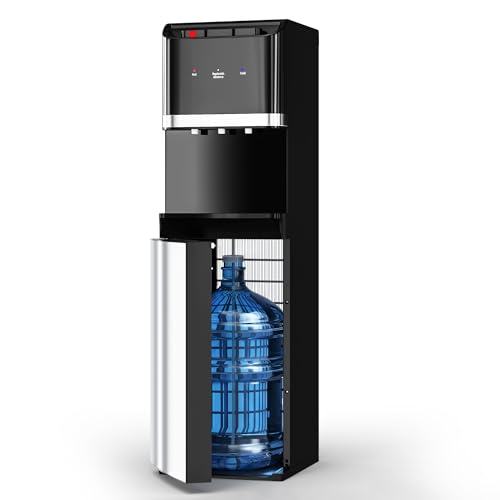
Tehanld Bottom Loading Water Cooler Dispenser,Lustrous Black | 5 Gallon Bottles, Stainless Steel, 3 Temperature - Hot, Cold & Room, Child Safety Lock, Ideal for Home and Office
Chosen because it specifies Lustrous Black and 5 Gallon Bottles.
View on Amazon
Manastin Bottom Loading Water Cooler Dispenser, Matte Black | 3 Temperature Settings - Hot, Cold & Room, Empty Bottle Indicator, Child Safety Lock, Ideal for Office, Home, Living Room
Chosen because it specifies Matte Black and 3 Temperature Settings.
View on AmazonMost units use a cold reservoir cooled by either a compressor or a thermoelectric chip, and a hot reservoir heated by an element. Compressor cooling generally chills water further and holds temperature better in warm rooms. Thermoelectric cooling is quieter and lighter but its performance depends on the surrounding temperature, so it can struggle in a hot garage or sun-filled room.
At a Glance: Types of Bottom Loading Cooler
| Type | Best for | Typical features as makers describe them | Limits |
|---|---|---|---|
| Hot-and-cold, compressor cooling | Busy homes, home offices, larger households | Separate hot and cold taps, child safety lock on the hot tap, cabinet space for a five-gallon bottle | Larger, heavier, more noise than thermoelectric |
| Hot-and-cold, thermoelectric cooling | Small kitchens and quiet spaces | Lower power draw, compact bodies | Cold output affected by room temperature |
| Cold-and-room-temperature | Households without a need for hot water | Simpler controls, fewer components | No hot tap |
| Countertop bottom loading or compact units | Small apartments | Smaller footprints, sometimes smaller bottles | May not hold a full five-gallon bottle |
| Self-cleaning or UV-enabled units | Buyers who want less manual sanitizing | Makers describe built-in cleaning cycles or UV lights | Still require regular manual care; claims vary by maker |
Makers such as Primo, Brio, Avalon, Whirlpool and Igloo sell bottom loading lines in several of these categories. Model names and features change across years, so confirm the current specifications with the maker rather than relying on older listings.
Key Features to Compare
Hot and cold capacity
Makers typically state a hot water output per hour and a cold water output per hour. These are best treated as comparisons between models rather than guarantees, because room temperature and bottle temperature affect results. If you serve a large family, choose a unit whose rated output is higher than your daily peak use.
Safety features
The hot tap is the main hazard, especially around children. Look for a child safety lock or a two-step button on the hot dispenser, and place the unit where small children cannot reach. Hot water from a dispenser can scald. Follow the manual’s guidance on temperature settings and on turning off the heating element when the unit is empty or when you are away.
Materials and water contact parts
Reservoirs may be stainless steel or plastic, and some makers advertise stainless steel tanks as easier to keep clean. Certifications for materials in contact with drinking water vary by model, so rely on the certification information listed by the maker and by independent bodies such as NSF where cited, not on general claims.
Noise and power
A pump and compressor will produce some sound. If you will put the unit in a bedroom, home office or small studio, look for thermoelectric options or reviews that mention noise. Check the Energy Star status if the maker lists it, and consider that the heating element and cooling system run on a thermostat, drawing power intermittently.
Size and fit
Most bottom loading coolers stand around three to four feet tall and about a foot wide, but dimensions vary. Measure doorways, the space beside the cabinet door, and the side clearance the maker requires for ventilation. A compressor needs breathing room at the back and sides, and the instructions normally ask for a few inches of clearance from walls. Also confirm that the unit uses a standard three-gallon or five-gallon bottle in the style you can buy locally, because bottle neck sizes and cap styles differ among suppliers.
Budget Tiers
Budget units tend to be thermoelectric or simple compressor models with basic taps, minimal indicator lights and plastic bodies. Mid-range models often add stainless steel tanks, a more reliable compressor, and a childproof hot tap. Premium units typically add features such as touchscreens, built-in night lights, self-cleaning cycles, and filtered or point-of-use designs, though the extra features do not always improve basic water quality. Decide whether you value capacity and cooling power or extra convenience features, and spend accordingly.
Setting Up and Caring for a Cooler
- Unplug the unit before cleaning, and follow the manufacturer’s sanitizing steps for the reservoirs and the dispensing tubing.
- Wipe the spigots regularly and replace tubes or probes on the maker’s suggested schedule.
- Keep the cooler out of direct sunlight, away from heat vents, and with ventilation space around the back.
- Let a newly installed unit stand upright for the period the maker lists before plugging it in, particularly for compressor models.
- Do not run the heating element without water in the tank, and turn the unit off if you will be away for a long period.
If anyone in the household has a weakened immune system or other health concerns, ask a doctor whether additional treatment or filtration is advisable, and follow local guidance on drinking water. This article does not make any health claims about dispensed water.
Pick X If… Decision Table
| Pick this | If you want |
|---|---|
| Hot-and-cold compressor model | Strong cooling and hot water for a large family or office |
| Thermoelectric hot-and-cold model | A quiet unit for a small room and lower power use |
| Cold-and-room-temperature model | A simpler device with no hot tap near kids |
| Stainless steel tank model | An easier-to-clean reservoir, as makers describe it |
| Self-cleaning or UV model | Convenience features, while still doing manual cleaning |
Alternatives to Consider
- Top loading water cooler: typically lower priced, suited to people comfortable lifting bottles.
- Point-of-use water dispenser connected to the home plumbing: removes the need for bottles; installation may require a plumber.
- Countertop filtered dispenser or pitcher system: a compact option for small households that do not need a hot tap.
Questions to Ask Before You Buy
Start with how many people will use the unit and how often. A household of two drinking mainly cold water has different needs from a five-person family that also heats water for tea and cooking. Next, consider where bottles come from: a delivery service, a refill station or a store exchange. Some suppliers use caps and bottle styles that fit certain probes better than others, so confirm compatibility. Think about floor space for storing spare bottles, because a cooler with a deep cabinet can still leave you needing a spot for backups. Finally, read the warranty terms, including how long the compressor and parts are covered, whether the maker offers in-home service, and what counts as misuse. A longer warranty and easy access to replacement parts such as probes and tubing often matter more over several years than a short list of extra features.
Frequently Asked Questions
Are bottom loading water coolers worth the extra cost?
If lifting a heavy bottle is difficult for you, yes. They also look tidier. If you can lift easily and only drink cold water, a top loading model may do the job for less.
Do bottom loading coolers use more electricity?
Power use depends on the cooling method, the heating element, and the insulation. Makers list wattage and, in some cases, Energy Star status, so compare those figures on specific models.
How often should I clean the cooler?
Makers commonly suggest cleaning each time you change a bottle or at set intervals such as every few months. Follow your manual, since procedures differ.
Is the hot water safe around children?
Hot water can scald, so choose a model with a child safety lock, place it out of reach, and supervise children near the unit.
Can I use any five-gallon bottle?
Most coolers accept standard bottles, but cap styles and probe designs differ. Check the maker’s compatibility notes before buying a supply from a local delivery service.
How long can I leave water in the bottle?
Bottle suppliers usually print guidance on the bottle or in their documentation. Follow that and your cooler’s manual, and discard water that smells or tastes off.