Key takeaways
- Best compact class: Jackery Explorer 300 Plus. Its roughly 300Wh capacity suits phone charging, lights, and small electronics on short trips. It is easier to pack than a large station, but its modest reserve makes it a poor match for running a fridge for several days.
- Best balanced class: EcoFlow RIVER 2 Pro. At about 768Wh, it offers a useful middle ground for weekend camping, with AC, USB, and 12V options. It is a more practical starting point for a small fridge than a compact power bank, though fridge runtime still depends on real daily consumption.
- Best high-capacity class: BLUETTI AC180. Its roughly 1,152Wh capacity and multiple output types suit longer stays or a broader mix of gear. The extra reserve comes with substantial weight, so consider how far you need to carry it from the vehicle.
The best portable power stations for car camping in 2026
The best portable power station for car camping is a 500–1,000Wh model with a pure-sine-wave AC outlet, USB-C charging, and enough capacity for your actual overnight loads; choose a lighter 250–300Wh unit for phones and lights, or a 1,000Wh-plus model for a 12V fridge and multi-day trips. The right pick depends less on peak wattage than on usable energy, recharging opportunities, and whether you can lift and shelter the unit comfortably.
Choose by camping setup
| Your setup | Useful capacity | What to prioritize | Typical trade-off |
|---|---|---|---|
| One or two nights, phones and LED lights | 250–300Wh | Low weight, USB-C, 12V output | Limited reserve for cold weather or extra devices |
| Weekend trip with camera, laptop, and lights | 500–700Wh | At least one AC outlet and several USB ports | Heavier; recharge planning matters |
| 12V fridge, two people, two or more nights | 700–1,000Wh | 12V output, solar input, clear battery data | A fridge can consume most of the available capacity |
| Longer trip or higher-power appliances | 1,000Wh or more | Fast car/solar charging, strong inverter, expandable capacity if needed | Bulky and often awkward to move around a campsite |
These ranges are starting points, not guarantees. A small fridge’s consumption varies with ambient temperature, ventilation, set point, and how often it is opened. Check its stated daily energy use rather than estimating from compressor wattage alone.

Anker SOLIX C300 Portable Power Station, 288Wh Solar Generator for Camping
Included for 'Best Portable Power Stations for Car Camping' because the listing specifies 288Wh Solar Generator for Camping, details this guide uses to compare options.
View on Amazon
EnginStar Solar Generator, 300W Portable Power Station, 296Wh Lithium Battery Backup w/Two 110V Pure Sine Wave AC Outlet for Camping Road Trip RV, 80000mAh Sufficient Power Supply for Blackout
Included for 'Best Portable Power Stations for Car Camping' because the listing specifies 300W Portable Power Station and 80000mAh Sufficient Power Supply for Blackout, details this guide uses to compare options.
View on Amazon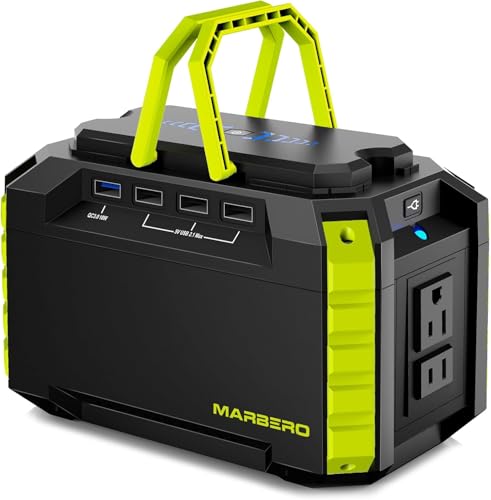
MARBERO Portable Power Station 150Wh Camping Solar Generator Laptop Charger Power Bank with AC Outlet 110V 150W Peak with 4*USB, 4*DC Ports, LED Flashlights for CPAP Home Camping Hurricane Emergency
Included for 'Best Portable Power Stations for Car Camping' because the listing specifies 4*DC Ports and LED Flashlights for CPAP Home Camping Hurricane Emergency, details this guide uses to compare options.
View on AmazonShortlist: choose for the job, not the biggest number
- Best compact class: Jackery Explorer 300 Plus. Its roughly 300Wh capacity suits phone charging, lights, and small electronics on short trips. It is easier to pack than a large station, but its modest reserve makes it a poor match for running a fridge for several days.
- Best balanced class: EcoFlow RIVER 2 Pro. At about 768Wh, it offers a useful middle ground for weekend camping, with AC, USB, and 12V options. It is a more practical starting point for a small fridge than a compact power bank, though fridge runtime still depends on real daily consumption.
- Best high-capacity class: BLUETTI AC180. Its roughly 1,152Wh capacity and multiple output types suit longer stays or a broader mix of gear. The extra reserve comes with substantial weight, so consider how far you need to carry it from the vehicle.
Product revisions and regional versions can change ports, charging limits, and specifications. Before buying, confirm the exact model’s usable capacity, output ratings, input limits, and weight on the manufacturer’s current spec sheet.
Compare usable watt-hours, not just advertised capacity
A station’s capacity is measured in watt-hours (Wh), but not all of that reaches your devices. When power passes through an AC inverter, conversion losses reduce the energy available at the outlet. For rough planning, count on about 80–90% of the advertised capacity for AC loads; DC and USB use may be more efficient. Actual results vary by load and conditions.
| Advertised capacity | Rough AC energy available | Example use | Approximate runtime or charges |
|---|---|---|---|
| 300Wh | 240–270Wh | 10W LED light | About 24–27 hours |
| 768Wh | 614–691Wh | 60W laptop | About 10–11 hours |
| 1,152Wh | 922–1,037Wh | 40W average fridge load | About 23–26 hours |
These are arithmetic estimates, not runtime promises. The fridge example assumes a steady 40W average, which may not match a particular model’s cycling pattern. Devices also draw power while charging, and some stations use energy even when idle. For a more reliable estimate, multiply each device’s average watts by hours of use, add the totals, then leave a 15–25% margin.
Check the outlets and charging paths
For common camping gear, look for USB-A and USB-C ports, a regulated 12V car-style socket, and at least one pure-sine-wave AC outlet if you need household plugs. USB-C Power Delivery is especially useful for compatible laptops and phones because it can avoid the inverter losses of an AC adapter. Check the USB-C output wattage: a port may exist but still be too low-powered for a laptop.
Charging is part of the capacity decision. A vehicle’s 12V socket can replenish a station while driving, but charging speed depends on both the station’s input limit and the vehicle socket. Solar panels can extend a longer stay, but rated panel output is a best-case figure: shade, clouds, panel angle, and heat reduce real-world input. AC charging is usually the quickest option when you have access to a mains outlet. A station that accepts faster input is valuable only if your car or panels can supply it.
Weight, weather, and campsite practicality
Capacity adds weight. Compact stations commonly weigh around 7–12 lb, mid-capacity models around 17–25 lb, and units near or above 1,000Wh can exceed 30 lb. These approximate ranges vary by model. A heavy station may be manageable from trunk to picnic table, but inconvenient to carry over a long, uneven campsite path. Check the carry handle, dimensions, and whether the unit can be secured during transport.
Do not assume a power station is weatherproof because it is marketed for outdoor use. Many are not designed to withstand rain, splashes, dust, or condensation. Keep the unit under a dry shelter with ventilation, off wet ground, and away from direct sun and heat. Never cover its vents while it is operating. If rain protection is important, check the exact model’s ingress-protection rating rather than relying on vague “rugged” wording.
Final decision checklist
- List each device, its average wattage, and hours of use; include a reserve for cold nights and unexpected charging.
- For a fridge, compare its daily Wh consumption with the station’s usable energy—not its brief compressor wattage.
- Match ports to devices, including USB-C output wattage and the station’s 12V output rating.
- Confirm that your car, solar panel, or available AC source can recharge the station at a useful rate.
- Choose a weight you can lift and a location where the station can stay dry, ventilated, and shaded.
For most weekend car campers, a 500–800Wh station offers the best balance between useful reserve and portability. Go smaller for lights and personal electronics, and larger when a fridge or longer time away from charging is central to the trip.